Although there have been many strides taken at the state level to reduce the property tax burden, local governments’ incessant and reckless spending continues to drive up the bill.
Key points:
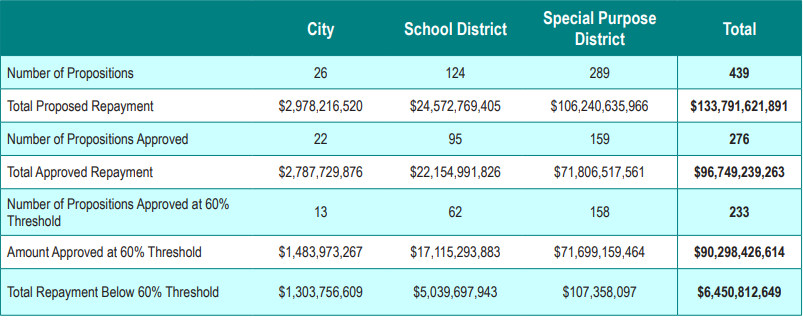
- In May 2026, Texas voters considered 439 bonds. Of those, 233 were approved.
- The passage rate for bond propositions for the May 2026 cycle was 63%.
- Total repayment for every bond measure passed was $96.7 billion.
- Denton County Municipal Utility District 7 approved Proposition C with only 1 person voting, approving $5.9 billion in total repayment.
- The City of Saginaw approved Proposition B, 767 to 766, a margin of 1 vote, authorizing $9.6 million.
The Texas Legislature should consider establishing higher voter thresholds, requiring a minimum voter threshold, moving all bond elections to November, and increasing the transparency of ballot language in the 90th legislative session.
Click here to download the full research paper
Introduction
With principal and interest, the debt in Texas’s counties, cities, school districts, and special purpose districts now totals $552 billion (Quintero & Solin, 2025). This saddles every man, woman, and child in the state with $18,939 in debt.1 This debt is driven entirely by unrestrained local government spending. In a time when affordability of everything from groceries to housing is a kitchen table conversation in the homes of Texan families, it is necessary to examine how to relieve cost burdens.
Governments have a variety of tools to issue debt, which can be broken down into tax-supported debt, general obligation (GO) debt, or revenue-supported debt. GO debt is secured by a promise that the borrowing government entity will repay it with money collected through taxation. Those are the ways debt is secured, but debt can also be approved in different ways (Tex. Tax Code § 26.012). The statute that primarily covers bond elections is Chapter 1251 of the Texas Government Code (Texas Government Code Chapter 1251). This research will examine how reforming portions of Texas Government Code Chapter 1251 to spur voter turnout and increase the scrutiny required to pass a bond could reduce the debt local governments incur.
May 2026 Bond Election
The following report lists every bond passed in the May 2026 election cycle, organized by taxing entity. It synthesizes information from the BRB’s searchable bond election database. The BRB catalogs every bond proposed in a given cycle along with basic data on votes cast, principal amounts, estimated interest, and stated purposes taken from the various Voter Information Documents (VIDs) and financial disclosures provided by individual political subdivisions. These documents contain ballot language, existing debt profiles, projected tax impacts, and other legal information. The passage and implementation of House Bill (HB) 3526 mandated the creation of a database that provides consolidated information on bond elections, from which this research drew its data (HB 3526, 2025; Bond Review Board, n.d.).
Below is a high-level analysis of bond elections across cities, school districts, and special purpose districts in May of 2026. Each election is analyzed by issuer, bond purpose, total votes cast, votes for and against each proposition, approval status, total estimated repayment, and, if it passed, the percentage of voters who approved the bond.
Bonds that were “carried,” or passed, by voters are highlighted in green, and those carried by a threshold of 60% or greater are highlighted in red. Bonds for refunds, bonds that were canceled, or bonds pending at the time of research were included in the full count of bond elections but removed as the level of analysis increased. Refunding bonds were removed because they are not subject to the same election requirements as other bonds (Texas Government Code § 1251.006 (1), 1999). Canceled or pending elections were removed so that only elections that took place and had observable results were included in conclusions regarding total estimated repayment.
Results At a Glance
In this election cycle alone, 439 bond measures were proposed, worth nearly $133 billion in total repayment. Of those, 276 passed (a 63% passage rate), for a total repayment of $96.7 billion. Table 1, below, shows the aggregated bond election information for Cities, School Districts, and Special Purpose Districts. Two fields were added to examine the impact of a 60% voter approval threshold. 234 bonds were passed at the 60% approval threshold, 43 fewer than those approved with a simple majority, resulting in a reduction of $6.4 billion in total repayment.
Table 1
May 2026 Bond Election At a Glance
Note. Data from Local Bond Elections, by Bond Review Board, n.d. (https://brb.texas.gov/searchable-db.html#/datasets/local_elections) and author’s calculations.
City Bond Elections
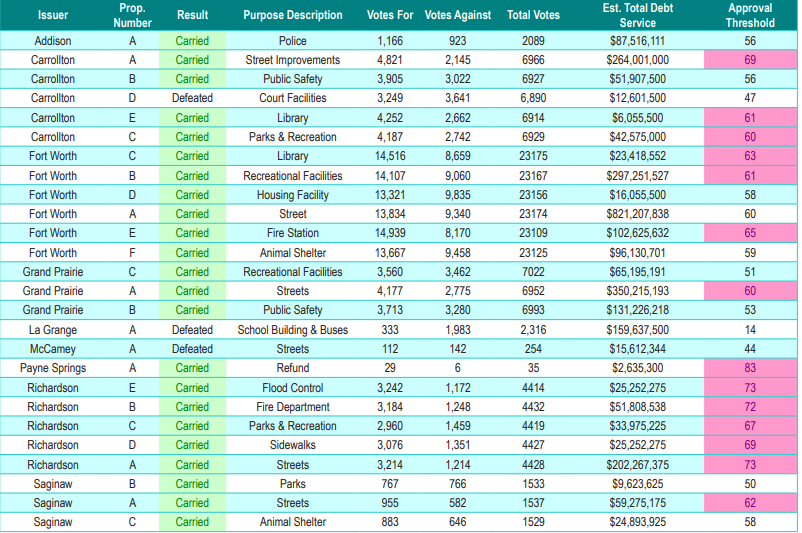
In this cycle, as described in Table 2, 26 city bonds were proposed and considered by voters; Payne Springs, while displayed, was not included in calculations because it was a refunding bond. Of the 25 bonds in the calculation, 22 passed, giving cities an 88% passage rate. However, some of these bonds passed by relatively small margins. For example, 9 of the 25 city bonds passed with less than 60% approval. The bonds that passed will require as much as $2.78 billion to fully repay, $1.3 billion of which passed with less than 60% of the vote.
The defeated bonds included Carrollton’s Proposition D, La Grange Proposition A, and McCamey Proposition A. Proposition D sought $7.85 million for improvements to municipal court facilities, the smallest of five bond measures Carrollton placed on the May 2 ballot, which would have resulted in a total repayment of $12.6 million. La Grange Proposition A was defeated with a proposed amount of $90 million, which would have resulted in a total repayment of $159.6 million. McCamey Proposition A was also defeated with a proposed amount of $8 million, which would have resulted in a total repayment of $15.6 million.
The largest city bond passed was Fort Worth’s Proposition A, which asked for approval of $511 million and would have resulted in a total repayment of $821 million for street improvements. The City of Fort Worth simultaneously holds the title of the biggest spender in 2026, authorizing just over a billion dollars in total cost, nearly a third of all city bond spending statewide. It was the largest bond program in the city’s history, surpassing even the nearly $847 million total repayment package Fort Worth voters approved in 2022 (City of Fort Worth, 2022).
Table 2
City Bond Elections May 2026
Note. Data from Local Bond Elections, by Bond Review Board, n.d. (https://brb.texas.gov/searchable-db.html#/datasets/local_elections) and author’s calculations.
ISD Bond Elections
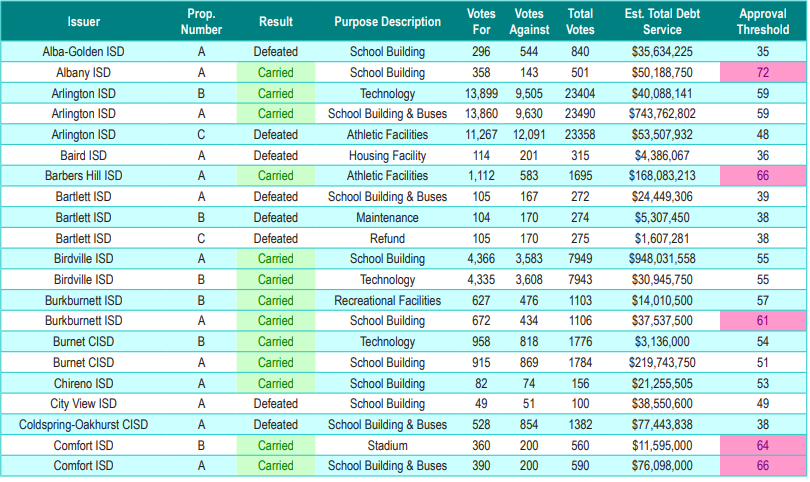
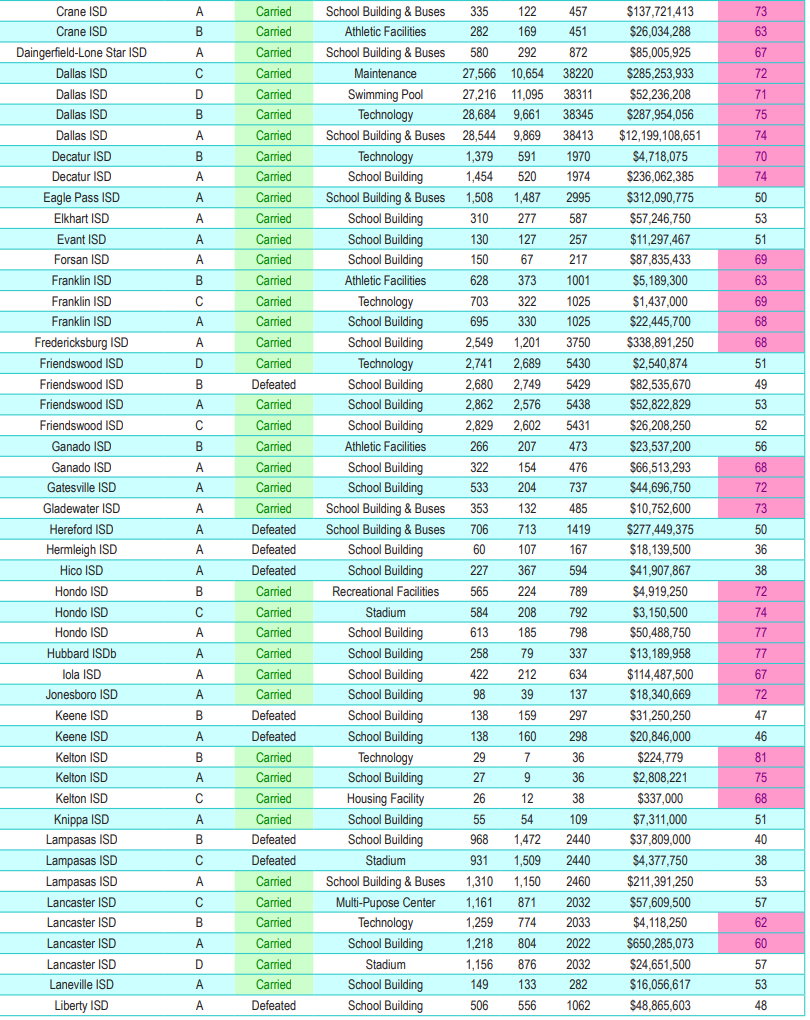
In the May 2026 Bond election cycle, the number of Independent School District (ISD) elections dwarfed city bond elections by just over a magnitude of 5. Before filtering out refunding bonds, 124 propositions were on the ballot compared to 26 city bonds. The total repayment amount proposed surpassed $24.7 billion. After removing refunding bonds, 122 bond propositions remained, with a proposed total repayment of $24.2 billion. 96 bonds passed, with a total repayment of $22.1 billion. However, if a 60% threshold were required to pass bonds, 63 bonds would have passed with a total repayment of $17.1 billion, eliminating $5 billion in total debt repayment and removing only one-third of the total bonds approved.
The largest single proposition was Dallas ISD’s Prop A, which carries a total repayment burden of more than $12 billion, which is 55%% of all ISD bond propositions that passed in this election cycle. It was part of a larger $12.5 billion bond package, the most expensive in Texas history, topping Dallas ISD’s previous package approved just six years before (Dallas Independent School District, n.d.). Voters approved all three2 propositions by wide margins, with Proposition A receiving 74.3% support (Dallas County Elections Department, 2026).
The largest defeated ISD proposition was Pilot Point ISD’s $295 million bond, which failed decisively. Of the 1,384 votes cast, 845 were against, and only 539 were in favor, a margin of roughly 61% to 39%. The measure would have funded Phase 1 of a new high school, a new elementary school, and renovations to existing campuses (Garcia, 2026).
Table 3
ISD Bond Elections May 2026
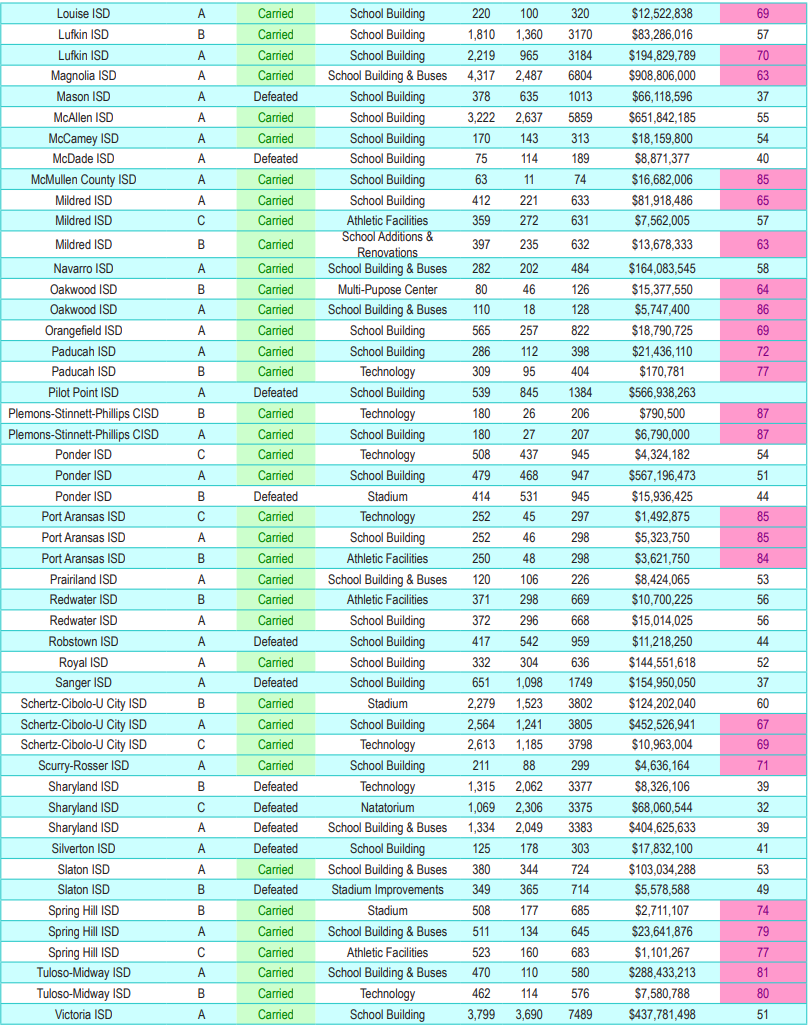

Note. Data from Local Bond Elections, by Bond Review Board, n.d. (https://brb.texas.gov/searchable-db.html#/datasets/local_elections) and author’s calculations.
SPD Bond Elections
In Texas, there are thousands of Special Purpose Districts (SPDs), which are independent entities of local government created to provide a specific service such as water and sewer service, toll roads, fire protection, hospital care, or community college education, among dozens of other purposes (Texas Comptroller of Public Accounts, n.d.). Despite their narrow scopes, SPDs have broad financial powers, including the authority to impose property taxes to service debt; because they carry taxing authority, SPDs must hold bond elections before taking on new debt, just as cities and ISDs do.
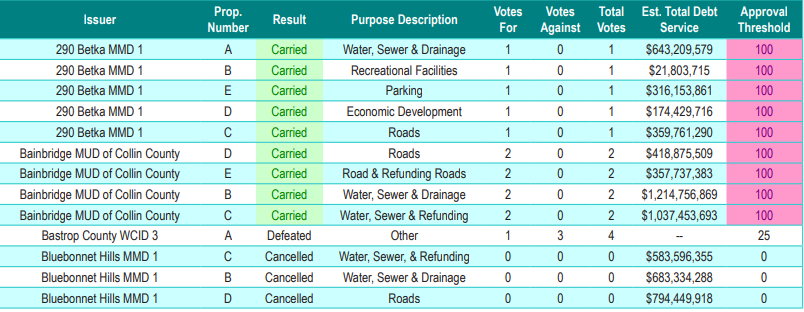
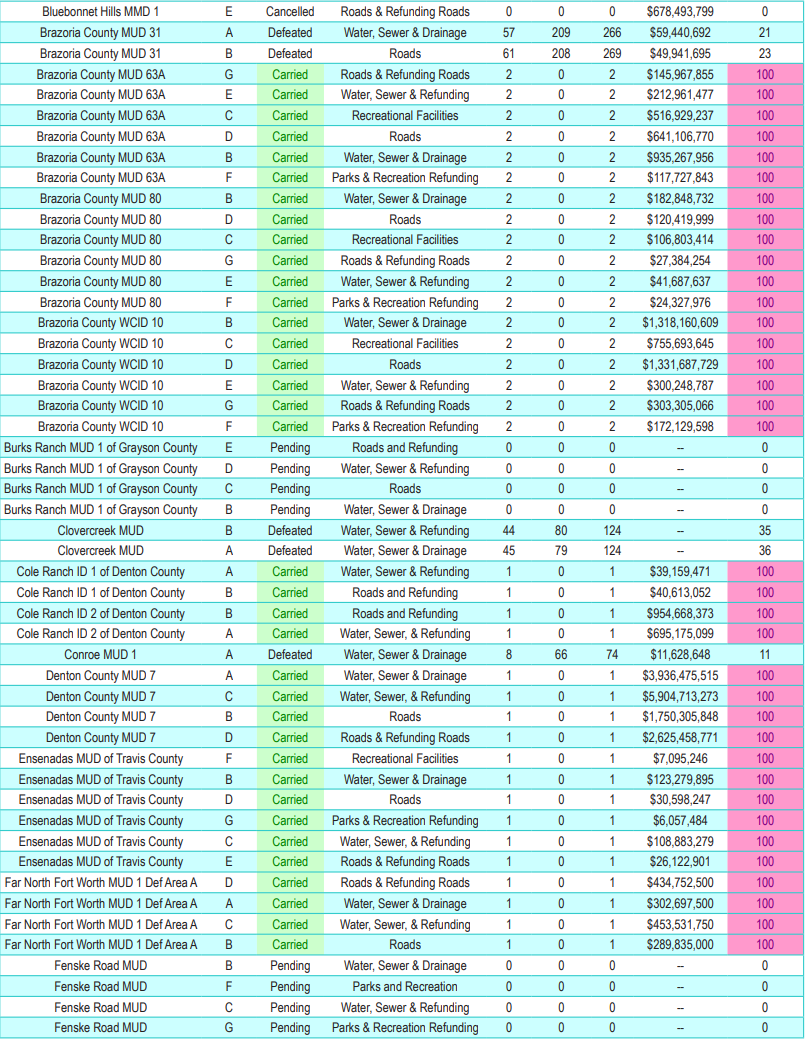
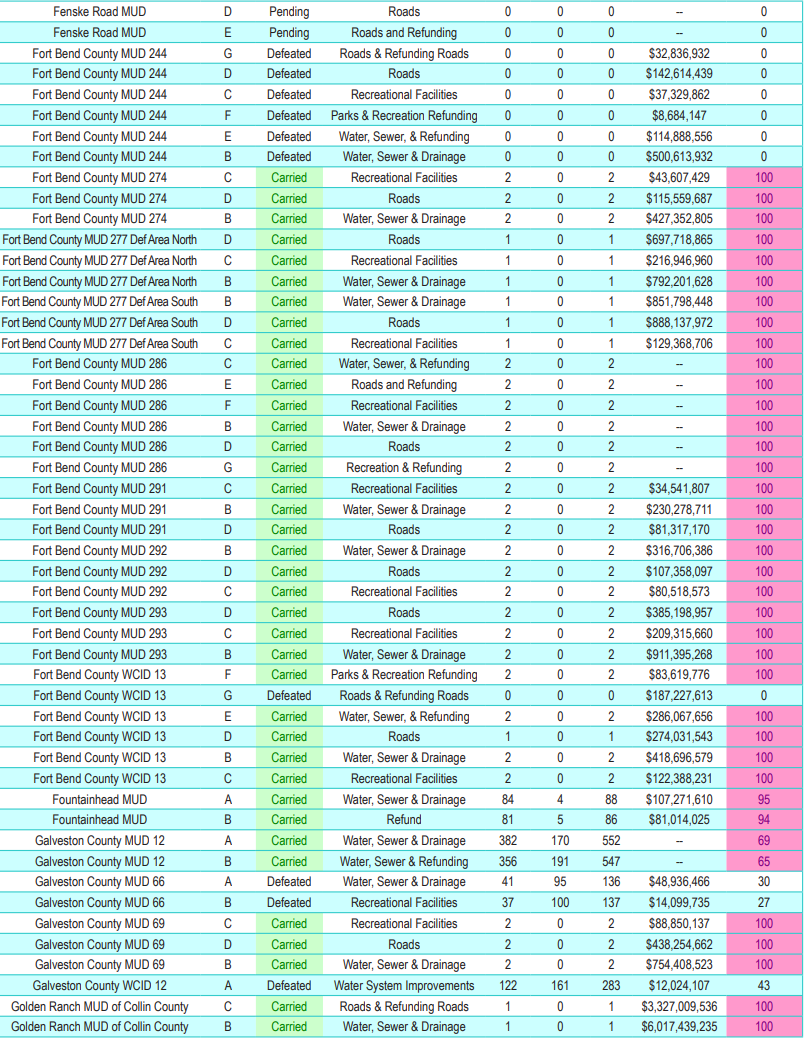
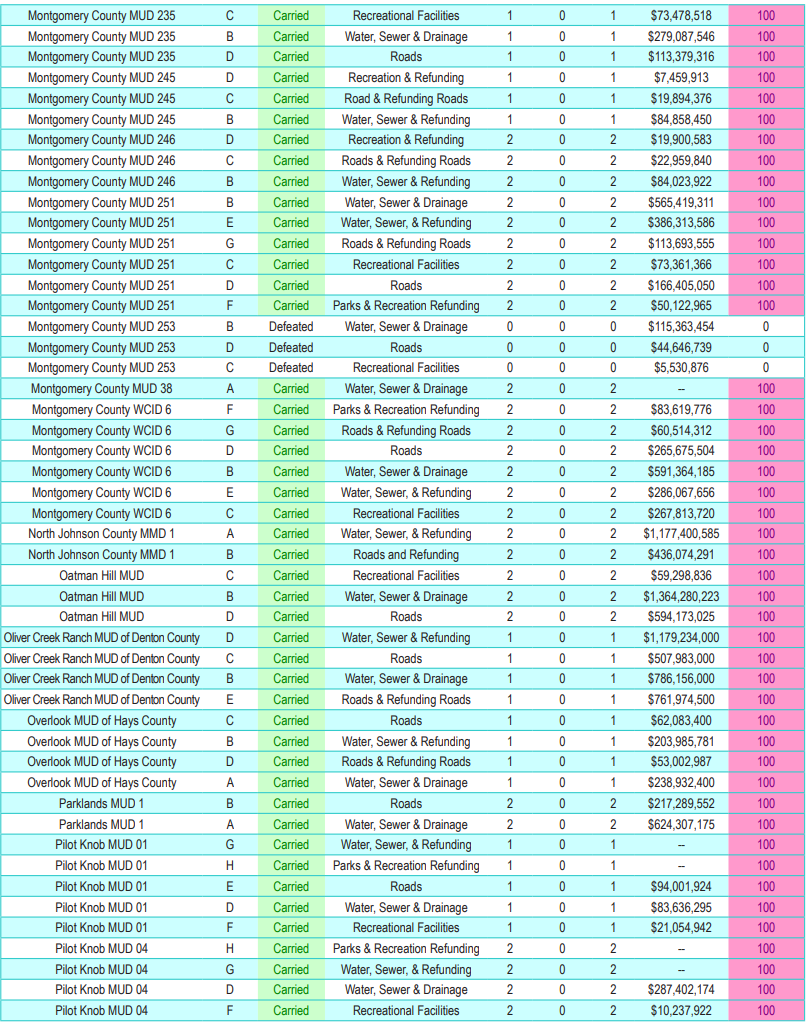
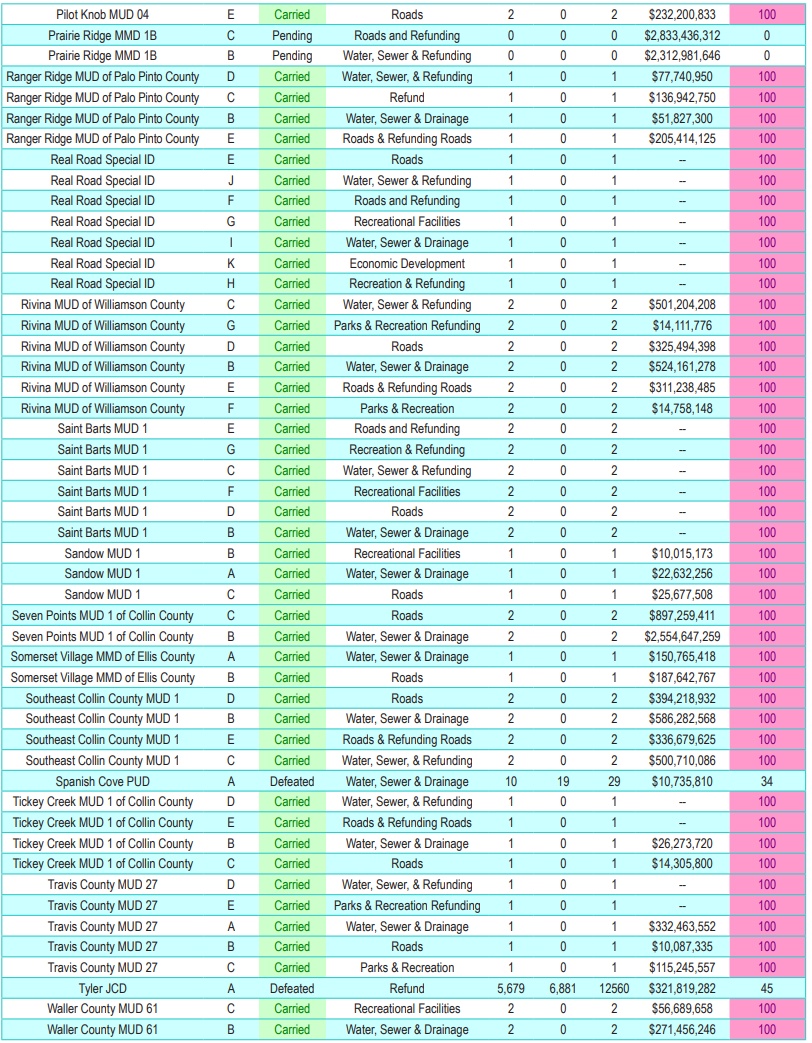
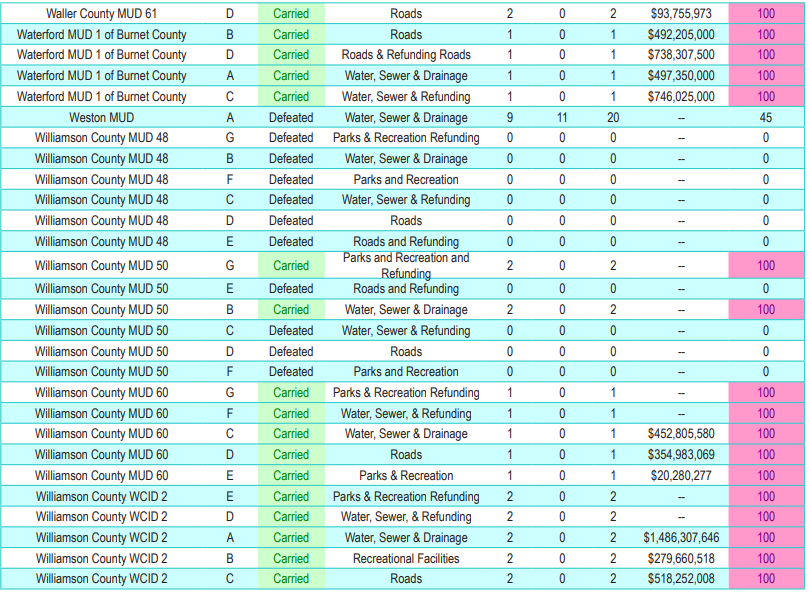
In the May 2026 bond elections, described in Table 4, there were 289 SPD propositions, more than twice the number of propositions for ISDs. Before removing refunding bonds, the total proposed repayment was $105.6 billion. After removing refunding bonds, canceled propositions, and elections with pending results, the 187 bonds had a total proposed repayment of $76.4 billion. The 160 bonds that passed had a total repayment of $71.6 billion. Of those 160 that passed, 158 passed with the 60% threshold, and their total repayment was $71.5 billion.
In practice, many SPD elections draw a tiny fraction of the turnout seen in city or ISD races. In the 2026 cycle, for example, only 5 of 289, or 1.7%, of SPD bond elections statewide had more than 250 voters participate, down from 6.3% the year before, meaning relatively few residents can authorize debt obligations worth tens or even hundreds of millions of dollars.
In this cycle, only one of the 228 SPD bonds passed with less than 60% approval: Harris County’s Water Control and Improvement District 109’s Proposition A, a total repayment of $107.3 million, passed with 56.9% of the vote. The contrast with ISDs is stark, as just over 1/3 of all ISD bonds passed this cycle faced significant voter opposition; SPD elections almost universally pass, often with unanimous margins.
Table 4
SPD Elections May 2026
Recommendations
The May 2026 bond election cycle set a record for local bond debt authorized in a single May election. By comparison, May 2024 saw voters approve $33.3 billion in total bond repayment debt, which is less than half of the nearly $71 billion authorized in 2026 (Quintero, 2024). Texas local governments are increasingly willing to bring large debt packages to voters, and voters that show up are increasingly willing to approve them. The key phrase is “voters that show up.” As this report documents, many of these elections, especially in SPDs, are decided by a handful of residents, raising serious questions about whether the democratic check that bond elections are meant to provide is functioning as intended.
Legislators in the 90th legislative session should prioritize reforms that ensure voters not only have the opportunity to weigh in on debt but are also equipped to understand what they are approving and what it will cost them over the long term.
- Implementing a Supermajority Threshold: The first, and perhaps most significant, reform the Legislature should pursue is raising the voter approval threshold required to pass a bond. Under current law, a simple majority is all that is needed to authorize debt (Tex. Educ. Code § 45.003). This report recommends the Legislature raise that threshold to a supermajority of 60%. If the 60% threshold had been in place in 2026, taxpayers would have been spared nearly $6.4 billion in authorized debt. Therefore, it is recommended that legislation similar to HB 96 (2025) be advanced in the 90th legislative session.
- Establishing a Minimum Turnout Requirement: Along with a supermajority threshold, it is recommended that the Legislature adopt a minimum voter turnout requirement. Especially in SPDs, billions of dollars are adopted usually by just one or two people. For example, one singular person in the Denton County MUD 7 Proposition C election approved more than $5.9 billion in total repayment. This issue was explored briefly in 2017 through SB 702 (2017), which sought to require a minimum 30% participation in bond elections; however, the legislation failed. The 90th Legislature should revive and pass a similar requirement. A minimum turnout floor would ensure that decisions reflect a true community consensus rather than the preferences of a select few.
- Uniform November Election Dates: Bond elections have notoriously low turnout. Tarrant County reported that only 4.1% of registered voters participated in the May 2026 bond election, yet in the November 2024 general election, 63.8% turned out, more than a 15-fold difference (Tarrant County Elections, 2024). This results from holding consequential fiscal elections in low-visibility, off-cycle windows when most voters are not paying attention. SB 1209 (2025) directly addressed this problem by eliminating the May uniform election date and requiring most elections to be held on the first Tuesday after the first Monday in November, aligning with the federal election calendar. The 90th Legislature should revisit similar legislation.
- Ballot Transparency: The final category of reform concerns what voters actually see when they walk into the voting booth. Current ballot language for bond measures is vague and structured in ways that obscure rather than illuminate the financial commitment being made. A ballot might ask voters to approve the issuance of general obligation bonds in a specific amount without ever telling them the total repayment cost. The 89th Legislature made meaningful progress, including SB 1025 (2025), HB103 (2025), and SB 843 (2025). But gaps remain: Ballot language still permits significant “bundling” of unrelated projects into single propositions, preventing voters from approving infrastructure they support while rejecting spending they oppose. The 90th Legislature should build on the 89th’s foundation by mandating universal VID distribution requirements across all taxing entities, prohibiting the bundling of substantively unrelated projects into a single proposition, and requiring all bond ballot language to include the estimated total repayment cost with interest so that voters understand the full price tag of what they are being asked to approve (Tex. Gov’t Code § 1251.052). Additionally, the same section of code should be amended to change the assumed property value used as the basis for estimations from $100,000 to better reflect the value of homes across the state, which is $339,000 according to the Texas Real Estate Research Center (TRERC, 2026).
Challenges
Issues with special purpose districts, particularly Municipal Utility Districts (MUDs), often stem from starting with a very low population. It is entirely possible to create a MUD with the petition of one person (Texas Water Code §54.014; 54.016; 54.016, 1971 and rev. 2023) and approve bonds with one vote. While bonds are necessary for a MUD’s development, they are expected to grow, and as they do, the debt is passed on to future residents. If a MUD is annexed before it pays off its debt, the city absorbs that debt, and its residents shoulder it. However, until then, bond debt stays within those districts. Limits on these districts should not prevent MUDs from being lawfully established, but should be enough to protect future residents from debt approved by a few voters.
One way to address this issue would be to exempt districts with a population less than 250 from the turnout or approval thresholds, similar to how districts with fewer than 250 people are exempt from providing a Voter Information Document (Tex. Gov’t Code § 1251.052). This would maintain the logical consistency of a reasonable population threshold to ensure MUDs can be created, but as they grow, debt decisions would face higher scrutiny.
One last challenge is whether changes to approval thresholds, turnout thresholds, and election dates would require constitutional amendments. Further research is needed to determine whether these provisions would conflict with Texas Constitution Article VIII, which governs taxation, particularly the prohibition on a state property tax and equity in valuation (Tex. Const. Art. VIII).
Conclusion
Debt directly contributes to Texans’ property tax bills. Increases in the I&S rate often must occur to service growing debt, or valuations may increase as a result of increasing debt. Changing approval thresholds, turnout thresholds, consolidating elections in November, and providing more transparency are not punitive measures against local governments, but ways to put the decision to incur debt more firmly in voters’ hands. The spirit of these changes is to increase voter turnout and ensure overwhelming voter support for bond measures with hefty price tags.
References
Bonura, J., & Ebert, G. (2025). May 2025 bond election report. Texas Public Policy Foundation. https://www.texaspolicy.com/wp-content/uploads/2025/08/2025-08-TPP-May-2025-Bond-Election-Report-Bonura-Ebert.pdf
Bonura, J., & Veal, S. (2026). Supermajority solutions for Texas taxpayers. Texas Public Policy Foundation. https://www.texaspolicy.com/wp-content/uploads/2026/02/2026-02-TPP-Supermajority-Solutions-for-Texas-Taxpayers-VealBonura.pdf
City of Carrollton. (2026). An ordinance of the city council of the city of Carrollton, Texas, canvassing the returns and declaring the results of a bond election; providing a savings, an enforcement, and a repealing clause; finding that the meeting in which this ordinance was adopted was held in compliance with state law; and providing for an effective date. https://www.cityofcarrollton.com/home/showpublisheddocument/41181/639142719242170000
City of Fort Worth. (2022). Notice of special election. https://www.fortworthtexas.gov/files/assets/public/v/1/city-secretary/documents/elections/2022-election/2022-election-notices/25326-02-2022-exhibit-english.pdf
City of Fort Worth. (2026). Notice of special election. https://www.fortworthtexas.gov/files/assets/public/v/3/city-secretary/documents/elections/2026-election-special-d11-amp-bond/notices/tarrant-county-notice-final.pdf
Dallas County Elections Department. (2026). Summary results report: Joint and special election, May 2, 2026. https://www.dallascountyvotes.org/wp-content/uploads/2026/05/Upload-2.pdf
Dallas Independent School District. (n.d.). Bond programs. Dallas ISD Investor Relations. Retrieved September 18, 2026, from https://www.dallasisdinvestorrelations.com/dallas-independent-school-district-investor-relations-tx/bond-programs/i4803
Garcia, A. (2026, May 2). Pilot Point ISD asks voters to approve $295 million bond proposal. NBC 5 Dallas-Fort Worth. https://www.nbcdfw.com/news/politics/lone-star-politics/pilot-point-isd-bond-proposal-may-2026/4002224/
HB 96. Introduced. 89th Texas Legislature. First Called Session. (2025).
https://capitol.texas.gov/tlodocs/891/billtext/pdf/HB00096I.pdf
HB 103. Enrolled. 89th Texas Legislature. Regular. (2025). https://capitol.texas.gov/tlodocs/89R/billtext/html/HB00103F.htm
HB 3526. Enrolled. 89th Texas Legislature. Regular. (2025). https://capitol.texas.gov/tlodocs/89R/billtext/pdf/HB03526F.pdf
Quintero, J. (2024). May 2024 bond election report. Texas Public Policy Foundation. https://www.texaspolicy.com/wp-content/uploads/2024/08/2024-08-TPP-May-2024-Bond-Election-Report-Quintero_FINAL.pdf
Quintero, J. & Molina, I. (2025). Texas local government debt soars to $552 billion. https://www.texaspolicy.com/texas-local-government-debt-soars-to-552-billion/
SB 702. Introduced. 85th Texas Legislature. Regular. (2017). https://capitol.texas.gov/tlodocs/85R/billtext/pdf/SB00702I.pdf
SB 1025. Enrolled. 89th Texas Legislature. Regular. (2025). https://capitol.texas.gov/tlodocs/89R/billtext/html/SB01025F.htm
SB 1209. Enrolled. 89th Texas Legislature. Regular. (2025). https://capitol.texas.gov/tlodocs/89R/billtext/html/SB01209E.htm
Tarrant County Elections. (2024, November 5). Cumulative official results: Joint general and special election, November 5, 2024. https://www.tarrantcountytx.gov/content/dam/main/elections/2024/1124/reports/cumulative.pdf
Texas Bond Review Board. (n.d.). Local bond elections. Retrieved September 18, 2026, from https://brb.texas.gov/searchable-db.html#/datasets/local_elections
Texas Bond Review Board. (2024). Debt primer (FY 2023). https://www.brb.texas.gov/wp-content/uploads/2024/04/Debt-Primer-w-glossary-FY-2023.docx
Texas Comptroller of Public Accounts. (n.d.). Special purpose districts. Retrieved September 18, 2026, from https://comptroller.texas.gov/transparency/local/special-purpose.php
Tex .Const. Article VIII. https://statutes.capitol.texas.gov/?tab=1&code=CN&chapter=CN.8&artSec=
Texas Government Code §1251. (1999 & rev. 2019). https://statutes.capitol.texas.gov/?tab=1&code=GV&chapter=GV.1251&artSec=
Texas Public Policy Foundation. (2018). Special purpose districts. https://www.texaspolicy.com/wp-content/uploads/2018/08/Special-Purpose-Districts-copy.pdf
Texas Tax Code § 26.012. (1987 & rev. 2025). https://statutes.capitol.texas.gov/?tab=1&code=TX&chapter=TX.26&artSec=
Texas Water Code §54.014; 54.016; 54.0161/ (1971 & rev 2023). https://statutes.capitol.texas.gov/?tab=1&code=WA&chapter=WA.54&artSec=