Local governments in Texas have accumulated excessive public debt. Strict reforms are necessary to restore fiscal discipline.
Key points:
- In fiscal year 2025, local government borrowing reached nearly $561 billion in combined principal and interest, which is $17,706 in debt per capita.
- From 2016 to 2025, total local debt rose from $331.8 billion to $561 billion, an increase of 69%. In comparison, the population grew just 14%.
- In 2023, Texas’ local debt per capita ranked as the 3rd highest among the top ten most populous states.
To restore local fiscal discipline, the next Texas Legislature should institute various debt-related reforms, including a new borrowing limit, a supermajority requirement, a November election mandate, and improvements to the Voter Information Document.
Click here to download the full paper
Introduction
Local governments in Texas have accumulated excessive public debt.
In fiscal year (FY) 2025, the total amount of principal and interest owed by cities, counties, school districts, and special districts climbed to nearly $561 billion. Of this total, approximately 65%, or $365 billion, is required to repay the outstanding principal, while the remaining 35%, or $195 billion, is interest-related costs (see Table 1) (Texas Bond Review Board, 2025). On a per capita basis, local governments have borrowed around $17,706 for every man, woman, and child in Texas.
Independent school districts (ISDs) were responsible for the greatest amounts of excess, with debt reaching $236 billion or 42.1% of the total. Given that 5,544,255 students were enrolled in Texas K-12 institutions during the 2024-25 school year (Texas Education Agency, n.d.), ISD debt amounted to $42,687 owed per pupil. The next most indebted local government type was municipal governments, which were collectively obligated for $165 billion. This figure represented nearly 30% of total local debt. Special districts, including utility and emergency service districts, and county governments accounted for the remaining share.
A majority of Texas’s outstanding debt consists of tax-supported general obligation (GO) debt paid through property taxes, while a minor portion is made up of revenue debt secured by a specific revenue source.
Table 1
Local Debt Service Outstanding, Fiscal Year 2025
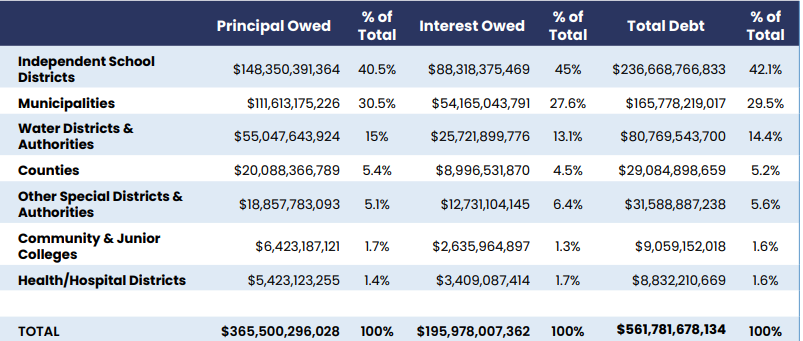
Source: Texas Bond Review Board (2025).
In isolation, Texas’s local debt is sufficiently concerning. However, with greater historical context, these borrowing challenges become even more alarming.
In 2016, Texas’s principal debt amounted to $208.5 billion. By 2025, that debt burden had grown to $365 billion, representing a 75% growth. In a similar way, the amount of interest owed on the debt rose from $123.3 billion to $195 billion over the same period, constituting a 58% increase. Combined, total local debt surged from $331.8 billion in 2016 to $561 billion in 2025 (Texas Bond Review Board, 2016; 2025) (see Table 2).
Interestingly, Texas’s population growth was not nearly as robust. From 2016 to 2025, the state’s population increased from 27.8 million to 31.7 million, or approximately 14% (U.S. Census Bureau, n.d.-a; n.d.-b).
The mismatch between aggressive local debt consumption and modest population growth explains, in part, the noticeable uptick in total debt per capita. Consider that over that period, the amount of local debt owed per Texan increased from $11,925 per person in 2016 to $17,706 per person in 2025—a 48% increase.
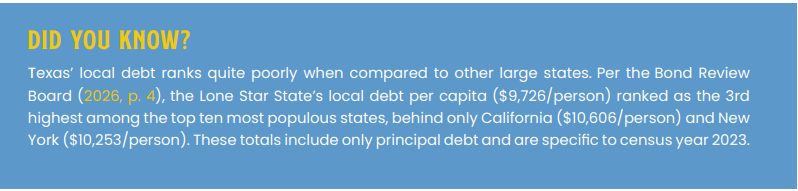
Table 2
Texas Debt and Population 2016-2025
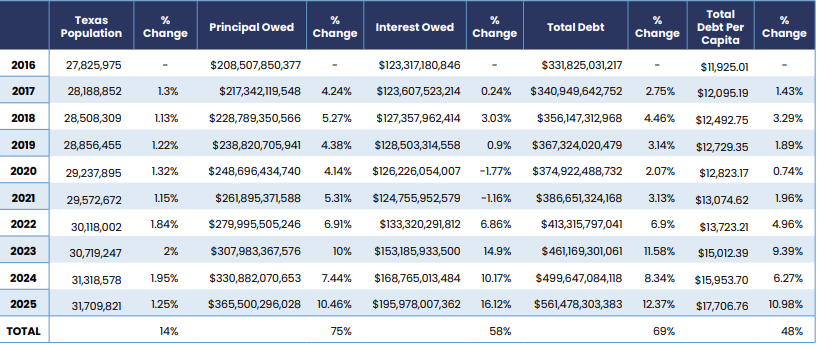
Source: Texas Bond Review Board (2025).
This tendency is reinforced by institutional rules that shape how governments respond when revenues fall short. As Alt and Lowry explain, “where no such law exists, a government can respond to a surprise deficit by borrowing” (Alt & Lowry, 1994, p. 816). When borrowing is available as an immediate response to fiscal imbalance, local officials face fewer incentives to weigh long-term costs against short-term benefits. Debt allows spending decisions to move forward without forcing difficult tradeoffs, which encourages repeated reliance on borrowing. Over time, this dynamic contributes to the accumulation of long-term obligations that are ultimately borne by taxpayers rather than the decisionmakers who approved them.
Even when borrowing decisions are subject to voter approval, those decisions are often made without full awareness of their long-term effects. As Richard Wagner explains, “median voters do not make debt choices under perfect knowledge of future consequences” (Wagner, 1971, p. 109). Because the costs of debt are delayed and spread out over time, voters who participate in local elections may support borrowing without fully accounting for how those obligations will affect the community in the future. In low-turnout local elections, this dynamic allows a relatively small group of voters to authorize long-term debt that the entire community must repay.
The implications of this growth are significant. As a larger share of local revenue is committed to principal and interest payments, fewer resources remain available for other priorities. Rising debt service reduces fiscal flexibility and limits communities’ ability to respond to economic downturns or unexpected needs. Long-term obligations approved today will shape local budgets for decades. A more disciplined and transparent approach to borrowing is essential to ensure that debt remains a tool of necessity rather than a routine practice.
Recommendations
While there is no silver bullet solution to Texas’s local debt problem, various legislative reforms can propel localities toward a better, more fiscally responsible direction. With this in mind, the next Legislature should give serious consideration to the following concepts.
- Require Bond Elections to Be Held in November. Bond elections should be held on the uniform election date in November to solicit the maximum number of voters and to ensure that a small minority of special interests is not unduly influencing bond elections’ outcome.
- Establish Minimum Voter Turnout Requirements. Establish a minimum voter turnout threshold for the approval of new bond propositions and tax ratification elections. This, too, will help prevent the process from being dominated by a relatively small percentage of voters.
- Local Government Debt Limitation. To prevent excessive debt accumulation, the Legislature should prohibit a political subdivision from authorizing any further debt if the resulting annual debt service on debt payable from property taxes exceeds 10% of the amount equal to the average of the amount of property tax collections for the three preceding fiscal years.
- Strengthen the Voter Information Document. The 86th Legislature passed another good government measure, HB 477 (2019), which requires political subdivisions with more than 250 registered voters to create a Voter Information Document (VID) for each bond proposition that contains the following information (HB 477 Bill Analysis, 2019, p. 2):
- The language that would appear on the ballot;
- A table with the principal, estimated interest, and estimated combined principal and interest required for full payment of the proposed bonds and the principal, estimated interest, and estimated combined principal and interest required for full payment of all outstanding bonds as of the date the political subdivision adopted the debt obligation order;
- The estimated maximum annual increase in taxes that would be imposed on a residence homestead with an appraised value of $100,000, based on certain assumptions made by the governing body of the political subdivision detailed in the bill; and
- Any other information considered relevant or necessary to explain the other information in the document.
However, despite the Legislature’s attempt to improve debt transparency, some problems have emerged with the information relayed on the VID, including statistical manipulation and the nondisclosure of certain details. To remedy these issues and improve the VID’s effectiveness, the Legislature should amend state law to eliminate the arbitrary $100,000 appraised value estimate (HB 477, 2019, p. 6) and replace it with the current year’s average taxable value for a residence homestead in the jurisdiction; force political subdivisions to disclose all underlying data; and require the VID to be prominently posted online, either on the political subdivision’s home page or its bond election website, if it has one.
These reforms, along with others, promise to make significant process changes that will bring about greater government transparency and accountability, with the goal of reducing the burden of increased local government debt across Texas.
References
Alt, J. E., & Lowry, R. C. (1994). Divided government, fiscal institutions, and budget deficits: Evidence from the states. American Political Science Review, 88(4), 811–828. https://www.jstor.org/stable/2082709
HB 477. Enrolled. 86th Texas Legislature. Regular. (2019). https://capitol.texas.gov/tlodocs/86R/billtext/pdf/HB00477F.pdf
HB 477 Bill Analysis. Senate Research Center. 86th Texas Legislature. Regular. (2019, April). https://hro.house.texas.gov/pdf/ba86r/hb0477.pdf
Texas Education Agency. (n.d.). Student enrollment reports. Retrieved March 12, 2026, from https://rptsvr1.tea.texas.gov/adhocrpt/adste.html
Texas Bond Review Board. (2016). Local debt outstanding. https://brb.texas.gov/searchable-db.html#/datasets/local_outstanding
Texas Bond Review Board. (2026). Texas bond review board local government annual report 2025. https://www.brb.texas.gov/wp-content/uploads/2026/02/2025LocalARFinal.pdf
Texas Bond Review Board. (2025). Local debt outstanding. https://brb.texas.gov/searchable-db.html#/datasets/local_outstanding
U.S. Census Bureau. (n.d.-a). State Intercensal Population Totals: 2010-2020. Retrieved October 5, 2026, from https://www.census.gov/data/tables/time-series/demo/popest/intercensal-2010-2020-state.html
U.S. Census Bureau. (n.d.-b). State Population Totals and Components of Change: 2020-2025. Retrieved October 5, 2026, from https://www.census.gov/data/tables/time-series/demo/popest/2020s-state-total.html
Wagner, R. E. (1971). OPTIMALITY IN LOCAL DEBT LIMITATION: REPLY. National Tax Journal, 24(1), 109–111. http://www.jstor.org/stable/41792247