Many small and mid-sized cities and counties are right now considering tax rates that, if ultimately adopted, will result in homeowners paying higher taxes. In some cases, those threatened tax hikes are dramatic.
To better understand which Texas taxpayers are in the danger zone, I recently surveyed numerous Notices of Public Hearing on Tax Increase, which are legally required public notices filled with critical information, like proposed and adopted rates, meeting times and locations, and the typical homeowner’s tax bill “for the current fiscal year; and an estimate of the property tax bill for the same property for the upcoming fiscal year if…the proposed budget is adopted.”
After surveying these notices with an eye toward homeowner tax bill changes, I created the chart below to illustrate the 12 largest proposed annual tax increases that I observed amongst cities and counties with relatively modest population sizes. The chart’s contents are organized from highest to lowest percentage change.
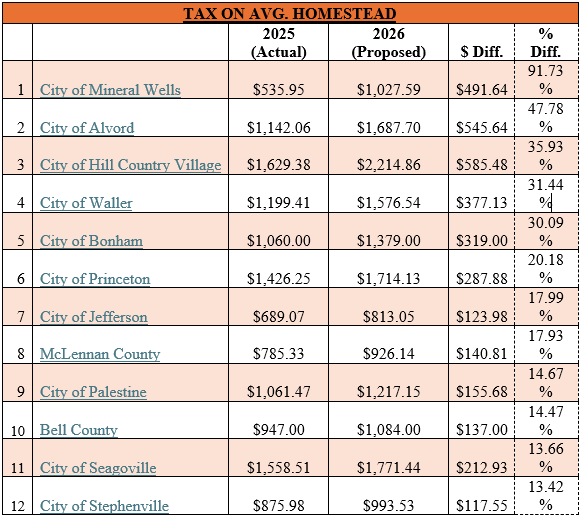
Source: Each local governmental entity’s most recent Notice of Public Hearing on Tax Increase (see hyperlinks).
As is apparent, there is a level of tax increase being contemplated in certain cities and counties that is downright confiscatory and incredibly disheartening given the near-universal concern over (un)affordability. If these governments move forward with their proposed tax hikes, then residents in those areas could be in for a shock—especially since cities, counties, school districts, and special districts tend to layer tax increase upon tax increase.
That said, it’s worth noting that the tax rate adoption process is still unfolding in some cases, meaning that the level of tax increase observed above may fluctuate as things are finalized. Even still, it’s alarming that any Texan today can be threatened with a 36%, 48%, or even 92% tax bill hike, potentially forcing them out of their house! That’s an obvious indication that we need stronger taxpayer protections and stricter rules governing local property tax growth.