Testimony of Brent Bennett, Ph.D.
Policy Director, Life:Powered
Texas Public Policy Foundation
July 29, 2026
Chairman Schwertner and Members of the Committee:
Thank you for another opportunity to testify about the important challenges facing the Texas electric grid and particularly on the urgent challenge of transmission planning. We all agree that Texas needs more reliable energy to meet demand growth, and the question is how to get it. Our research shows that building more energy-dense, reliable generation like natural gas and nuclear close to demand centers would eliminate the need for the cross-state 765-kV lines while decreasing total system costs for consumers. This is not a statement that Texas needs to compel generators to build in certain place or directly subsidize generators. Rather, a market that properly values reliable, energy-dense generation will naturally build that generation close to demand centers where the power can be efficiently used.
Figure 1
What the PUC and ERCOT Should Do Regarding the 765-kV STEP
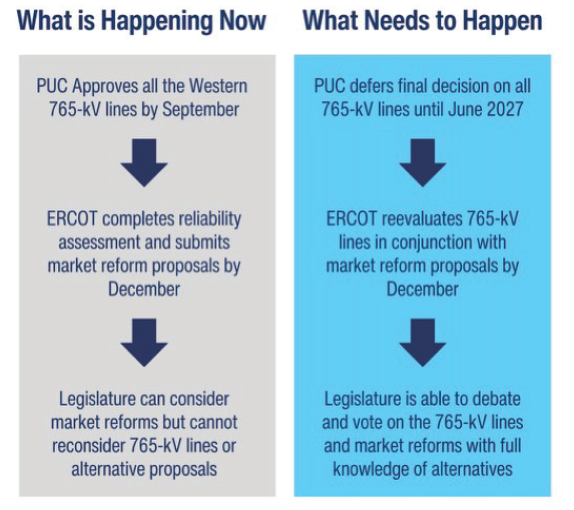
TPPF recommends that the final decisions on the 765-kV lines currently being considered by the PUC should be paused until
after the 90th Legislature to allow the following actions to be completed first.
1. ERCOT should perform a full reappraisal of the 765-kV lines in its Regional Transmission Plan by January 2027. This review should compare the current plan, which is heavily reliant on new wind and solar generation to meet new demand, to plans that include sufficient local generation and transmission to avoid the need for cross-state transmission.
2. Concurrent with ERCOT’s study, the PUC should conduct a review of market design changes that would allow for construction of new, online generation that would negate the basis for cross-state transmission. This review should be completed in time to allow the 90th Texas Legislature to compare these options to the status quo and enact reforms to the current Texas system to better provide for the future needs of all Texans.
A major driving force for new cross-state transmission in Texas is the need to move diffuse wind and solar hundreds of miles across the state to load centers. The overbuilding of wind and solar is especially prevalent in West Texas, which is suppressing the building of reliable generation despite consistent load growth in that region. As shown in Figure 2, the eastern regions of the ERCOT market are relatively balanced, with demand in each region (noted by the black lines) roughly matching dispatchable capacity. The West Zone, on the other hand, has almost 10 times as much installed capacity of wind, solar, and storage as natural gas with demand starting to exceed that gas supply. This imbalance is what the Permian Basin import lines are designed to fix, but the problem is that there is not much excess reliable generation anywhere in the state to supply the lines.
Figure 2
Installed Capacity by Resource Type for Each Load Zone, August 2026
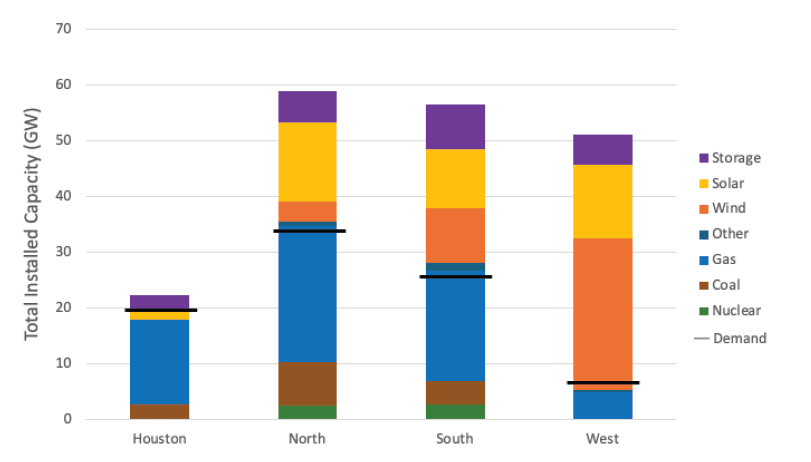
ERCOT developed the Permian Basin Reliability Plan (PBRP) and the 765-kV Strategic Transmission Expansion Plan (STEP) under the assumption that about 90% of new capacity in the coming decade would be wind, solar, and storage, thereby perpetuating the existing imbalances. The transmission lines provide optionality for siting new generation but do not ensure that generation gets built. The current structure of ERCOT is doing exactly the opposite of what is needed by unduly rewarding diffuse and variable wind and solar while subsidizing the transmission of their power to demand centers. The 765-kV STEP, rather than solving this problem, merely provides a temporary band aid while further entrenching this broken system over the long term. More reliable generation will help keep the lights on during the next winter storm, a problem that new transmission by itself does not solve.
This committee will hear from many parties about the risks of delaying the transmission buildout, but the risks of continuing to build transmission while not reforming the wholesale market to better value reliable generation are even greater. First, further increasing the proportion of wind and solar in the ERCOT grid, which the 765-kV lines are likely to do, will increase the risk of outages during winter storms. Under current generation trends, 1-in-10-year winter storm in 2030, even in a system with adequate new transmission, will result in nearly 3 days of outages and cost tens of billions of dollars.3
The second major impact is the cost to Texas ratepayers of continuing to plan and build transmission in this manner. TPPF estimates that if the 765-kV STEP is fully implemented, the lifetime cost to ratepayers will approach $100 billion, or about $3 billion per year. Under current cost allocation rules, the average residential ratepayer would pay over $150 per year for these projects alone, which represents a 7-8% increase to the average bill. While TPPF applauds the Legislature’s requirement to reassess transmission cost allocation and the PUC’s efforts to minimize the costs imparted to residential ratepayers, spreading transmission costs around does not make them go away. The first and best approach is to minimize how much transmission is built in the first place.
Third, and not to be underestimated, is the permanent damage these projects will cause to Texas landowners. Even after landowners are compensated for land condemned through eminent domain for the transmission lines, there are permanent impacts to the value and use of private property that extend far beyond the easement itself. Studies have shown that property which is up to 1,000 feet from transmission lines can be devalued by 18% or more. Applying this factor to all the landowners affected by the 765-kV lines results in a total loss of value that could easily exceed $10 billion.
Figure 3
Annual Transmission Cost of Service due to CREZ Lines, Wind and Solar Interconnections, and New 765-kV Lines, Actual 2022-2024 and Estimated 2025-2034
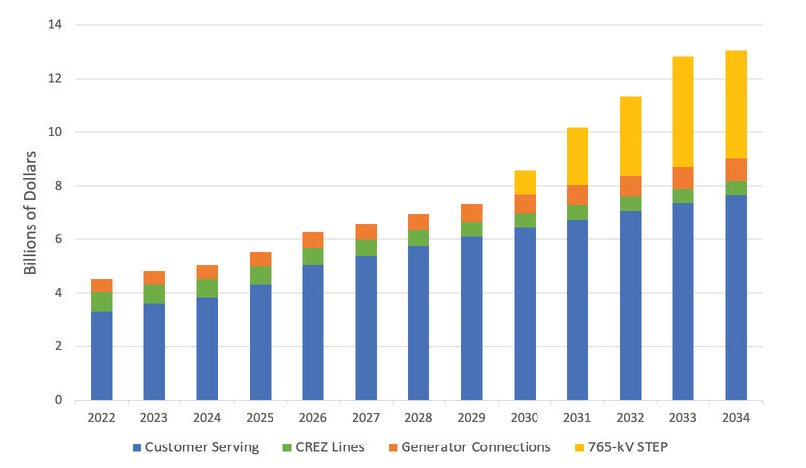
The 765-kV STEP is nearly five times larger in cost and scope than the CREZ lines, yet it has never been expressly authorized by the Legislature in the same way the CREZ lines were. In 2005, Senate Bill 20 expressly directed the PUC to “develop a plan to construct transmission capacity necessary to deliver” renewable generation from designated renewable energy zones to customers throughout Texas (emphasis added). Consistent with this mandate, the PUC and ERCOT went on to develop the CREZ transmission projects.
Compare this with House Bill 5066, which required ERCOT to develop a reliability plan for the Permian Basin that must (1) address extending transmission service to areas where mineral resources have been found; (2) address increasing available capacity to meet forecasted load; and (3) provide available infrastructure to reduce interconnection times in areas without access to transmission service. The bill mandated a regional planning framework to identify reliability concerns and evaluate potential solutions but did not direct the construction of transmission lines across the entire state. Consistent with historical practice, a project with the cost and statewide impact of the 765-kV STEP should only be undertaken after a vote from the Legislature and should not be initiated by the PUC and ERCOT alone.
TPPF fully supports immediately building more local transmission to enable demand growth of new, reliable generation, especially in the Permian Basin. More growth is what our grid needs to bring on more reliable generation to build our way out of the problems created by nearly two decades of overbuilding subsidized wind and solar. But that growth must be accompanied by market reforms to better value reliability, lest the new demand continue to on more unreliable generation. The upcoming end of federal subsidies alone will not correct the damage already done.
In the absence of market reforms to better value reliable generation, more cross-state transmission to manage the imbalances created by wind and solar generation will simply lead to more wind and solar, exacerbate the reliability problems caused by those resources, and impose extra costs on ratepayers. The CREZ lines demonstrated that this will happen, and yet Texas is setting itself up to repeat the mistake on an even greater scale, such that building more cross-state transmission lines will become the norm, not a one-time event. Texas must fix the wholesale market first and
then reconsider whether the Permian Basin import lines, the 765-kV STEP, and any other major statewide transmission projects are needed. There is time to correct the path we are on, and that time is now.
References
1 Bennett, B. (2026, June). An Economic Assessment of the 765-kV Strategic Transmission Expansion Plan. Texas Public Policy Foundation.
https://www.texaspolicy.com/wp-content/uploads/2026/06/2026-05-LP-Strategic-Transmission-Expansion-Plan-Bennett-combined.pdf
Figure 2 Note: Data from Monthly Outlook for Resource Adequacy (MORA) Reporting Month: August 2026, Revised, Electric Reliability Council of Texas,
June 2025, (https://www.ercot.com/files/docs/2026/06/05/MORA_August2026.pdf).
2 Electric Reliability Council of Texas (ERCOT). (2024, July). ERCOT Permian Basin Reliability Plan Study. pp. 5-6, 55-57.
https://interchange.puc.texas.gov/Documents/55718_17_1414013.PDF
3 Reed, M. & Bennett, B. Forecasting the Future of the ERCOT Grid, Part 1: The Ongoing Winter Reliability Challenge. Texas Public Policy Foundation. p. 3. https://www.texaspolicy.com/wp-content/uploads/2026/06/2026-05-LP-Future-ERCOT-Grid-Part1-ReedBennett-1.pdf
4 Bennett, B. and Piracci, J. (2026, January). The Explosion of Transmission Costs in ERCOT: Causes, Forecasts, and Policy Solutions.Texas Public Policy Foundation. p. 10.
https://www.texaspolicy.com/wp-content/uploads/2026/01/2026-01-LP-Transmission-Costs-BennettPiracci-updated6-2026.pdf
5 Wyman, D. & Mothorpe, C. (2018). The Pricing of Power Lines: A Geospatial Approach to Measuring Residential Property Values. Journal of Real
Estate Research, 40(1), 121-154. https://www.tandfonline.com/doi/epdf/10.1080/10835547.2018.12091490
Figure 3 Note: Figure from The Explosion of Transmission Costs in ERCOT: Causes, Forecasts, and Policy Solutions, B. Bennett & J. Piracci, Texas Public Policy Foundation, January 2026, p. 11 (https://www.texaspolicy.com/wp-content/uploads/2026/01/2026-01-LP-Transmission-Costs-BennettPiracci-updated6-2026.pdf).
6 SB 20. Enrolled. 79th Texas Legislature. Regular. (2005).
https://capitol.texas.gov/tlodocs/791/billtext/pdf/SB00020F.pdf
7 HB 5066. Enrolled. 88th Texas Legislature. Regular. (2023).
https://capitol.texas.gov/tlodocs/88R/billtext/pdf/HB05066F.pdf