TWIA has become the leading wind and hail insurer in the catastrophe area. Its position has direct and indirect consequences for Texans statewide.
Key points:
- Since 2020, TWIA has steadily increased its market share in the catastrophe area, raising concerns about scope and cost.
- TWIA’s quasi-governmental model imposes potential costs on statewide policyholders and private insurers alike, while conferring a benefit to coastal residents in the form of lower insurance premiums.
- TWIA’s expanded reach creates additional risk and complication for policyholders statewide.
The 90th Texas Legislature should closely examine TWIA’s operation and offerings to determine what opportunities, if any, exist to advance market principles.
Executive Summary
The Texas Windstorm Insurance Association (TWIA) has been increasing its market share in what is known as the “Catastrophe Area” along the Texas coast since 2020 (TWIA, 2025a). TWIA’s expanded reach, in terms of both policies and total exposure, raises concerns regarding whether they could sufficiently cover catastrophe costs without relying on third-party financing mechanisms. Recent changes to TWIA’s funding structure make it unclear to what extent costs will be distributed to member insurers and the average non-TWIA policyholder; however, TWIA’s potential dependence on third-party mechanisms exposes private policyholders to a degree.
The “Last Resort” Insurance
TWIA is a not-for-profit insurance organization that offers windstorm and hail coverage to seacoast residents who are unable to obtain it in the private market. Among the short list of requirements for TWIA coverage eligibility are living within the catastrophe area (which includes 14 coastal counties1 and part of Harris County) and to “have been denied coverage by at least one insurer in the private market” (TWIA, n.d.-a). For these reasons, TWIA is considered a “residual insurer of last resort and as such is not a direct competitor in the private market” (TWIA, n.d.-b). However, TWIA’s status as a last resort insurer implies certain qualities, some of which are not readily apparent.
Consider that, far from being the last resort insurer, TWIA has become the leading windstorm provider in the catastrophe area. In fact, TWIA’s coverage makes up 55% of the residential windstorm and hail insurance market share in the catastrophe area, with 276,457 residential and 286,251 total properties insured (TDI, 2026). In 2020, TWIA’s exposure-in-force, or the “total insured value of the properties that TWIA insures” (TWIA, 2024a), totaled $55 billion (TWIA, 2020a), and in 2025, totaled $126.5 billion (TWIA, 2025b), which is a 130% increase in five years (see Table 1).
Table 1
TWIA’s Exposure-in-Force (2020 – 2025)
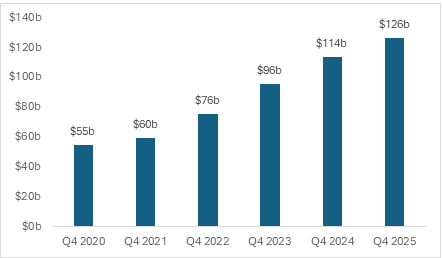
Note: Data attained through TWIA’s 2020 to 2025 Liability Quarterly (Q4) Reports (TWIA, n.d.-c.)
TWIA’s framework creates an imbalanced incentive structure that has historically produced negative externalities for private insurers and private policyholders. TWIA includes assessments from private insurers operating in Texas and, as of recently, statewide surcharges as part of its current funding structure that could be utilized under specific circumstances. Within this setting, TWIA’s beneficiaries have been permitted to pursue coastal living while distributing its financial risks to third parties. To a certain extent, there is an inherent tension between these heightened costs, however diffuse, and the “public policy reasons for creating TWIA,” which, according to the Texas Department of Insurance, included “supporting general economic development” along the “coastal area” (TDI, 2026). The nature of TWIA’s funding structure and its stated goal of spurring economic development contributes significantly to the agency’s sharp increase in policies and exposure amounts in recent years. In turn, this has increased total risk exposure and may ultimately prompt future cost increases for member insurers and statewide policyholders.
A Cat and Mouse Game
The Texas Legislature has attempted to mitigate various weaknesses of TWIA’s funding structure on numerous occasions. In fact, the Texas Legislature passed 23 bills pertaining to TWIA in 8 of the last 9 legislative sessions (TDI, 2026).2 None of those efforts, however, have eliminated TWIA’s reliance on third party funding mechanisms.
Prior to 2009, TWIA could fund losses through “potentially unlimited assessments on insurance companies” (TWIA, 2022), a controversial aspect following $100 million in member assessments from Hurricane Rita in 2005, $100 million from Hurricane Dolly in 2008, and another $430 million from Hurricane Ike in 2008 (TDI, 2026). Assessments ranged from $2,954 to $14.8 million from Hurricane Rita, depending on member insurers’ market share; $500 to $13.8 million from Hurricane Dolly; and $2,000 to $35 million from Hurricane Ike (TDI, 2026).
The Legislature recognized the inefficiencies and lopsidedness of TWIA’s funding structure and implemented a series of revisions to confront them. HB 4409 (2009), for instance, created a layered structure that provided TWIA with additional funds to pay for losses exceeding pre-funding sources, most notably by providing TWIA with access to public securities. The funding structure was further revised following SB 900 (2015), which added more structure, statutory constraints, and statutorily required TWIA to build a funding stack capable of covering the costs of a 1-in-100-year storm, a metric known as Probable Maximum Loss (PML).
The combination of these bills sought to “reduce unknown financial liability for member insurers” and to require “TWIA to maintain an actuarially sound financial structure” (SB 900 Bill Analysis, 2015). These goals, however, fell short. Consider that TWIA remained largely dependent upon member assessments to pay their claims and levied a total of $372 million in member assessments following Hurricane Harvey in 2017 (TDI, 2026). The first assessment was $175 million in June 2018, then $106.8 million in August 2018, and nearly two years after the initial assessment, $90 million in February 2020 (TDI, 2026).
The 89th Texas Legislature made notable revisions to TWIA’s funding structure in an attempt to mitigate its cost burdens. For instance, HB 3689 (2025) lowered PML from a 1-in-100-year storm to a 1-in-50-year storm, thereby reducing total pre-funding amounts and lowering its demand for reinsurance. HB 3689 (2025) also replaced public securities with a state financing arrangement, which provides a more “efficient method for the association to pay losses following a catastrophic event” (HB 3689, 2025, p. 10). In addition, the 89th Legislature passed HB 2517 (2025), which granted TWIA maintenance and premium tax exemptions. Despite these reforms, TWIA’s reliance on third parties remains and, to some degree, has expanded.
Third Party Mechanisms
HB 3689 (2025) introduced statewide surcharges to TWIA’s funding stack as the mechanism to repay the state financing arrangement when funds are utilized. This is in addition to TWIA continuing to include member assessments in its funding structure, which imposes negative externalities on private policyholders. According to TWIA, “companies generally include a provision for potential assessments in their rates” (TWIA, 2020b), suggesting that private policyholder premiums reflect member insurers’ risk of assessments. This means that private policyholders may not only be subject to increased premium amounts due to member assessment risks, but they may now be repaying the principal and interest of funds they did not receive.
Conclusion
Far from being the last resort insurer, TWIA’s expansive reach in terms of market share, policy count, and total exposure, raises concerns for member insurers and private policyholders. Policymakers should remain aware of this situation and explore opportunities in the future to cultivate the free market.
References
HB 4409. Enrolled. 81st Texas Legislature. Regular. (2009). https://capitol.texas.gov/tlodocs/81R/billtext/pdf/HB04409F.pdf
HB 3689. Enrolled. 89th Texas Legislature. Regular. (2025) https://capitol.texas.gov/tlodocs/89R/billtext/pdf/HB03689F.pdf
HB 2517. Enrolled. 89th Texas Legislature. Regular. (2025) https://capitol.texas.gov/tlodocs/89R/billtext/pdf/HB03689F.pdf
SB 900. Enrolled. 84th Texas Legislature. Regular. (2015). https://capitol.texas.gov/tlodocs/84R/billtext/pdf/SB00900F.pdf
SB 900, 84th Texas Legislature. Regular. Bill Analysis (2015) https://capitol.texas.gov/tlodocs/84R/analysis/html/SB00900I.htm
Texas Department of Insurance (TDI). (2026). TWIA overview. https://tdi.texas.gov/pubs/pc/twia-overview.pdf
Texas Windstorm Insurance Association (TWIA). (n.d.-a). Frequently asked questions. Retrieved April 13, 2026, from
Texas Windstorm Insurance Association (TWIA). (n.d.-b). Overview. Retrieved April 13, 2026, from https://www.twia.org/about-us/overview/
Texas Windstorm Insurance Association (TWIA). (n.d.-c). Financial reports and statements. Retrieved April 13, 2026, from https://www.twia.org/about-us/financial-reports/
Texas Windstorm Insurance Association (TWIA). (2025a). TWIA fact book: Q3 2025. https://www.twia.org/wp-content/uploads/Q3-2025-TWIA-Fact-Book.pdf
Texas Windstorm Insurance Association (TWIA). (2025b). TWIA liability report: As of December 31, 2025. https://www.twia.org/wp-content/uploads/TWIA-Liability-Report-20251231.pdf
Texas Windstorm Insurance Association (TWIA). (2024a). 2024 annual report & catastrophe (CAT) incident response plan. https://www.twia.org/wp-content/uploads/2024-Annual-Report-CAT-Plan.pdf
Texas Windstorm Insurance Association (TWIA). (2022). Legislative & External Affairs Committee meeting materials. https://www.twia.org/wp-content/uploads/TWIA-Legislative-Exernal-Affairs-Committee-Meeting-Materials-July-20-2022.pdf
Texas Windstorm Insurance Association (TWIA). (2020a). Quarterly liability statement (as of December 31, 2020). https://www.twia.org/wp-content/uploads/TWIA_Qtrly_Liab_20201231-1.pdf
Texas Windstorm Insurance Association (TWIA). (2020b). Board of Directors meeting materials. https://www.twia.org/wp-content/uploads/TWIA-Board-of-Directors-Meeting-Materials-August-4-2020.pdf