Texas governments received $84.3 billion in federal funding in 2023, raising concerns over financial dependency and regulatory consequences. Creating an Office of State Sovereignty to monitor the application, receipt, and conditions of this aid could mitigate fiscal risk and improve transparency.
Key points:
- Texas lacks a centralized system to oversee federal grants potentially flowing to more than 5,000 local governments.
- Federal grants frequently carry policy conditions that expand Washington, D.C.’s influence and can conflict with Texas’s limited government vision.
- Long-term reliance on federal aid tends to increase government spending, reduce discretion and choice, and create fiscal dependence.
Reimagine the Office of State-Federal Relations as the Office of State Sovereignty and designate it as Texas’s single point of contact for applying for federal assistance. The new office should also require review of major federal grants, create a statewide grants transparency portal, and conduct annual assessments of the state’s dependence on federal funding.
Reinvigorating Federalism and Fiscal Discipline in Texas: Establishing the Office of State Sovereignty
“States are separate and independent sovereigns. Sometimes they have to act like it.”
~ Chief Justice John Roberts (National Federation of Independent Business v. Sebelius, 2012)
ISSUE
Federal funding permeates U.S. state and local budgets.
In fiscal year (FY) 2017, federal aid1 to all state and local governments totaled $711.8 billion, with state governments collectively receiving $642.8 billion and local governments obtaining $69.1 billion. By FY 2023—the latest available data—the federal government provided $1.235 trillion to all state and local governments, with state governments accepting $1.09 trillion and local governments gaining $140.6 billion (U.S. Census Bureau, 2025). In both cases, federal proceeds were dispersed directly from the national government to sub-national governments; but in the case of state governments, “[s]ome of this was federal funding passed through states to local governments” (Levin, 2025, para. 10). Excluding state-local intergovernmental transfers, direct federal aid comprised between 25% to 36% of state governments’ total revenues and between 3% to 6% of local governments’ total revenues, as depicted in Table 1 (U.S. Census Bureau, 2025).
Table 1
Federal Aid to All U.S. State and Local Governments, 2017 – 2023
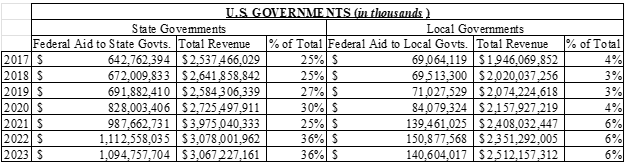
Note. Data from State and Local Government Finances Datasets and Tables, by U.S. Census Bureau, n.d. (https://www.census.gov/data/datasets/2023/econ/local/public-use-datasets.html) and authors’ calculations.
In the Lone Star State, a similar, if not more robust, arrangement is observable. In FY 2017, the federal government sent Texas state and local governments a combined $45.9 billion. Of this amount, the state received nearly $42 billion, which accounted for 33% of its total revenue, while local governments took in $3.9 billion, constituting 3% of total local revenue. By FY 2023, Texas governments jointly received $84.3 billion from the federal government. Of this, the state’s portion totaled $76.2 billion while local governments accepted slightly more than $8 billion (U.S. Census Bureau, 2025). As with the prior dynamic, some portions of Texas’s federal receipts were transferred from the state to local governments, generally through appropriations, grants, and other aid. Excluding transfers from the Texas state government to local governmental entities, direct federal aid comprised between 32% to 44% of the state’s total revenues and between 3% to 6% of local governments’ total revenues, as detailed further in Table 2 (U.S. Census Bureau, 2025). The amount of federal aid as a percentage of Texas state spending is higher than the national average, indicating a greater degree of dependency and susceptibility to the national government’s influence. Such a heavy reliance is consistent with historical trends2 as well as the most recently adopted budget framework.3
Table 2
Federal Aid to Texas’s State and Local Governments, 2017 – 2023
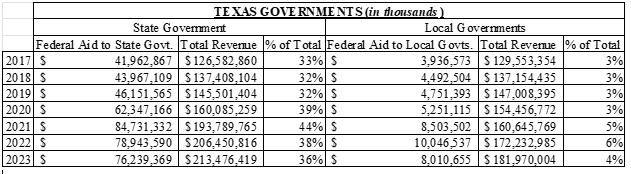
Note. Data from State and Local Government Finances Datasets and Tables, by U.S. Census Bureau, n.d. (https://www.census.gov/data/datasets/2023/econ/local/public-use-datasets.html) and authors’ calculations.
The extent to which Texas governments rely on federal funding is noteworthy for several reasons rooted in economy, efficiency, and effect. However, the degree to which these factors influence and shape the policy environment is difficult to know given the lack of adequate transparency and oversight.
In some ways, the Texas state government’s stewardship of federal aid is less affected by these concerns thanks to certain state-led open government efforts. For instance, every year, the Legislative Budget Board (LBB) prepares and publishes a comprehensive report, titled the Top 100 Federal Funding Sources in the Texas State Budget, which provides basic grant information about the largest federal funding sources in the state’s General Appropriations Act (GAA), otherwise known as the state budget, and records critical information, like: “the purpose of the grant; information regarding how federal allocations to states are determined; match or [maintenance of effort (MOE)] provisions and dollar amounts of the MOE requirements, if available; information regarding allowable federal uses or restrictions; relevant eligibility criteria; and the recipient state agency” (LBB, 2025a, pp. 8-9). While this publicly available report excludes certain types of federal monies—like disaster aid, higher education funding, Medicaid supplemental payments, and in-kind federal contributions—it nonetheless provides important insight into large and costly programs.4
Furthermore, the Legislature’s deliberative process, committee structure, and public hearing format provide stakeholders with opportunities to inspect and track federal monies as they are appropriated in the GAA as well as their intended purpose. Still further, state-level entities other than the LBB have certain reporting requirements that help monitor aspects of federal assistance. For example, Section 772.009 of the Texas Government Code requires all state agencies (except higher education institutions) to prepare and provide “a report of the federal grants for which the agency has applied” to the Office of the Texas Governor’s Budget and Planning Division (n.d.).
In contrast, local governments generally lack these same checks-and-balances or, to the extent that they exist, the systems are less comprehensive and managed in a more isolated fashion. The absence of any robust oversight mechanism is aggravated by the sheer number of local governmental entities in Texas. One estimate from the Federal Reserve Bank of St. Louis (Smaldone & Wright, 2024) suggests that “in 2022, Texas ranked second [in the nation] in terms of local governments with 5,533,” which was only behind Illinois (6,930). It is unclear how many of these entities act independently to secure federal funding, but considering the count, it has the potential to be a significant number.
What’s more, no central authority currently collects and reports on the use(s), cost(s), and consequence(s) of federal aid by one, some, or all local governments. Instead, this type of information is usually released haphazardly or inconsistently at the discretion of the local governing body, such that it makes it difficult to develop a proper fiscal picture or make comparisons between like entities.
Evidence of the size and scope of this challenge is apparent in certain municipal finance reports. For example, a 2025 city of Dallas presentation notes that it has “realized average annual grants from the federal government of $305.2 million,” while a separate 2025 Fort Worth report estimates that replacing its federal funding would require a 19.8% increase in the local property-tax rate (Weedon & Williams, 2025; Burghdoff, 2025). Nationally, the Congressional Research Service (CRS) estimates that Washington, D.C., sent $146.3 billion directly to local governments in 2022, separate from pass-throughs to states (Levin, 2025). This was tantamount to 6.2% of all local government revenue. Together, these figures provide a partial indication of how intertwined federal funding has become with local government operations, in some cases without a meaningful check-and-balance in place. Such a dynamic raises concerns over the prudence of receiving funding with strings attached, likely outcomes once those funds are exhausted, or even what might happen to an entity if the federal government’s finances experienced a worse-case scenario and funding disappeared.
The consequences invited by accepting federal aid brings to mind an adage popularized by Milton Friedman, who warned that “there’s no such thing as a free lunch” (1975). This dictum is particularly true in this context. The influx of federal funds “often come[s] with onerous conditional requirements that tend to put upward pressure on spending and the growth of government,” and because funds can flow directly to local governments, there is the potential for grants to be used contrary to Texas’s dominant political ethos (Quintero, 2025). For instance, during the Biden Administration, the allure of federal funding enticed some Texas governments into adopting ideologically driven policies involving DEI, climate change, and gender theories. The city of Fort Worth’s Diversity & Inclusion program offers one real-world example of this phenomenon, as 14 separate federal awards provided nearly $5 million over a multi-year period for the purpose of advancing a race-based policy framework (Burghdoff, 2025). Around the same time, the city Dallas received a $652,662 environmental justice grant from the U.S. Environmental Protection Agency to purportedly “advance equity and justice…[for] disadvantaged communities that are marginalized by underinvestment and overburdened by pollution” (U.S. Environmental Protection Agency, 2023, para. 11).
While the oscillatory nature of party control means that these ideological crusades are not currently in season, Texas’s fundamental belief in a limited government vision ought not be wholly dependent on a friendly administration in Washington. For this reason, the state should position itself as a supervising agent to monitor the receipt, requirements, and amounts of federal aid flowing to Texas’s 150-plus state agencies and over 5,000 political subdivisions, and to ensure that said federal aid aligns with the state’s policy and budgetary priorities. In so doing, this will allow the state to preserve its sovereignty, protect taxpayers, encourage prudence within local budgets, and ensure that federal funds serve Texas on Texas’s terms.
From Aid to Authority: How the Federal Government Colonized the States
The origins of federal-state aid can be traced to the Morrill Act of 1862, which established the land-grant university system (Advisory Commission on Intergovernmental Relations, 1978). Early grants were simple lumpsum transfers without matching requirements or meaningful federal oversight. The modern system of conditional grants, by contrast, likely finds its roots in the Morrill Act of 1890, which required the Secretary of the Interior to certify that Congress’s conditions had been met, or else annual payments could be withheld—ushering in the concept of federal aid tied to specific conditions.
It was not until the Progressive Era, under President Woodrow Wilson, that large-scale “state-aid” programs emerged. As the CRS notes, “Outlays for federal grants to state and local governments increased from $12 million in FY1913 to $118 million in FY1922” (Levin, 2025, p. 24). The growth of such programs provoked early warnings. In 1925, the governor of Maryland declared, “The system ought to be abolished, root and branch” (Edwards, 2019). At the same time, President Calvin Coolidge, in his State of the Union address, similarly cautioned against expanding Washington’s role in local affairs (Edwards, 2007).
If the Progressive Era was a rising tide, then the New Deal was the first levee to give way. By 1935, federal grants to state and local governments totaled $2 billion, transforming states from partners into instruments of federal policy (Advisory Commission on Intergovernmental Relations, 1978, p.19). A book from the period, The Administration of Federal Grants to the States, captured the shift succinctly: “The states become…agents of the central government in the prosecution of activities deemed by Congress to be clothed with a national interest” (Key, 1937, p. 368).
The trajectory accelerated further during President Lyndon B. Johnson’s “Great Society.” In 1960, $7 billion flowed from federal coffers to state and local governments. Between 1964 and 1969, those transfers doubled, from $10.2 billion to $24.1 billion (Ballotpedia, n.d.). The proliferation of categorical grants, each with narrow purposes and detailed requirements, tethered local governance to federal priorities.
Economist Charles L. Schultze, who later chaired the Council of Economic Advisers under President Jimmy Carter, described the situation candidly:
“Many federal categorical grants for restricted purposes… probably serve no major national purpose but simply reflect the substitution of the judgment of federal legislators and agency officials for that of state and local officials about what specific local services should be available” (Advisory Commission on Intergovernmental Relations, 1978, p. 34).
By the late twentieth century, the system of federal aid had evolved into a sprawling web of intergovernmental transfers, blurring accountability and subordinating state decision-making to national policy preferences. During the Covid-19 pandemic, more than $10 billion flowed directly to Texas local governments.
Coercion by Consent: The Subversion of Federalism
Federal grants to political subdivisions are ultimatums wrapped in the linguistic façade of aid and charity. As Mario Loyola (2014) aptly describes, “Here is a lot of money you can have if you comply with 100 conditions, otherwise you get nothing.”
From Washington, D.C.’s perspective, such enticements help transform cities and counties into de facto executors of a federal policy agenda. This arrangement allows Congress and the executive to do indirectly—through its spending power—what it cannot do directly under the Constitution’s enumerated powers. In point of fact, the U.S. government is unable to require a state or local official to do anything; likewise, it cannot force a legislature or political subdivision to pass a law or ordinance (Printz v. United States, 1997; New York v. United States, 1992). Indeed, post United States v. Butler, the U.S. Supreme Court has acknowledged few limits on the levels of coercion the government can impose through its spending power (United States v. Butler, 1936; South Dakota v. Dole, 1987).
The Framers of the Constitution never intended for such a broad conception of government power (Somin & Bagenstos, n.d.). Their view was that the general grants of constitutional authority were qualified by specific enumerations. This is captured by the legal maxims of “expressio unius est exclusio alterius,” meaning the expression of one thing is the exclusion of others, and “esjudem generis,” meaning when general words follow specific words, the general words only apply to the class of specific words (Black,1990; Scalia & Garner, 2012).
James Madison (1788), writing in Federalist 41, explains: “For what purpose could the enumeration of particular powers be inserted, if these and all others were meant to be included in the preceding general power? Nothing is more natural nor common than first to use a general phrase, and then to explain and qualify it by a recital of particulars.”
Jefferson (1817) likewise believed “that Congress had not unlimited powers to provide for the general welfare, but were restrained to those specifically enumerated; and that, as it was never meant they should provide for that welfare but by the exercise of the enumerated powers, so it could not have been meant they should raise money for purposes which the enumeration did not place under their action: consequently that the specification of powers is a limitation of the purposes for which they may raise money.”
This doctrine of specific enumeration would have largely precluded the use of federal grants as instruments of regulatory control over state and local governments. For instance, a federal grant that, as a condition of its receipt, requires the adoption of particular zoning ordinances or social programs would be unconstitutional under this view, since the federal government possesses no general police power and cannot use the spending power to circumvent that limitation.
Modern coercive federal grants, therefore, amount to an end-run—achieving through subsidy what cannot be mandated through statute. This undermines the Tenth Amendment’s reservation of powers, “to the states respectively, or to the people,” and in practice turns our system of dueling federalism into one where states serve as middle managers for Washington (1791).
Critics may contend that limiting the influence of coercive federal grants on state and local policymaking amounts to a revival of John C. Calhoun’s doctrine of states’ rights (Keyser, 2020). They may argue that a state’s decision to decline discretionary federal aid designed to advance national policy objectives resembles modern nullification—an interposition of state authority between the federal government and its intended regulatory ends. This objection, however, conflates fundamentally distinct concepts. First, federal grants operate within the realm of voluntary intergovernmental relations. A state’s refusal to accept discretionary aid, or its decision to condition acceptance upon meeting certain requirements, does not contravene the Supremacy Clause, because no federal law is being obstructed—only an offer declined. Second, any decision regarding the acceptance of voluntary funds necessarily occurs prior to their receipt. No federal enactment is nullified; rather, the state simply declines to participate in an optional spending program. Moreover, local governments are political subdivisions of the state. As creatures of state law, they possess only those powers the state confers upon them. It therefore falls well within a state’s constitutional authority to determine, structure, and supervise the manner in which its subdivisions engage with the modern federal funding apparatus.
While it is easy to fault state and local governments for acquiescing to federal inducements, the deeper issue is structural. Fragmented grant administration leaves municipalities negotiating against the full force of the federal bureaucracy, one by one. Without a coordinated state framework, local governments are functionally defenseless. Texas’s task, therefore, is not punitive but protective: to construct a system of statewide coordination that restores constitutional balance and shields the people of Texas from coercion.
Cost to the Taxpayer
Federal grants are often portrayed as free money. Yet, recipient governments often incur unexpected fiscal impacts once those temporary monies expire. Whether by introducing new positions, programs, or projects that require long-term maintenance or tempting the entity to continue it on in perpetuity, federal aid commonly invites upward pressure on state-local government spending and taxes, if not carefully managed.
In theory, one might expect a substitutionary effect to occur wherein recipient governments utilize grant funding to replace or ease own-source tax revenue. In practice, however, the economic literature shows a persistent stimulative whereby the introduction and exhaustion of federal grants gradually nudge the tax burden higher, presumably in an effort to maintain some portion of previously elevated spending levels (Crowley et al., 2010a). A study from George Mason University found, “Every dollar in temporary federal grants leads to 40 cents of tax increases. Economists have long suggested the existence of a ‘flypaper effect,’ wherein federal money given to states prompts additional spending” (Crowley et al., 2010b). An example of this is Texas public school districts, many of whom directed pandemic aid to recurring expenses, like new hires, staff salary increases, operational expenses, and vendor subscriptions. While some of these ongoing costs were able to be eliminated once pandemic aid expired, much was not, prompting school boards to adopt higher tax rates than otherwise would be necessary. Again, this is on account of the fact that, once federal funds eventually expire, state-local governments rarely reduce spending back to prior levels. Instead, many often raise taxes to sustain the programs that those funds created, creating a ratchet effect.
Further research confirms the magnitude of this burden. In a (2015) study, Eric Fruits of Portland State University reviewed 40 years of federal grant data. He concluded that for every dollar received through federal grants, state and local taxpayers nationwide paid an additional 82 cents in taxes and fees. The fiscal consequences extend beyond tax burdens. A 2016 meta-analysis of intergovernmental transfers found that “When central governments give more grants to subcentral governments, particularly when the subcentral governments enjoy borrowing autonomy, … the results are higher government spending (especially government consumption), higher government debt, worse public-sector efficiency, lower voter knowledge about government responsibility, and lower economic growth” (Sorens, 2016, pp. 30-31).
In short, federal aid compounds rather than substitutes for local spending. By inflating government budgets, masking actual costs, and generating dependency, conditional grants transform temporary assistance into permanent fiscal expansion. The result is a heavier load for taxpayers and an opaquer system of public finance, where responsibility is diffused and accountability diminished.
Recommendations
To effectively defend Texas’s constitutional independence and reduce reliance on federal aid, lawmakers should reconstitute the Office of State-Federal Relations into a newly empowered Office of State Sovereignty (OSS) with a modified focus. Instead of solely seeking out federal aid, this reimagined office would serve as the state’s primary instrument for safeguarding Texas against excessive federal overreach.
Modeled in part on President Ronald Reagan’s Executive Order 12372 (1982), the OSS should be formally designated as Texas’s Single Point of Contact (SPOC) for all federal assistance. Under this system, all federal grant applications, whether submitted by a state agency, county, municipality, or special district, would undergo state-level review prior to submission. The OSS would examine each grant for its consistency with Texas law, fiscal impact, and potential coercive conditions. Texas should refuse any federal funds that compromise state policy or impose ideological mandates contrary to the state’s priorities.
The OSS should also be tasked with conducting comprehensive cost-benefit analyses of all major federal funding streams, following the example established by Indiana’s Executive Order 13-20 (2013) under then-Governor Mike Pence. Each review should evaluate not only the immediate fiscal benefits but also the long-term regulatory and compliance costs imposed by the grant (Indiana Office of State Based Initiatives, n.d.). In cases where federal programs are found to be coercive or inconsistent with state priorities, the OSS would work with the Attorney General and the Comptroller to identify alternatives, and, when necessary, withdraw from participation or contest the coercive conditions in court. The framework envisioned by House Bill 1379 from the 83rd Legislature (2013), which sought to define “coercive federal funding program” and require statewide coordination to avoid such conditions, offers a foundation for this reform.
The OSS can also bring much-needed transparency to federal aid, in a similar way as proposed by SB 446 from the 85th Legislature (2017). The OSS should create and maintain a publicly accessible grants database that details every federal dollar received by Texas entities. This system should be integrated with the Comptroller’s website, displaying the amount, source, purpose, and duration of each grant. Local governments, including cities, counties, and special districts, should be required to disclose their federal receipts and the policy obligations that accompany them on their own public dashboards.
To address fiscal dependency directly, the Legislature should adopt a proactive planning framework like the one established by Utah’s HB 138, Federal Receipts Reporting Requirements Act (2011). Under this system, the OSS would annually assess the state’s vulnerability to federal funding fluctuations and model scenarios in the event of cutbacks. Through federal receipts risk assessments, the office would quantify each agency’s exposure to Washington’s purse strings and propose alternative funding strategies to preserve autonomy.
Finally, the OSS should be codified by statute as a permanent guardian of Texas sovereignty. Some insights can be gleaned from the legislative findings of HB 796 from the 89th Legislature (2025). Its core mission should be threefold: first, to preserve state sovereignty by preventing the federal government from using its spending power to dictate policy; second, to protect taxpayers by revealing the true costs and risks of federal programs; and third, to promote transparency and independence through comprehensive public reporting.
By consolidating oversight, transparency, and accountability within a single institution, the Office of State Sovereignty would transform Texas from a passive recipient of federal largesse into an active defender of constitutional federalism. These reforms would not sever cooperation with Washington but would ensure that all such cooperation occurs voluntarily, transparently, and, above all, on Texas’s terms.
References
Advisory Commission on Intergovernmental Relations. (1978). Categorical grants: Their role and design (Report No. A-52). U.S. Government Printing Office. https://library.unt.edu/gpo/acir/reports/policy/a-52.pdf
Ballotpedia. (n.d.). Federalism by the numbers: Federal grants-in-aid. Retrieved July 30, 2026, from https://ballotpedia.org/Federalism_by_the_numbers:_Federal_grants-in-aid
Black, H. C. (1990). Ejusdem generis. In Black’s law dictionary (6th ed.). West Publishing Co.
Burghdoff, D. (2025, June 17). Response to recent requirements for federal grants (Work session presentation). City of Fort Worth. https://www.fortworthtexas.gov/files/assets/public/v/1/8.-response-to-recent-requirements-for-federal-grants.pdf
Edwards, C. (2019, May 20). Restoring responsible government by cutting federal aid to the states. Cato Institute. https://www.cato.org/policy-analysis/restoring-responsible-government-cutting-federal-aid-states
Executive Order No. 12,372, 47 Fed. Reg. 30,959 (1982). https://www.archives.gov/federal-register/codification/executive-order/12372.html
Friedman, M. (1975). There’s no such thing as a free lunch. Open Court. https://archive.org/details/theresnosuchthin00frie
Fruits, E. (2015). Impact of federal transfers on state and local own-source spending (SSRN Electronic Journal). https://www.researchgate.net/publication/284159917_Impact_of_Federal_Transfers_on_State_and_Local_Own-Source_Spending
HB 138. Introduced. 59th Utah Legislature. General Session. (2011). https://le.utah.gov/~2011/bills/static/hb0138.html
HB 796. Introduced. 89th Texas Legislature. Regular. (2025). https://capitol.texas.gov/tlodocs/89R/billtext/html/HB00796I.HTM
HB 1379. Introduced. 83rd Texas Legislature. Regular. (2013). https://www.legis.state.tx.us/BillLookup/History.aspx?LegSess=83R&Bill=HB1379
Indiana Office of State Based Initiatives. (n.d.). Publications. Retrieved July 30, 2026, from https://www.in.gov/hoosiersolutions/publications/
Jefferson, T. (1817). Letter to Albert Gallatin [Letter]. Founders Online, National Archives. https://founders.archives.gov/documents/Jefferson/03-11-02-0341
Key, V. O., Jr. (1937). The administration of federal grants to states. Public Administration Service.
https://archive.org/details/administrationof0000voke/page/368/mode/2up?q=
Keyser, R. (2020). Ch. 4.3. Primary source: John Calhoun’s Fort Hill Address, 1831. American Legal History to the 1860s. https://wisc.pb.unizin.org/ls261/chapter/ch-4-4-john-calhouns-fort-hill-address-1831/
Legislative Budget Board (LBB). (2025a). Top 100 federal funding sources in the Texas state budget (Legislative Primer No. 8552). https://www.lbb.texas.gov/Documents/Publications/Primer/8552_Top_100_Federal_Funding_Sources_2025.pdf
Legislative Budget Board (LBB). (2025b). Fiscal size-up: 2026-27 biennium. https://www.lbb.texas.gov/documents/publications/fiscal_sizeup/fiscal_sizeup.pdf
Levin, A. G. (2025, June 26). Federal grants to state and local governments: Trends and issues (CRS Report No. R40638). Congressional Research Service. https://www.congress.gov/crs-product/R40638
Loyola, M. (2014). Reclaiming liberty: How states can revive the 10th Amendment and save the Constitution. Texas Public Policy Foundation. https://www.texaspolicy.com/wp-content/uploads/2018/08/2014-03-PP10-ReclaimingLiberty-CTAA-MarioLoyola.pdf
Madison, J. (1788). The Federalist Papers No. 41: General view of the powers conferred by the Constitution (Publius). The Avalon Project, Yale Law School, Lillian Goldman Law Library. https://avalon.law.yale.edu/18th_century/fed41.asp
McPherson, K., & Wright, B. (2017). Federal funding in Texas. Office of the Texas Comptroller of Public Accounts. https://comptroller.texas.gov/economy/fiscal-notes/archive/2017/november/federal-funding.php
National Federation of Independent Business v. Sebelius, 567 U.S. 519 (2012). https://supreme.justia.com/cases/federal/us/567/519/
New York v. United States, 505 U.S. 144 (1992). https://supreme.justia.com/cases/federal/us/505/144/
Office of the Texas Governor. (n.d.). Budget and policy division. Retrieved July 30, 2026, from https://gov.texas.gov/organization/bpp
Pence, M. R. (2013). Executive Order 13-20: Promoting job creation, economic development, Hoosier ingenuity, and the principles of federalism by establishing the Office of State-Based Initiatives. State of Indiana. https://www.in.gov/governorhistory/mikepence/files/EO_13-20.pdf
Printz v. United States, 521 U.S. 898 (1997). https://www.oyez.org/cases/1996/95-1478
Quintero, J. (2025). Invited testimony to the House Committee on the Delivery of Government Efficiency: Organizational hearing (Testimony). Texas Public Policy Foundation. https://www.texaspolicy.com/wp-content/uploads/2025/03/2025-03-Testimony-DOGE-Org-Hearing-Quintero.pdf
SB 446. Introduced. 85th Texas Legislature. Regular. (2017). https://capitol.texas.gov/billlookup/History.aspx?LegSess=85R&Bill=SB446
Scalia, A., & Garner, B. A. (2012). Reading law: The interpretation of legal texts. Thomson/West.
Smaldone, A., & Wright, M. (2024, March 14). Local government in the U.S.: A breakdown by number and type. Federal Reserve Bank of St. Louis. https://www.stlouisfed.org/publications/regional-economist/2024/march/local-governments-us-number-type
Sobel, R. S., & Crowley, G. R. (2010a, September 7). Do intergovernmental grants create ratchets in state and local taxes? (Mercatus Center Working Paper No. 10-51). Mercatus Center at George Mason University. https://www.mercatus.org/research/working-papers/do-intergovernmental-grants-create-ratchets-state-and-local-taxes
Sobel, R. S., & Crowley, G. R. (2010b). Do intergovernmental grants create ratchets in state and local taxes? Mercatus Center at George Mason University. https://www.mercatus.org/media/52036/download
Somin, I., & Bagenstos, S. (n.d.). The Spending Clause. National Constitution Center. Retrieved July 30, 2026, from https://constitutioncenter.org/the-constitution/articles/article-i/clauses/755
Sorens, J. (2016, February 9). Vertical fiscal gaps and economic performance: A theoretical review and an empirical meta-analysis (Mercatus Center Working Paper). Mercatus Center at George Mason University. https://www.mercatus.org/research/working-papers/vertical-fiscal-gaps-and-economic-performance-theoretical-review-and
United States v. Butler, 297 U.S. 1 (1936). https://www.oyez.org/cases/1900-1940/297us1
U.S. Census Bureau. (n.d.). Chapter 4. Revenue. Retrieved February 17, 2026, from https://www2.census.gov/govs/class06/ch_4.pdf
U.S. Census Bureau. (2025). 2023 state & local government finance historical datasets and tables [Table GS00LF01]. https://www.census.gov/data/datasets/2023/econ/local/public-use-datasets.html
U.S. Const. amend. X. https://constitution.congress.gov/constitution/amendment-10/
U.S. Environmental Protection Agency. (2023, November 16). EPA announces more than $3.5 million for Texas environmental justice projects as part of Biden-Harris Administration’s investing in America agenda [Press release]. https://www.epa.gov/newsreleases/epa-announces-more-35-million-texas-environmental-justice-projects-part-biden-harris
Weedon, J., & Williams, C. (2025, February 5). Federal grants – financial status update (City Council briefing). City of Dallas, Budget & Management Services. https://dallascityhall.com/government/citymanager/Documents/Council%20Materials/ARPA.pdf