Texas’s rapidly growing population requires new infrastructure and improvements, which oftentimes come at great expense. To fund these projects, local officials often impose impact fees on new development—but their use comes at a cost.
Key points:
- Texas is the fastest-growing state in the nation. As such, it has robust infrastructure requirements.
- To help finance capital improvement projects and facility expansions, policymakers gave cities and certain special districts the authority to impose impact fees on new development.
- The basis for establishing impact fees is not unreasonable, but strict safeguards are needed to ensure proper use and transparency and to avoid government growth.
- Impact fees tend to increase the cost of homeownership and worsen affordability, although the exact degree remains uncertain.
Executive Summary
Texas is the fastest-growing state in the nation, having recently been recognized for being “the top state for population growth in 2025 and over the last two decades, surpassing 31.7 million in total population” (Texas Office of the Governor, 2026). Due to this enormous growth, Texas requires certain infrastructure additions and expansion, like wider roads, extended water mains, and wastewater development. These foundational upgrades carry enormous costs, which oftentimes fall on local government administrators to manage and maintain. One tool that the Texas Legislature has provided to local governments to fund the development and delivery of these improvements is the impact fee. These one-time charges are imposed on new construction projects to pay for necessary infrastructure required by incoming residents. Supporters argue that impact fees represent a “growth pays for growth” approach by shifting costs away from existing taxpayers and toward the developments creating additional demand for public services. However, critics argue that impact fees increase the cost of new construction, therefore contributing to higher home prices and a worsening affordability dynamic.
Gone to Texas: Migration Trends
Americans are relocating to the Lone Star State in record numbers. The most recent data suggests that, from 2024 to 2025, Texas’s population increased by 391,243, or 1.2%, the most of any state (U.S. Census Bureau, 2026). At this rate of growth, the state has added more than 1,476 new people per day last year, which is on par with past trends.1 As a result of these new additions, Texas has positioned itself as the second most populous state in the nation (31,709,821), behind only California (39,355,309).
Over a slightly longer time horizon, Texas has consistently maintained a healthy population growth too, especially as compared to other large states. From 2011 to 2024, the state’s estimated annual population change outpaced the same measure in Florida, California, Illinois, and New York for every year, except one (Potter, 2025, p. 6). Only in 2022 did Florida add more new residents (+547,363) than did Texas (+543,137).2
Looking ahead, some demographers estimate that the state’s “population will grow from 31.2 million in 2024 to 42.6 million in 2060” (Gray, 2025, para. 3), signaling the popularity of the Texas Model of low taxes and limited government but also indicating an ongoing need to continue making prudent investments to build and expand appropriate infrastructure projects. For that reason, policymakers have been provided certain revenue-raising tools.
What are Impact Fees?
Impact fees are defined in Texas law as, “a charge or assessment imposed by a political subdivision against new development in order to generate revenue for funding or recouping the costs of capital improvements or facility expansions necessitated by and attributable to the new development” (Tex. Loc. Gov’t Code § 395.001(4)). In theory, these fees “shift more of the costs of financing public facilities from the general taxpayer to the beneficiaries of those new facilities” (American Planning Association, n.d., para. 2), at least in the immediate sense. Prior to their popularization, “cities had traditionally paid for off-site infrastructure through the revenue or general obligation bonds or passed such costs on to the developers” (Evans-Cowley, 2008).
Texas was one of the first states to codify impact fees, enacting legislation in 1987 during the 70th Legislature (Evans-Cowley, 2008). Chapter 395 contains a broad definition of new development, stating that it, “means the subdivision of land; the construction, reconstruction, redevelopment, conversion, structural alteration, relocation, or enlargement of any structure; or any use or extension of the use of land; any of which increases the number of service units” (Tex. Loc. Gov’t Code § 395.001(6)). This broad definition covers nearly any new commercial or residential building project that generates demand for public services, meaning it is likely subject to an impact fee.
However, there are many noted exceptions under Chapter 395’s definition of impact fees. Express exceptions include the dedication of land for public parks or payment in lieu of such dedication, the dedication of rights-of-way or easements, the construction or dedication of on-site water distribution or wastewater collection facilities, lot or acreage fees placed in trust funds to reimburse developers for oversizing utility lines, and various other pro rata reimbursement fees (Tex. Loc. Gov’t Code § 395.001(4)(A-D)). Section 395.011 makes clear that, unless otherwise specifically authorized by state law, no governmental entity or political subdivision may enact or impose an impact fee outside the bounds of Chapter 395 (Tex. Loc. Gov’t Code § 395.011(a)).
Under Chapter 395, there are four express categories in which impact fees may be levied; those include (1) water supply, treatment, and distribution facilities, (2) wastewater collection and treatment facilities, (3) stormwater, drainage, and flood control facilities, and (4) roadway facilities (Tex. Loc. Gov’t Code § 395.001(1)). Impact fees may only be imposed to pay the costs of constructing capital improvements or facility expansions; this includes construction contract costs, surveying and engineering fees, and land acquisition costs (Tex. Loc. Gov’t Code § 395.012(a)). Finally, impact fees may not be used to fund the repair or operation of existing infrastructure, administrative overhead, or the costs of upgrading existing systems to meet higher regulatory standards (Tex. Loc. Gov’t Code § 395.013).
How Are They Used?
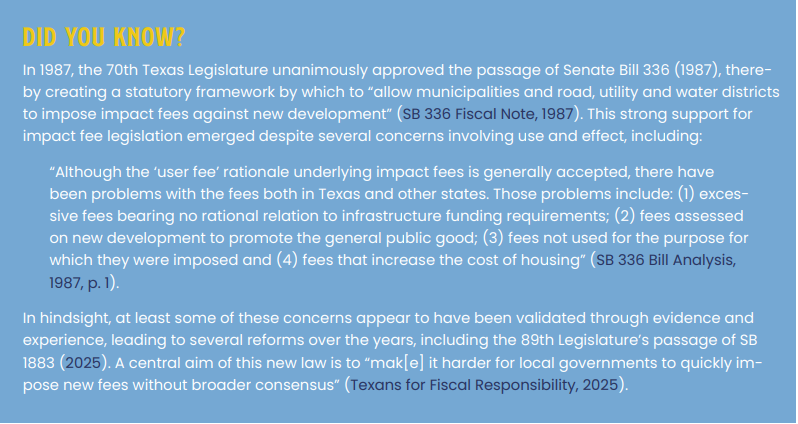
Impact fees exist as one-time fees added to new developments for the purpose of funding capital improvements and facility improvements warranted by the growth. In this way, new development shares in the cost of necessary infrastructure that accompanies it. When originally established, “Impact fees could only be levied after the municipality or district has conducted a study to determine the basis of the fee and has held public hearings on the proposed ordinance or resolution establishing the fee” (SB 336 Fiscal Note, 1987, para. 3). An updated version of these requirements still exists today, with state statute providing that:
“The law requires political subdivisions to issue public notices and hold hearings before adopting or updating impact fees. Political subdivisions must also appoint an advisory committee and prepare a capital improvement plan with land use assumptions before adopting an impact fee. Forty percent of the advisory committee must include representatives of the real estate, development, or building industries. If the political subdivision, however, has a planning and zoning commission, the commission may act as the advisory committee. A political subdivision is not limited to how frequently it may increase an impact fee” (SB 1883 Bill Analysis, 2025, para. 1).
Without impact fees, the funding mechanism required to acquire, construct, or expand infrastructure projects would likely come as general obligation (G.O.) bonds, which are “[d]ebt backed by the credit and taxing power of the issuing jurisdiction” (Bond Review Board, 2026, p. 95). The issuance of G.O. bonds generally necessitates a property tax increase on the taxpayers within the jurisdiction where the infrastructure will be constructed. The argument is that impact fees are a way to shift the financial burden off taxpayers as a whole and onto the developers. These developers typically then pass these costs to new residents or prospective buyers, who are the group responsible for creating the demand for new infrastructure. This is reinforced by Texas law, stating that impact fee “funds may be spent only for the purposes for which the impact fee was imposed as shown by the capital improvements plan and as authorized by this chapter” (Tex. Loc. Gov’t Code § 395.024(c)).
Effects on Housing Costs & Property Values
While the economics literature appears divided on the effect of imposing impact fees, it is unquestionable that these exactions put upward pressure on housing costs. In particular, these fees increase the upfront cost of developing vacant property, which is initially borne by the developer but eventually passed along to the consumer in the form of higher prices.
Impact fees are not uniform across the state; therefore, each municipality typically sets its fee amount, and these amounts vary widely depending on the jurisdiction. In 2022, the Austin Board of Realtors and the Home Builders Association of Greater Austin released a report analyzing Central Texas housing development fees. This report found that, “[a]cross the five largest metro areas, the average total housing development fees charged per unit is $10,073, with a range between $4,841 and $18,168” (Austin Board of REALTORS & Home Builders Association of Greater Austin, 2022, p. 3). Similarly, the $18,168 estimated total per-unit fee (for suburban-style single-family housing) is from the City of Austin; of this amount, $7,200 alone is the impact fee (Austin Board of REALTORS & Home Builders Association of Greater Austin, 2022, p. 2). For lots platted after 2023, this cost increased
Given the substantial costs possible, impact fees can play a significant role in determining a housing unit’s final price. For example, a $7,700 impact fee on a $750,000 newly constructed home represents approximately 1% of the total cost of that home. However, that percentage grows the lower the cost (and size and class) of homes. Following the above example, a $7,700 impact fee represents slightly more than 3% of the total cost of a newly constructed $250,000 home. Looking at this example, whenever impact fees are present, there is a cost-benefit analysis that encourages new developments to build larger, more expensive (materials and labor-wise) homes to absorb the effect of the impact fee.
Using this framework, large impact fees tend to raise the costs of building new homes, thereby restricting housing supply and driving up both new and existing home prices. Existing homeowners receive a windfall; the scarcity premium created by impact fees inflates their property value. Thus, existing homeowners likely have an incentive to push for impact fees, as they can lead to higher property values for them, at increased costs passed to buyers in new developments.
Water and Wastewater Impact Fees
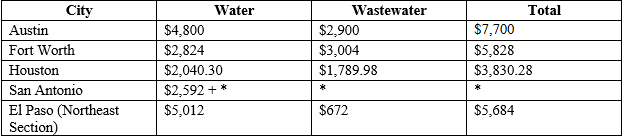
Austin’s $7,700 impact fee per unit covers all zones and is for lots platted after October 1, 2023, and can be broken down into a combination of $4,800 for water and $2,900 for wastewater (Austin Water, n.d.). In Fort Worth, the combined utility impact fee for a standard 5/8″ x 3/4″ meter is $5,828, which can be broken down as $2,824 for water and $3,004 for wastewater (City of Fort Worth, n.d.). The City of Houston impact fee for water and wastewater is $3,830.28, which can be broken down into $1,789.98 for wastewater and $2,040.30 for water (Houston Wastewater, 2025). San Antonio’s water and wastewater impact fees depend on your location within San Antonio, with a base water supply impact fee of $2,592 and water flow delivery and wastewater fees grouped by San Antonio’s geographical regions (San Antonio Water System, n.d.). El Paso, similar to San Antonio, charges different water and wastewater impact fees depending on geolocation, but for the Northeast section (primarily north of U.S. 54), a less than one-inch meter will cost $5,012 for water and $672 for wastewater, giving a total of $5,684 per unit (Raftelis, 2024, p. 7). Table 1 gives a breakdown of municipal water and wastewater impact fees.
Table 1
Breakdown of Municipal Water and Wastewater Impact Fees
*Depending on geographical region, there are different rates for water and wastewater impact fees.
Recent Legislative Reform: Senate Bill 1883
In the 2025 legislative session, policymakers passed Senate Bill 1883 (2025) to make the process of imposing impact fees more transparent and predictable for both taxpayers and the development community. The new law attempts to do so by tightening procedural rules around when and how these capital improvement plans and related fees can be adopted or changed. It also requires that information be made publicly available earlier in the process and lengthens the lead time and the structure of public hearings.
Further, SB 1883 also reshapes the role and composition of the advisory committees that review impact fees. It also aspires to increase required representation in the decision-making process from private sector actors, ensuring that affected stakeholders have a formal voice in reviewing the underlying land-use assumptions and capital plans. This is intended to check overly aggressive or poorly justified fee structures by bringing practical development and market expertise directly into the advisory process.
Further still, the new law creates additional safeguards restricting local governments’ ability to raise impact fees. One such protection requires a political subdivision to obtain an independent financial audit to verify the basis for the fee increase before raising fees. The new law also limits how often these fees can be increased (generally no more than once every three years), thereby reducing the risk of frequent, unpredictable fee hikes.
Together, these new protections seek to align infrastructure cost recovery with more rigorous oversight, regular external review, and greater stability for property owners and developers.
Recommendations
While recent legislative reforms have improved impact fees, concerns still exist that these exactions worsen housing affordability and delay the prospect of homeownership. In order to create a more hospitable environment, policymakers should consider the following reforms:
- Require that the imposition of any new impact fee or fee increase be approved by a three-fourths supermajority vote of the local governing body.
- Prohibit a political subdivision from increasing impact fees beyond a certain measure over a five-year period.
- Enact a temporary moratorium on the imposition of any new impact fees, with some narrow exceptions provided for public infrastructure projects already underway.
Conclusion
As Texas continues to experience unprecedented population growth, the demand for expanded infrastructure will only intensify. Development impact fees provide local governments with a tool to help ensure that the costs associated with growth are borne, at least in part, by the new development creating the demand for additional infrastructure. When properly structured under Chapter 395 of the Texas Local Government Code, impact fees can serve as a transparent and dedicated funding mechanism for critical capital improvements such as roads, water systems, wastewater facilities, and drainage infrastructure.
However, while impact fees can reduce reliance on existing taxpayers to fund growth-related infrastructure, they also represent a direct increase in the cost of new development and can contribute to higher housing costs, particularly for entry-level and affordable housing. Therefore, policymakers must balance the need to fund necessary infrastructure with the broader goal of maintaining housing affordability and encouraging responsible development. Ultimately, impact fees are neither inherently beneficial nor harmful; their effectiveness depends on whether they are implemented in a manner that accurately reflects the costs created by new growth while avoiding unnecessary barriers to expanding Texas’s housing supply.
References
American Planning Association. (n.d.). APA Policy Guide on Impact Fees. Retrieved July 7, 2026, from https://www.planning.org/policy/guides/adopted/impactfees.htm
Austin Board of REALTORS & Home Builders Association of Greater Austin. (2022). 2022 Central Texas housing development fees analysis. https://www.hbaaustin.com/uploads/1/3/6/8/136826201/2022_central_texas_housing_development_fees_analysis.pdf.
Austin Water. (n.d.). Rates and fees. City of Austin. Retrieved July 7, 2026, from https://www.austintexas.gov/water/rates-and-fees
Bond Review Board. (2026, January). 2025 local government annual report. https://www.brb.texas.gov/wp-content/uploads/2026/02/2025LocalARFinal.pdf
City of Fort Worth. (n.d.). Current impact fees: Water and wastewater impact fees. Retrieved July 7, 2026, from https://www.fortworthtexas.gov/impact-fees/water-impact-fees/current-fees
Evans-Cowley, J. (2008). Impact fees and exactions. In Texas Planning Guide. https://txplanningguide-ojs-utexas.tdl.org/txplanningguide/article/view/19/15
Gray, A. (2025, November 3). Driven by migration trends and suburban sprawl, Texas population expected to hit 42.6M by 2060. UT San Antonio Today. https://news.utsa.edu/2025/11/driven-by-migration-trends-and-suburban-sprawl-texas-population-expected-to-hit-42-6m-by-2060/
Houston Wastewater. (2025, July 5). City of Houston wastewater impact fee. https://houstonwastewater.com/city-of-houston-wastewater-impact-fee/
Potter, L. (2025, July 2). Texas population: Trends and characteristics. Texas Demographic Center. https://demographics.texas.gov/Resources/TDC/Presentations/88837d2e-786a-4c0a-a0d3-55fd7d54cef8/20250702_TexasWorkforceCommission.pdf
Raftelis. (2024, January 3). Water and wastewater impact fee report: El Paso Water. City of El Paso. https://www.elpasotexas.gov/assets/Documents/CoEP/Planning-and-Inspections/misc/2024_EPW_IF_Report-Draft-Final-010324.pdf
San Antonio Water System. (n.d.). Impact fees. Retrieved July 7, 2026, from https://apps.saws.org/business_center/Developer/ImpactFees/
SB 336. Enrolled. 70th Texas Legislature. Regular. (1987). https://lrl.texas.gov/LASDOCS/70R/SB336/SB336_70R.pdf#page=145
SB 336 Bill Analysis. Committee on Natural Resources. 70th Texas Legislature. Regular. (1987, May). https://lrl.texas.gov/LASDOCS/70R/SB336/SB336_70R.pdf#page=112
SB 336 Fiscal Note. Legislative Budget Board. 70th Texas Legislature. Regular. (1987, May). https://lrl.texas.gov/LASDOCS/70R/SB336/SB336_70R.pdf#page=174
SB 1883. Enrolled. 89th Texas Legislature. Regular. (2025). https://capitol.texas.gov/tlodocs/89R/billtext/pdf/SB01883F.pdf
SB 1883 Bill Analysis. Senate Research Center. 89th Texas Legislature. Regular. (2025, June). https://capitol.texas.gov/tlodocs/89R/analysis/pdf/SB01883F.pdf
Texans for Fiscal Responsibility. (2025). HB 225 (SB 1883) – Limit local impact fee hikes. https://index.texastaxpayers.com/votes/2025-house-vote-rv2920
Texas Local Government Code § 395.001 (2026). https://statutes.capitol.texas.gov/?tab=1&code=LG&chapter=LG.395&artSec=.
Texas Office of the Governor. (2026, July 8). Top Texas touts: People. Retrieved July 29, 2026, from https://gov.texas.gov/es/top-texas-touts-people
U.S. Census Bureau. (2026, January 27). U.S. population growth slows due to historic decline in net international migration [Press release]. https://www.census.gov/newsroom/press-releases/2026/population-growth-slows.html