Rogue prosecutors refuse to enforce laws, undermining accountability and public trust. Texas lawmakers must act to ensure consistent enforcement of laws, strengthen oversight, and restore faith in the justice system.
Key Points
- Rogue prosecutors are undermining laws throughout the nation, issuing official memos or informal orders to not prosecute certain types or classes of crimes.
- Going against the national trend, many cities with rogue prosecutors have experienced rising crime rates in certain categories of offenses.
- Many states have taken different measures to address the rogue prosecutor problem with differing outcomes.
Executive Summary
Despite decades of bipartisan criminal justice reform and declining national crime rates, several U.S. cities have experienced increases in crime under the leadership of rogue prosecutors who abuse their discretion by refusing to enforce laws they disagree with and instead pursue lenient charges against violent criminals. These district and county attorneys implement formal or informal non-prosecution policies that violate their sworn duties, undermine the rule of law, and erode public trust in the justice system. Data from the FBI indicates that during the tenure of these prosecutors, occurrences of several major crimes, such as murder and aggravated assault, rose. The crime rates in cities like Austin, Philadelphia, and Minneapolis illustrate correlations between the implementation of reformist prosecutorial policies and some rises in violent and property crime (FBI, n.d.). States, like Texas, have responded by enacting laws to enable the public to remove such officials.
Rogue prosecutors continue to refuse to enforce certain laws for political purposes, despite previous legislative attempts to address the issue. This paper evaluates several innovative policy solutions to address the issue in Texas, including the creation of a Statewide District Attorney’s Office, led by a Chief State Prosecutor; the establishment of an oversight commission; the formation of regional judicial districts; and the expansion of the Attorney General’s prosecutorial authority. These solutions may also be replicated in other states. Texas must adopt a strengthened, statewide framework to ensure uniform enforcement of state law, preserve public safety, and restore confidence in our criminal justice system.
Introduction
Decades after the implementation of bipartisan criminal justice reform policies that focus on evidence-based, cost-effective solutions, national crime rates have declined dramatically since their peak in the 1990s (Lopez, 2026). Crimes ranging from homicide to petty theft are down in most major cities (Lopez, 2026). The keyword here is most. There are cities throughout our nation that have elected officials who refuse to enforce legitimate federal, state, or even local laws (Stimson, 2023). These officials are commonly referred to as “rogue prosecutors.” Often coinciding with the election of these officials are rises in crime, against national trends.
Rogue prosecutors are elected district and county attorneys who implement blanket policies (either formally through a memo or informally through unwritten, office-wide “policies”) that defy laws, thereby violating their sworn oath of office to preserve public safety and, as a result, compromising the rule of law (Altman, n.d.). Many states have enacted laws to combat rogue prosecutors, including processes for removal and providing strict interpretations of official misconduct for which these officials can be ousted. In Texas, for example, official misconduct is defined as “intentional, unlawful behavior relating to official duties by an officer entrusted with the administration of justice or the execution of the law” (Texas Local Government Code Sec. 87.011). The statute goes on to clarify that this can include “failure, refusal or neglect” to follow the law, including issuing and enforcing policies of refusal to prosecute certain classes or types of criminal offenses (Texas Local Government Code Sec. 87.011).
According to the Bureau of Justice Statistics’ National Crime Victimization survey in 2024, 68% of property crime victims did not even report their crimes to law enforcement (BJS, 2024). Forty-one percent of property crime victims and 23.3% of violent crime victims cited that they did not report their crime to law enforcement because they did not believe that the police could or would do anything (BJS, 2024).
When local prosecutors are not enforcing laws passed by our elected state officials, public safety is jeopardized, the rule of law is undermined, and public faith in our institutions is eroded. Research has shown that when prosecutors have higher conviction rates, mortality rates decline (Bencsik & Giles, 2026). Although there have been valiant attempts to address this issue nationwide, states across the country, including Texas, still have elected officials who are derelict in their duties to enforce the law and, thus, deny justice to victims. The Texas Legislature should enact a statewide framework to address failures to prosecute serious crimes and improve public safety. This paper will explore a variety of policy solutions that can be enacted alone or jointly to address the rogue prosecutor problem plaguing localities.
Rogue Prosecutors Defy State Laws in Major U.S. Cities
While many district and county attorneys who refuse to prosecute certain crimes never make news headlines, there are several that regularly capture the public’s attention. Rogue prosecutors are not confined to red or blue states but tend to be elected in progressive-minded cities like Austin, Texas, and Minneapolis, Minnesota. Most of these officials were elected in the late 2010s and early 2020s. Some have retained their office and have won re-election, while others have been successfully removed from their posts by an outraged public or governor.
Figure 1
Major U.S. Cities with Rogue Prosecutors
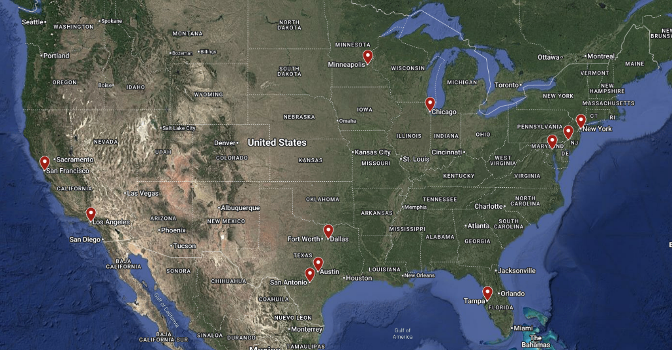
Note: Image from Stimson, 2023
Nationally Prominent Rogue Prosecutors
In 2014, Marilyn Mosby, a self-proclaimed “reformist” prosecutor, was elected as the State Attorney from Baltimore, Maryland. Shortly after taking office, major violent crimes, including murder, rape, aggravated assault, and robbery, surged (Stimson & Smith, 2020). In 2021, Mosby announced that her office would no longer prosecute drug possession, prostitution, trespassing, certain traffic violations, and other minor offense cases—in direct violation of state law (Jackman, 2021). Crime rose steeply again, with increases in homicide, aggravated assault, and robbery (Council on Criminal Justice, 2025). This followed a decrease in crime experienced during the Covid-19 pandemic when Mosby announced her non-prosecution policies (Council on Criminal Justice, 2025). In 2022, Mosby was indicted on perjury and fraud charges and subsequently lost her re-election campaign (Witte, 2022). Crime rates have significantly declined since she left office in 2023, with her successor reversing many of her non-prosecution policies (Council on Criminal Justice, 2025; Mann, 2023).
In 2016, voters in Cook County, Illinois, (home of Chicago), elected prosecutor Kim Foxx. Upon taking office, she instituted radical bail-reform policies that included dropping hundreds of bail violation cases (Richards & Jackson, 2020). Between 2016 and 2019, the state attorney’s office dropped nearly 30% of charges against felony defendants—a 50% increase from her predecessor (Richards & Jackson, 2020). In that same time frame, the rates for several categories of violent crimes rose in Chicago (Smith & Stimson, 2020). Although re-elected in 2020, Foxx chose not to run for re-election in 2024 amid widespread criticism for soft-on-crime policies and for her role in fumbling the widely publicized Jussie Smollett case (Jordan & Wall, 2023). Today, she is widely regarded as one of the first rogue prosecutors and an influential one at that, setting the stage for future radical district attorneys (Smith & Stimson, 2020).
In 2017, Philadelphians elected Larry Krasner, a radical district attorney who implemented office-wide policies that included declining charges for certain crimes such as prostitution, marijuana possession, and other drug charges (Philadelphia District Attorney Office, 2018). He also demanded that no bail be set in retail theft cases and ordered prosecutors to seek diversion whenever possible in cases involving firearms and intoxicated driving (Philadelphia District Attorney Office, 2018). After Krasner took office, Philadelphia residents experienced a rise in non-fatal shootings, aggravated assaults, retail thefts, auto thefts, and homicides (Stimson, 2024). Krasner quickly garnered local and statewide criticism that resulted in an impeachment by the Pennsylvania House of Representatives in 2022. The charges against him were improper use of prosecutorial discretion and the implementation of ineffective crime-combatting policies, leading to public safety concerns for the City of Philadelphia. The articles of impeachment specifically cited rises in violent crime under Krasner’s leadership (Pennsylvania House Republican Caucus, 2022). Although impeached, the disgraced district attorney was not removed from office due to a technicality (AP News, 2024). The Supreme Court of Pennsylvania ruled in 2024 that the state constitution does not allow the House and Senate in subsequent sessions to act on matters that were begun in prior session (AP News, 2024). Despite widespread criticism and condemnation of his policies, Krasner was re-elected in 2025 (MacDonald & Rinde, 2025).
In 2020, voters in Los Angeles County, California, elected George Gascon, a rogue prosecutor who previously served as the district attorney for San Francisco County. Upon taking office, Gascon implemented radical, sweeping policy changes in the country’s largest local government prosecutorial office. Under his leadership, the Los Angeles County district attorney’s office no longer sought cash bail for “misdemeanor, non-serious, or nonviolent” crimes and promised to no longer seek capital punishment for any offense (Munoz & Cota-Robles, 2020). Gascon also promised to resentence all inmates currently housed on death row to life in prison sentences (Munoz & Cota-Robles, 2020). Crimes that Gascon’s office announced he no longer intended to prosecute included trespassing, disturbing the peace, driving without a license, making criminal threats, drug possession, public intoxication, loitering to commit prostitution, and resisting arrest (ABC7, 2020). Los Angeles law enforcement quickly objected to these blanket policies of non-prosecution, insisting that they would “further victimize Los Angeles residents, especially Black and Hispanic residents who currently make up 70% of violent crime victims” (Munoz & Cota-Robles, 2020). Los Angeles County has since elected a new district attorney.
San Francisco, California, swapped one reformist district attorney for another in 2020. Chesa Boudin ran on a reformist platform, promising to reduce mass incarceration, establish a more equitable justice system, and vowing to not prosecute “quality of life” crimes (Harvard Law Review, 2023). Under the leadership of Boudin, prosecutors sought out shorter carceral sentences and more diversion programs. This came as San Franscisco experienced increases in theft, organized crime, and racially motivated crimes (Harvard Law Review, 2023). Outraged voters in San Francisco felt that his policies were too lenient and created a safe haven for criminals. As a result, just one and a half years into his role, Boudin faced a citizen-initiated recall election that proved successful. He was removed officially in 2022 (Harvard Law Review, 2023). The mayor of San Francisco also faced criticism for the rise in crime. He was not recalled, but lost reelection in 2024 (Harvard Law Review, 2023).
In 2022, nearly two years after the killing of George Floyd in Minneapolis, Hennepin County voters elected radical progressive Mary Moriarty (Ibrahim, 2022). Since taking office, Moriarty has received widespread criticism for her emphasis on pursuing lenient charges and plea deals for violent offenders, which she views as focusing criminal justice reform policy on rehabilitation rather than punishment (Hyatt, 2023). Additionally, Moriarty has sought harsh charges against law enforcement officers in use-of-force cases (Manix, 2024). Under her leadership, Hennepin County began to consider race as a factor in plea deal negotiations (Rantala, 2025). As of 2026, Moriarty still holds office but will not run for reelection (Ryan & Brown, 2025).
Other Examples
From 2017 to 2025, Andrew Warren, the State Attorney from Hillsborough County, Florida, issued policies in his office to not prosecute cases that he did not personally or morally agree with, such as state laws related to abortion and gender-affirming care for minors (Executive Office of the Governor of Florida, 2022). Warren also allegedly pursued lesser charges for defendants convicted of first-time offenses (Executive Office of the Governor of Florida, 2022). As a result of his direct disregard for state laws, the Governor of Florida suspended him in 2022 (Executive Office of the Governor of Florida, 2022). The Supreme Court upheld this suspension in 2024, and a new state attorney took office in 2025 (Eisen & Subramanian, 2024).
In 2022, Manhattan elected district attorney Alvin Bragg, who ran on a reformist platform. He issued a memo upon taking office instituting a policy of non-prosecution for marijuana, prostitution, and fare evasion offenses (CBS, 2022). Additionally, Bragg encouraged staff to pursue lesser charges for less serious drug offenses, burglary offenses, and store robberies where a weapon is present but presents no “genuine risk of physical harm” (CBS, 2022). As of 2026, Bragg remains in office.
Texas Rogue Prosecutors
In 2020, Travis County (which includes Austin) voters elected progressive district attorney, Jose Garza. Garza vowed on the campaign trail, even before taking office, to not prosecute several offenses in direct disobedience of the state legislature and to prosecute law enforcement officers harshly (Sanders, 2024). He has set a precedent within his office of not prosecuting abortion or drug possession offenses (Sanders, 2024). He has pursued aggressive charges against police officers and has fumbled high profile homicide cases, releasing dangerous offenders back onto the streets of Austin and denying many victims due justice (Hogan, 2025). The Austin Police Association has accused him of “emboldening criminals” (Freeman, 2024). Although he has faced multiple removal efforts under the Texas Legislature’s Rogue Prosecutor law, he has yet to be successfully removed (Fogel, 2024). This is largely because no official memo or other document specifically detailing policies of non-prosecution has been distributed to attorneys in the office. Texas’s Rogue Prosecutor law only prohibits blanket, official non-prosecution policies (HB 17, 2023). Garza won re-election in 2024, despite law enforcement and sizable public opposition (Freeman, 2024).
Although Austin, Texas, might have the most infamous rogue prosecutor, other major cities in the state have district attorneys who have run on progressive, reformist platforms and have unofficial non-prosecution or leniency policies. San Antonio District Attorney, Joe Gonzales, first elected in 2018, has been accused of having soft on crime prosecution policies (Marfin, 2019). For example, in 2019, he gave local law enforcement officers the option to issue tickets for certain drug, theft, and traffic misdemeanors in lieu of jail time (Marfin, 2019). In Dallas, Texas, the district attorney, John Creuzot, announced that he would no longer pursue charges against low-level, first time drug offenders (Marfin, 2019). While prosecutor and officer discretion are important and cases should be evaluated individually, all public servants must follow the law and not implement contradictory blanket policies. All of the aforementioned Texas district attorneys in three of the state’s largest cities have received substantial funding from radical, progressive billionaires via the Texas Justice and Public Safety PAC (Schoffstall, 2022).
In 2026, Travis County District Attorney Jose Garza, along with nine other progressive district attorneys (including Philadelphia District Attorney Larry Krasner, Minneapolis District Attorney Mary Moriarty, and Dallas District Attorney John Creuzot) launched an organization called the Project for the Fight Against Federal Overreach (aka FAFO), with the primary purpose of prosecuting federal law enforcement officials accused of misconduct in their respective jurisdictions (Dewan, 2026). This group was created in response to the killings by federal agents in recent months in Minneapolis and aligns with the rogue prosecutors movement’s prioritization of pursuing harsh penalties against law enforcement officers accused of misconduct (Dewan, 2026).
An Analysis of Crime Rates in Cities with Rogue Prosecutors
The rise of rogue prosecutors and their reformist policies began in the mid- to late 2010s. To examine what crime in those cities looked like before and after these district and county attorneys took office, the FBI’s crime data portal provides some insight. Looking into nine major cities, it is evident that some serious, violent crimes, as well as major property crimes, have risen during the tenure of some of these prosecutors. Tables of crime rates, derived from official FBI data, for Austin, Baltimore, Chicago, Dallas, Los Angeles, Minneapolis, Philadelphia, San Antonio, and San Francisco from 2016 to 2024 are in the appendix. Although it would be spurious to say the election of these attorneys caused a rise in crime, it would be unwise to forgo a scrutinous examination of the correlation.
The most notable rises in crime from 2016 to 2024 occurred in Philadelphia, Minneapolis, Chicago, and Baltimore. In Philadelphia, Pennsylvania, the aggravated assault, arson, larceny theft, and motor vehicle theft rates climbed dramatically from 2016 to 2024 (FBI, n.d.). The Philadelphia rogue prosecutor, Krasner, was elected in 2017. During his time in office, the aggravated assault rate rose almost 20% (FBI, n.d.). The overall major property crime rate rose by over 43%, and larceny-theft climbed by over 35% (FBI, n.d.). Motor vehicle theft in the city nearly tripled (FBI, n.d.). From 2016 to 2024, Minneapolis experienced an 112% rise in homicide (FBI, n.d.). Violent crime and property crime have both risen in the city during that same period, with climbs in aggravated assault, arson, larceny-theft, and motor vehicle theft (FBI, n.d.). Minneapolis’s current rogue prosecutor, Mary Moriarity, took office in 2022. In Chicago, property crime rate rose about 5% from 2016 to 2024, the exact period that the reformist prosecutor, Kim Foxx, held office (FBI, n.d.). The highest rise was in motor vehicle theft rate, which nearly doubled in Chicago (FBI, n.d.). Baltimore also experienced a large increase in motor vehicle theft during the same time that reformist prosecutor, Marilyn Mosby, held office (FBI, n.d.).
Focusing on Texas, the city of Austin has experienced the most dramatic surges in violent and property crimes. Between 2016 and 2024, Austin saw its homicide rate climb by over 60% (see Figure 2) (FBI, n.d.). The aggravated assault rate in the city rose over 40% (see Figure 3), and arson and motor vehicle theft (see Figure 4) have nearly doubled in the same time frame (FBI, n.d.). Meanwhile, San Antonio saw a doubling in its motor vehicle theft rate and a short-lived rise in its homicide rate, which has since subsided (FBI, n.d.). Dallas experienced a nearly 28% jump in aggravated assaults and a near doubling of its motor vehicle theft rate (FBI, n.d.). Statewide, Texas has seen a rise in motor vehicle theft, but most other crimes have had a notable decline in the same period, albeit a temporary crime rise in 2022 that was experienced nationally (FBI, n.d.). The correlation of the election of rogue prosecutors in the Lone Star State and rises in crime that are comparable to America’s most dangerous cities cannot be disregarded.
Figure 2
Austin vs. National Homicide Rates (2016-2024)
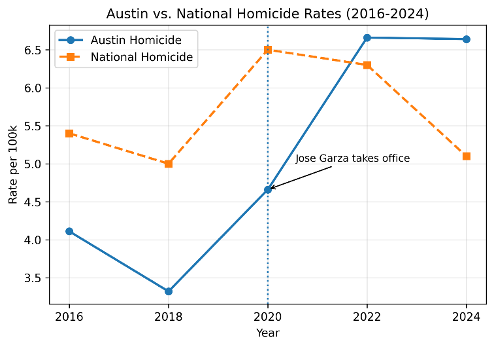
Note: Data from FBI, n.d.
Figure 3
Austin vs. National Aggravated Assault Rates (2016-2024)
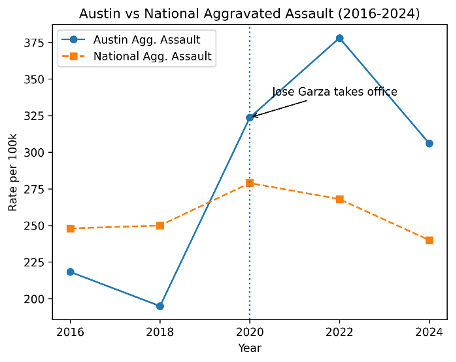
Note: Data from FBI, n.d.
Figure 4
Austin vs. National Motor Vehicle Theft Rates (2016-2024)
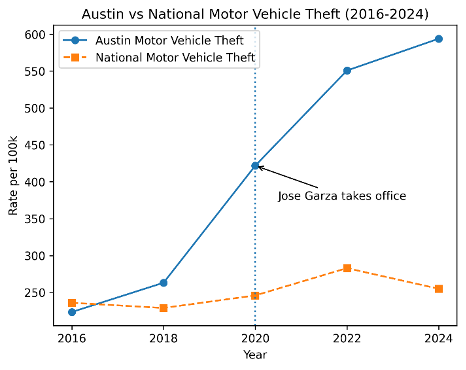
Note: Data from FBI, n.d.
Existing State Rogue Prosecutor Removal Processes
Even before the rogue prosecutor movement crept its way through the nation, many states had statutes to safeguard citizens from corrupt public officials. Twenty-nine states (seen in green in Figure 5 below) allow for citizen-initiated removal of rogue prosecutors (AFPI, 2024).
Figure 5
States with Citizen Recall of Rogue Prosecutors
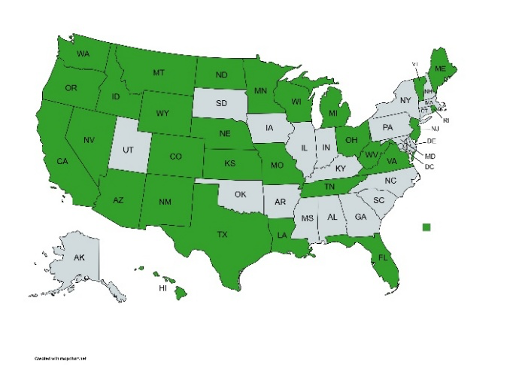
Note: Data from AFPI, 2024.
The ability to recall prosecutors is clearly not a red state or blue state policy. States from across the ideological spectrum allow for citizen recall. Some states also allow the governor or state legislature to remove prosecutors, which has been utilized. As discussed above, Florida Governor DeSantis was able to remove Andrew Warren, the state attorney from Hillsborough County, for his reform pledges to not prosecute certain crimes, in direct violation of state law (Executive Office of the Governor of Florida, 2022). The removal was later upheld by the Florida Supreme Court (Eisen & Subramanian, 2024).
Around the same time that the country saw the election of rogue prosecutors, many state legislatures responded by passing laws to protect citizens from rogue district attorneys who refused to fulfill their official duties and who abused their prosecutorial discretion.
In 2019, Pennsylvania lawmakers passed a bill to expand the prosecutorial powers of the attorney general to include certain offenses, including firearms-related offenses (HB 1614, 2019). This was enacted as a direct result of the election of the Philadelphia district attorney, Larry Krasner, who ran on a progressive platform that included the harsh prosecution of firearm offenses, as well as the non-prosecution of several offenses including prostitution and drug offenses (Camacho et al., 2023).
In 2021, the Tennessee Legislature enacted a bill that triggers alternative prosecution arrangements when a local prosecutor institutes a policy that blanketly prohibits the prosecution of certain offenses (HB 9071, 2021). The law allows the state attorney general to petition a state court to appoint a special prosecutor to enforce the law, ensuring victims that justice is served regardless (Camacho et al., 2023).
In 2021, Iowa legislators enacted a law prohibiting local entities from adopting policies prohibiting or discouraging the enforcement of federal, state, or local laws (SF 342, 2021). The law was written intentionally broadly to encompass written policies as well as informal ones, such as internal guidance provided to litigation staff for district attorney offices (Camacho et al., 2023). This legislation also allows for the Iowa Attorney General to file a civil suit against an office in violation of the law, and allows the withholding of state funds until the office is back in compliance with the law (Camacho et al., 2023).
In 2022, Utah passed a law prohibiting prosecutors from filing misdemeanor offense charges if felony ones are available in an attempt to undermine lenient prosecution by radical prosecutors (HB 257, 2022).
The State of Texas responded to the rise of rogue prosecutors by enacting legislation that redefined prosecutorial misconduct (HB 17, 2023). The bill expanded the meaning of misconduct for which an elected district attorney may be subject to removal. The law now allows any person with established residency in a county for at least six months to petition for a district attorney’s removal for incompetency or official misconduct, defined broadly. Since its passage, charges have been filed against Travis County District Attorney Jose Garza, but he has not been removed (Fogel, 2024). Garza has likely succeeded in evading removal because the 2023 legislation only deems written non-prosecution policies to be misconduct; Garza’s office uses informal, internal guidance to choose not to pursue certain crimes or pursue lesser charges (Fogel, 2024).
An Exploration of Courses of Action for Texas
Despite the enactment of HB 17 in 2023, rogue prosecutors throughout the State of Texas still refuse to enforce legitimate state laws, consequently endangering public safety and depriving crime victims of due justice. Policymakers and advocacy groups have floated several different solutions to this issue. One solution is to create a statewide prosecutor. Another option involves creating a commission to oversee the affairs of district attorneys and have the power to remove rogue actors. This power could also be delegated to an existing commission. Other viable alternatives include expanding the prosecutorial powers of the Attorney General of Texas or creating regional judicial districts with elected judges and prosecutors who would have original jurisdiction over cases involving major crimes.
Chief State Prosecutor
A Chief State Prosecutor would serve as a statewide district attorney, created by the legislature, and would have the power to take major crime cases from any other district or county attorney’s office in the state. Major crimes are serious felony offenses such as those listed in [1]
Article 5, Section 21 of the Texas Constitution authorizes the Texas Legislature to create district attorney offices at their discretion. This would not create a statewide office that necessitates an election and would be appointed by the state’s governor and confirmed by the Texas Senate. Article 5, Section 21 specifies that the Texas Legislature may allow for the election of district attorney but does not explicitly require an election.
The office of the Chief State Prosecutor would have the power to prosecute cases that local jurisdictions refuse and high-profile cases that take up a lot of manpower, especially in rural counties. This could dramatically benefit rural counties, thereby reducing departmental caseloads and giving them the ability to focus their resources elsewhere.
Creating the Chief State Prosecutor position offers many benefits. The Texas Attorney General does not currently possess the power to prosecute criminal cases that have been neglected by city officials (The State of Texas vs. Stephens, 2022). A new office with broad prosecutorial authority would need to be created, barring granting the attorney general this power. Giving this power to the attorney general would be met with legislative hurdles, such as passing a constitutional amendment with bipartisan, bicameral support in the state legislature.
This solution also solves the problem of uniformity in prosecution and enforcement of state law throughout all 254 counties. Texans’ access to justice should not be dependent on where they reside in the state. All victims deserve to have their case thoroughly reviewed regardless of whether they live in a big, blue city or a small, red town. There should be uniformity among local jurisdictions in the enforcement of state law.
Lastly, the process of removing a district attorney from office is lengthy, and during that time, countless cases could be left unresolved. With a Chief State Prosecutor, the office could take up cases with original jurisdiction and without having to petition for removal and go through all sorts of legal proceedings for crime victims to receive the justice they deserve.
The creation of this office may generate some criticism, such as centralizing power (i.e., prosecutorial authority) that was intentionally decentralized to promote local authority and freedom from a powerful state government. Critics may also argue that the 2023 rogue prosecutor bill already addressed this issue, and if changes are needed, those should be made to the existing law. Lastly, a chief prosecutor may also be viewed as a new level of government, going against the typical conservative mantra of smaller government and personal liberty.
Oversight Commission
The State of Texas established a Prosecuting Attorneys Coordinating Council in 1977 with the purpose of providing legal education, professional development, and technical training to local district attorney offices. It was dissolved in 1985 due to redundancy in training and lack of funding. In 2023, lawmakers introduced HB 200 to resurrect the Council with the purpose of disciplining attorneys (HB 200, 2023). This was seen as an alternative to the rogue prosecutor bill, HB 17, that eventually passed. The State of Texas could choose to resurrect this council with the purpose of creating a mechanism by which to discipline rogue district attorneys.
Alternatively, the Legislature could give the power to discipline these rogue prosecutors to an existing commission, such as the Commission on Judicial Conduct. This would likely require statutory changes and potentially a constitutional amendment if the state granted the commission the power to remove district attorneys found to be incompetent or engaged in misconduct.
Regional Districts
Similar to the Chief State Prosecutor proposal, the Texas Legislature could opt to create regional district attorney offices under Article 5, Section 21 of the Texas Constitution. In the 89th Texas Legislature, lawmakers proposed a bill that created five regional judicial districts divided among the five largest cities in the state and surrounding rural areas (SB 2384, 2023). Each of these districts would have its own prosecutors and judges.
Creating regional districts has several benefits. It may or may not require a constitutional amendment based on the interpretation of Article 5. Additionally, this would give rural counties with corrupt district attorneys other avenues for justice and alleviate the burden on local county and district attorney offices overwhelmed with cases.
This option, however, does come with some cons worth considering. There might be some pushback against creating another level of government, especially from limited-government conservatives. Additionally, this would be a more expensive option than creating a single statewide attorney, and it would require more funding from the state. If these positions were elected—which the public would probably demand—the same dark money that is behind the election of the rogue prosecutors in our cities now could infect those regional district offices as well. Additionally, this does not solve the issue of uniformity in prosecution like a statewide district attorney would. There would still be the potential for uneven enforcement and prosecution if rogue prosecutors and judges were elected to these regional positions.
Expand Prosecutorial Powers of the Attorney General
Since the Texas Court of Criminal Appeals ruling in 2022, the Attorney General of Texas has been unable to prosecute most criminal cases (The State of Texas v. Stephens, 2022). Texas could pursue expanding the prosecutorial powers of the attorney general; however, this would require a constitutional amendment and the support of members of both parties in the state legislature. This would be an incredibly difficult hurdle to overcome, given the often-partisan nature of the office.
Conclusion
Rogue prosecutors undermine the rule of law, endanger the public, and deprive victims of crime due justice. There must be a mechanism by which those in power who choose not to enforce the law can be held accountable. This will restore confidence in our justice system and our republic. Several viable solutions exist to address this issue in Texas, whether that means creating a new position of the Chief State Prosecutor, expanding the current prosecutorial powers of the attorney general, creating a new oversight commission, or establishing new regional district attorney offices that can seek justice when local officials fail to answer the call. It may also be valuable to jointly enact several of these solutions to maximize effectiveness.
References
ABC 7 Staff. (2020). New DA Gascon to decline prosecution on range of low level crimes. ABC 7 News. https://abc7.com/post/george-gascon-los-angeles-district-attorney-lada-misdemeanor-crimes/8674095/
America First Policy Institute. (2024). Rogue Prosecutor Removal Processes in the States. https://www.americafirstpolicy.com/issues/rogue-prosecutor-removal-processes-in-the-states
Altman, K. (n.d.). Prosecutorial Reform. Right on Crime. Retrieved April 20, 2026, from https://rightoncrime.com/prosecutorial-reform/
AP News. (2024). Philadelphia’s district attorney scores legal win against GOP impeachment bid. https://apnews.com/article/larry-krasner-philadelphia-district-attorney-impeachment-6b38e18792357afe0538ea7f8724cf3a
Bencsik, P., & Giles, T. (2026). Local Prosecutors and Public Health. https://drive.google.com/file/d/1aEfIlS943SwbDytdghTdFeWc49dws7yw/view
Bureau of Justice Statistics. (2024). National Crime Victimization Survey. https://ncvs.bjs.ojp.gov/quick-graphics#quickgraphicstop
Camacho, J., Goldrosen, N., Su, R., & Roy, M. (2023). Preempting Progress: States Take Aim at Local Prosecutors. Local Solutions Support Center. https://static1.squarespace.com/static/592c8640c534a5adf895986b/t/63dad362de56d35595d2271d/1675285357150/ProsecutorialDiscretion2023.pdf
CBS New York. (2022). Manhattan DA Alvin Bragg Says His Office Won’t Prosecute Fare Evasion, Resisting Arrest, Prostitution And More Without Accompanying Felony Charge. https://www.cbsnews.com/newyork/news/manhattan-da-alvin-bragg-low-level-offenses/
Council on Criminal Justice. (2025). Crime in Baltimore: What You Need to Know. https://counciloncj.org/crime-in-baltimore-what-you-need-to-know/
Jordan, K., & Wall, C. (2023). Kim Foxx won’t seek reelection as Cook County State’s Attorney. ABC 7 Chicago. https://abc7chicago.com/post/kim-foxx-chicago-da-cook-county-states-attorney/13181281/
Dewan, S. (2026). Local Prosecutors Join Forces to Bring Charges Against Federal Agents. The New York Times. https://www.nytimes.com/2026/01/27/us/prosecutors-charges-against-federal-agents.html
Eisen, L., & Subramanian, R. (2024). Florida Supreme Court Allows DeSantis to Undermine Prosecutorial Independence. State Court Report.https://statecourtreport.org/our-work/analysis-opinion/florida-supreme-court-allows-desantis-undermine-prosecutorial
Executive Office of the Governor of Florida. (2022). Governor Ron DeSantis Suspends State Attorney Andrew Warren for Refusing to Enforce Florida Law. https://www.flgov.com/eog/news/press/2022/governor-ron-desantis-suspends-state-attorney-andrew-warren-refusing-enforce
Federal Bureau of Investigation. (n.d.). FBI Crime Data Explorer. Retrieved April 20, 2026, from https://cde.ucr.cjis.gov/LATEST/webapp/#/pages/explorer/crime/crime-trend
Fogel, B. (2024). Travis County district attorney faces removal attempt under Texas’ “rogue” prosecutors law. The Texas Tribune. https://www.texastribune.org/2024/04/20/texas-rogue-prosecutors-law-jose-garza-removal-attempt/
Freeman, A. (2024). Travis County DA Jose Garza wins re-election by wide margin, vows to continue reforms. CBS Austin. https://cbsaustin.com/news/local/betts-vows-a-tough-on-crime-stance-in-travis-county-bid-against-garza-for-da
Harvard Law Review. (2023). San Francisco District Attorney Chesa Boudin Recalled. https://harvardlawreview.org/print/vol-136/san-francisco-district-attorney-chesa-boudin-recalled/
HB 1614. Amended. 2019 Pennsylvania General Assembly. Regular. 2019. https://legiscan.com/PA/bill/HB1614/2019
HB 257. Enrolled. 2022 Utah General Session. Regular. 2022. https://le.utah.gov/~2022/bills/hbillenr/HB0257.pdf
HB 9071. Chaptered. 112th Tennessee General Assembly. Third Extraordinary Session. 2021. https://legiscan.com/TN/text/HB9071/2021
HB 17. Enrolled. 88th Texas Legislature. Regular. 2023. https://capitol.texas.gov/tlodocs/88R/billtext/pdf/HB00017F.pdf
HB 200. Introduced. 88th Texas Legislature. Regular. 2023. https://capitol.texas.gov/tlodocs/88R/billtext/pdf/HB00200I.pdf
Hogan, T. (2025). Austin’s Progressive Prosecutor Who Won’t Prosecute. City Journal. https://www.city-journal.org/article/austin-texas-district-attorney-jose-garza-progressive-ideology
Hyatt, K. (2023). Families of victims outraged over last-minute plea deals by Hennepin County Attorney. The Minnesota Star Tribune. https://www.startribune.com/hennepin-county-attorney-mary-moriarty-families-victims-plea-deals/600308775
Ibrahim, M. (2022). How Moriarty won the race for Hennepin County Attorney. MinnPost. https://www.minnpost.com/elections/2022/11/how-moriarty-won-the-race-for-hennepin-county-attorney/
Jackman, T. (2021). After crime plummeted in 2020, Baltimore will stop drug, prostitution prosecutions. The Philadelphia Tribune. https://www.phillytrib.com/news/after-crime-plummeted-in-2020-baltimore-will-stop-drug-prostitution-prosecutions/article_62f6764f-76bf-52f2-a5ab-528cd71e8aa5.html
Jordan, K., & Wall, C. (2023). Kim Foxx won’t seek reelection as Cook County State’s Attorney. ABC 7 Chicago. https://abc7chicago.com/post/kim-foxx-chicago-da-cook-county-states-attorney/13181281/
Lopez, E. (2026). Crime Trends in U.S. Cities Year-End 2025 Update. Council on Criminal Justice. https://counciloncj.org/crime-trends-in-u-s-cities-year-end-2025-update/
MacDonald, T., & Rinde, M. (2025). Philadelphia District Attorney Larry Krasner wins reelection. The Philadelphia Tribune.https://www.phillytrib.com/news/after-crime-plummeted-in-2020-baltimore-will-stop-drug-prostitution-prosecutions/article_62f6764f-76bf-52f2-a5ab-528cd71e8aa5.html
Manix, A. (2024). Hennepin County Attorney Mary Moriarty drops murder charges against state trooper in shooting of Ricky Cobb II. The Minnesota Star Tribune. https://www.startribune.com/hennepin-county-attorney-mary-moriarty-will-drop-murder-charges-against-state-trooper-in-shooting/600370487
Mann, A. (2023). Ivan Bates sworn in as Baltimore state’s attorney, immediately reinstates prosecution of low-level offenses. The Baltimore Sun. https://www.baltimoresun.com/2023/01/03/ivan-bates-sworn-in-as-baltimore-states-attorney-immediately-reinstates-prosecution-of-low-level-offenses/
Marfin, A. (2019). Texas prosecutors want to keep low-level criminals out of overcrowded jails. Top Republicans and police aren’t happy. The Texas Tribune. https://www.texastribune.org/2019/05/21/dallas-district-attorney-john-cruezot-not-prosecuting-minor-crimes/
Munoz, A., & Cota-Robles, M. (2020). New Los Angeles DA George Gascon to eliminate cash bail, won’t seek death penalty. ABC 7. https://abc7.com/post/george-gascon-lada-los-angeles-county-district-attorney-cash-bail/8592215/?userab=abc_web_player-460*variant_a_abc_control-1900%2Cotv_web_player-461*variant_a_otv_control-1902
PA House GOP. (2022). House Votes to Impeach Philadelphia DA Larry Krasner. Pennsylvania House Republican Caucus. https://www.pahousegop.com/phillycrime
Philadelphia District Attorney’s Office. (2018). Philadelphia DAO New Policies. https://phillyda.org/wp-content/uploads/2022/04/DAO-New-Policies-2.15.2018-UPDATED.pdf
Rantala, J. (2025). Hennepin County Attorney’s Office to consider race in plea deals. CBS News. https://www.cbsnews.com/minnesota/news/hennepin-county-attorneys-office-race-plea-deals/
Richards, A., & Jackson, D. (2020). Kim Foxx drops more felony cases as Cook County States Attorney than her predecessor. Chicago Tribune. https://www.chicagotribune.com/2020/08/10/kim-foxx-drops-more-felony-cases-as-cook-county-states-attorney-than-her-predecessor-tribune-analysis-shows/
Ryan, L., & Brown, G. (2025). Hennepin County Attorney Mary Moriarty won’t run for a second term. MPR News. https://www.mprnews.org/story/2025/08/07/mary-moriarty-wont-run-again-for-hennepin-county-attorney
Sanders, L. (2024). Will D.A. Garza Be Removed From Office Over Handling of Drug Cases, Nonexistent Abortion Crimes? The Austin Chronicle. https://www.austinchronicle.com/news/will-da-garza-be-removed-from-office-over-handling-of-drug-cases-nonexistent-abortion-crimes-12945788/
Schoffstall, J. (2022). Soros spends big in last-minute attempt to rescue far-left Texas district attorneys. Fox News. https://www.foxnews.com/politics/george-soros-spends-big-last-minute-attempt-rescue-far-left-texas-district-attorneys
SF 342. Enrolled. 89th General Assembly. Regular Session. 2021. https://legiscan.com/IA/text/SF342/id/2403581
Smith, R., & Stimson, C. (2020). Meet Kim Foxx, the Rogue Prosecutor Whose Policies are Wreaking Havoc in Chicago. The Heritage Foundation. https://www.heritage.org/crime-and-justice/commentary/meet-kim-foxx-the-rogue-prosecutor-whose-policies-are-wreaking-havoc
Stimson, C. (2023). The Soros Rogue Prosecutor Movement and the Insurance Industry. The Heritage Foundation. https://www.heritage.org/crime-and-justice/lecture/the-soros-rogue-prosecutor-movement-and-the-insurance-industry
Stimson, C. (2024). Rogue Prosecutors and the Rise of Crime. The Heritage Foundation. https://imprimis.hillsdale.edu/rogue-prosecutors-and-the-rise-of-crime/
Stimson, C., & Smith, Z. (2020). Meet Marilyn Mosby, the Rogue Prosecutor Wreaking Havoc in Baltimore. The Heritage Foundation. https://www.heritage.org/crime-and-justice/commentary/meet-marilyn-mosby-the-rogue-prosecutor-wreaking-havoc-baltimore
Texas Code of Criminal Procedure art. 42A.054. (n.d.). Retrieved April 20, 2026, from https://statutes.capitol.texas.gov/?tab=1&code=CR&chapter=CR.42A&artSec=42A.054
Texas Constitution art. V, § 21. (n.d.). Retrieved April 20, 2026, from https://statutes.capitol.texas.gov/Docs/CN/htm/CN.5.htm
Texas Local Government Code § 87.011. (n.d.). Retrieved April 20, 2026, from https://statutes.capitol.texas.gov/?tab=1&code=LG&chapter=LG.87&artSec=
The State of Texas v. Zena Collins Stephens, 663 S.W.3d 45 (Tex. App. 2022). https://caselaw.findlaw.com/court/tx-court-of-criminal-appeals/1913505.html
Witte, B. (2022). Baltimore prosecutor Marilyn Mosby defeated in primary. AP News. https://apnews.com/article/2022-midterm-elections-covid-health-general-marilyn-mosby-1742b1a284798e76a89f974cd8c5e497
Appendices


