Addressing the Environmental Challenges of Wind, Solar, and Energy Storage in Texas
Written by: Brent Bennett, Ph.D. and Cullen Neely
Download the full paper here.
Key Points
- Using wind and solar to produce electricity requires 22 times more land for wind and roughly seven times more land for solar than comparable fossil fuel generation resources.
- Most states around the country, including Texas, are just now catching up to crafting regulations to govern the siting and disposal of wind, solar, and energy storage, and gaps exist that will create billions of dollars in future unfunded liabilities.
- Texas needs to enact more comprehensive siting and disposal regulations to protect landowners’ property rights and prevent future waste-disposal disasters.
- Texas also must reform its electricity market to stop overbuilding distant wind and solar generation and the transmission needed to connect those resources to the grid.
Executive Summary
Texas has become the nation’s leading producer of both wind and solar energy, with over 15,000 wind turbines and rapid utility-scale solar growth transforming the state’s electricity landscape. However, the explosive growth of these resources—which require dozens of times more land per unit of energy produced than natural gas, coal, and nuclear—is imposing distinctive burdens on neighboring landowners and generating waste streams that existing regulations were not designed to handle. In many ways, electric grids across the country are trading the air emissions challenges associated with fossil fuel combustion for the land use and materials challenges of handling large amounts of wind, solar, and energy storage facilities.
This paper examines the current state of electricity generation permitting in Texas as it applies to wind, solar, and energy storage facilities. It reviews the land and material intensity of renewable energy technologies, catalogs the siting and disposal challenges they create, surveys how other states have responded to these challenges, and traces the legislative history of relevant Texas permitting laws. The Texas Legislature has made meaningful progress in recent sessions on decommissioning and disposal requirements, but significant gaps remain—particularly in the area of siting and permitting, where no statewide framework yet exists for wind, solar, or battery facilities.
Introduction
In addition to being highly variable and weather-dependent, a fundamental challenge of wind and solar energy is their low power density. Wind turbines and solar panels require dozens of times more land and materials to produce equivalent amounts of energy as natural gas and coal power plants. This reality has profound implications for land use, property rights, and environmental stewardship in Texas and across the nation.
Figure 1 illustrates the dramatic differences in land requirements across electricity generation technologies. For a 1,000 megawatt (MW) power plant, nuclear energy requires approximately 1 square mile, coal requires roughly 2 square miles, and natural gas about 3 square miles. By contrast, solar energy requires approximately 27 square miles, and wind energy demands about 89 square miles to produce the same amount of power. These figures account for the full land footprint required for fuel extraction and transportation for fossil fuels and nuclear, making the comparison especially striking. Importantly, they do not include the additional transmission infrastructure that wind and solar require, as these facilities are typically located far from the population centers they serve.
Figure 1
Land Required to Produce 5,200 GWh of Power in One Year—Equal to the Average Annual Output of a 1,000 MW Power Plant Operating at a 60% Capacity Factor
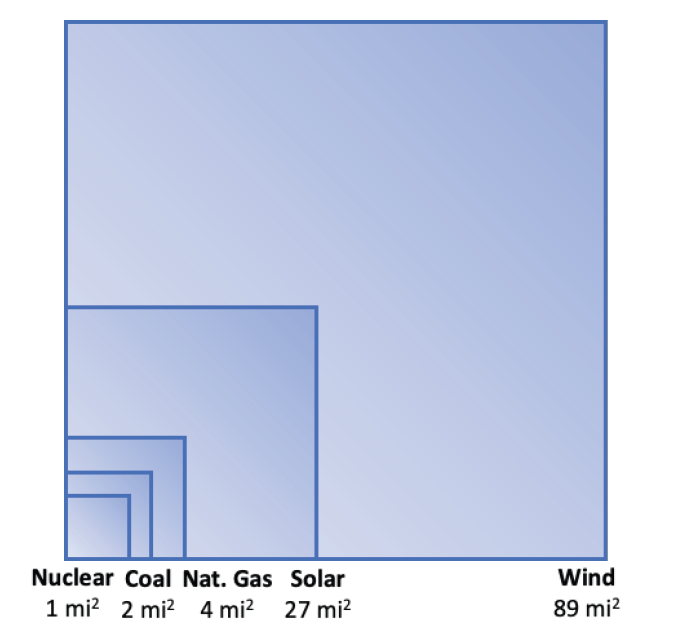
Note. The figure represents the amount of land required for 5,000 GWh of annual production, assuming a 60% capacity factor for nuclear, coal, and natural gas, 20% for solar, and 34% for wind. Capacity density for gas, coal, and nuclear derived from Smil, V., Power Density, MIT Press, 2015. Capacity density for wind and solar taken from Lopez, A. et al., Renewable energy technical potential and supply curves for the contiguous United States: 2024 edition, National Renewable Energy Laboratory, June 2025, pp. 4, 15 (https://www.osti.gov/servlets/purl/2500362). Land requirements for wind include spacing between turbines. Values for wind and solar do not include land for transmission lines or energy storage to ensure equal reliability to dispatchable power.
The implications of this low power density become even more dramatic when applied to real-world policy scenarios. Previous Life:Powered research calculated the land required if Texas were to transition to 100% wind and solar electricity generation and found that such a transition would require approximately 6 million more acres of land than the current electric grid—more than five times the area of Harris County, which is where Houston is located (Bennett, 2019, p. 3). The Electric Reliability Council of Texas (ERCOT) region is currently on a path toward 50% wind and solar generation by 2030, which will require more than 1 million additional acres compared to what was required for electricity generation and delivery in 2018 (see Table 1 below).
Texas consumes approximately 13% of the nation’s total electricity (EIA, 2025, Table 2.8), and other parts of the country, particularly the Northeast, will likely require a greater share of land to achieve high wind and solar penetration, given that Texas’s geography and climate are better suited to wind and solar generation than most other states. This enormous land footprint carries cascading consequences: displaced agricultural activity, fragmented wildlife habitats, altered rural landscapes, and the need for thousands of miles of new transmission lines.
Table 1
2030 Incremental Land Use Required for 50%, 80%, and 100% Wind and Solar Generation in ERCOT, in acres

Note: Data taken from Figure 3 in Bennett, B., Green New Deal Will Put Texas in the Red, Texas Public Policy Foundation, October 2019, p. 3 (https://lifepowered.org/wp-content/uploads/2019/10/2019-08-PP-LP-Bennett-Green-New-Deal.pdf).
The Unique Land Use Problems Created by Wind, Solar, and Energy Storage
Siting Impacts on Landowners and Communities
The physical characteristics of modern wind turbines create a distinctive set of impacts on neighboring landowners and communities. Onshore wind turbines usually reach over 500 feet from base to blade tip, making them among the tallest structures in rural landscapes (DOE, 2024). The effects of wind turbines are also becoming more challenging as more projects are located near where people live. A study from a group at the Lawrence Berkeley National Laboratory (LBNL) found that through 2015, almost 1.4 million homes in the U.S. were located within five miles of a utility-scale wind facility (Hoen et al., 2019, p. 1). There is now more than twice as much wind generation capacity in the U.S. compared to 2015 (EIA, 2025, Table 4.2B), so the number of impacted residences has likely grown proportionally. That same LBNL study found that the primary categories of concerns from local residents related to sound, lighting, and visual impacts (Hoen et al., 2019, p. 12).
Wind turbines produce both mechanical noise from the generator and gearbox as well as aerodynamic noise—a persistent “whooshing” sound—from the movement of air over the blades. Noise levels at the source are about 100 decibels, and even at a distance of over 1 km, sound levels can exceed 40 decibels (West Wind Energy, n.d.). Nighttime background levels in unpopulated areas may be 25 decibels or less (Punch & James, n.d. p. 16), making the introduction of turbine noise a noticeable change in the acoustic environment for nearby residents with a variety of potential health impacts (pp. 18-20).
There are also the visual challenges associated with wind turbines beyond their impact on the landscape. As turbine blades rotate, they cast moving shadows across the surrounding landscape and structures, creating a flickering effect that can be disorienting and distressing for residents, particularly those with photosensitive conditions. This shadow flicker effect is commonly observed at distances up to 10 times the rotor diameter, as much as 1 km from the turbine (Brinkerhoff and Court, n.d., p. 5). Additionally, the Federal Aviation Administration (FAA) requires aviation warning lights on wind turbines that reach more than 500 feet above ground level (FAA, n.d.), and the red blinking lights atop wind turbines are a common source of complaint among rural residents accustomed to dark night skies.
Solar facilities, while lacking the height and noise profile of wind turbines, create their own land use tensions. Utility-scale solar installations cover large areas of land with photovoltaic panels, permanently changing the character and productivity of the landscape. The conversion of agricultural land to solar production has raised concerns among farming communities, and the visual impact of panel arrays stretching across formerly open landscapes has generated opposition in many regions (Rosanky Rural Alliance, n.d.). There is also increasing concern about the vulnerability of solar panels to tornadoes and hail and the potential for broken glass and other materials to be strewn about during storms (Wallace, 2024).
Research about the impacts of wind and solar on the value of neighboring properties is sparse but does point toward negative impacts. The most comprehensive study performed to date indicates that there is, on average, an 11% decline in land values within a mile of a wind project after the project is announced (Brunner et al., 2024, p. 1). While erosion and water runoff impacts from solar facilities on neighboring properties are widely reported, the impact on property values is mixed (Hu et al., 2025). In Texas, the absence of statewide zoning and setback requirements means that the only mitigation for these impacts comes through county ordinances, local zoning, or private lease agreements, which vary widely and may offer insufficient protection for non-participating landowners.
Materials and Mining Requirements
The material intensity of wind and solar energy is another critical and often overlooked dimension of the land use challenge. All of the mining, processing, and manufacturing needed to make the components for these large machines carries its own environmental footprint—an impact that is in addition to the direct land use of the generating facilities themselves.
Wind turbine manufacturer Vestas estimated that constructing a 50 MW onshore wind plant requires nearly 23,000 metric tons of concrete, 6,000 tons of steel, and hundreds of tons of polymers, fiberglass, and aluminum (Vestas, 2015, pp. 44-45). That works out to over 1,100 metric tons of concrete (about 60 truckloads) and 300 tons of steel per 2.5 MW turbine. Other estimates place the materials use even higher, at approximately 2,500 short tons of concrete, 900 tons of steel, and 45 tons of non-recyclable plastic per turbine (Mills, 2019).
Solar power is similarly material intensive, requiring large amounts of crystalline silicon, glass, aluminum, copper, and silver. The International Energy Agency forecasts that to meet stated policy targets, copper production for energy end uses will need to increase by 60% by 2040, reaching about 40% of global copper consumption (IEA, n.d.). Critics of the IEA’s estimates say that such sharp increases in mining output in just a decade’s time are unlikely to happen and that the IEA “presents an optimistic view of technological progress in mining while ignoring the structural factors that limit progress in this challenging industry” (Bryant & Rao, 2025, p. 6).
The intermittent nature of wind and solar generation creates a need for large-scale energy storage, for which lithium-ion batteries have emerged as the dominant technology. However, batteries introduce their own set of environmental and safety concerns that the regulatory framework has been slow to address. The raw materials required for lithium-ion batteries—including lithium, cobalt, nickel, and manganese—are extracted through mining processes that carry significant environmental risks. Lithium mining can lead to substantial water depletion in the arid regions where it is concentrated. About three-quarters of the world’s cobalt came from the Democratic Republic of Congo in 2025 (USGS, 2026, p. 2), where mining operations have been associated with severe human rights concerns, including the use of child laborers in hazardous conditions (Amnesty International, 2016, pp. 5-6).
Lithium-ion batteries are also susceptible to thermal runaway, a chemical chain reaction that can cause fires that are extremely difficult to extinguish and that release toxic fumes, including hydrogen fluoride and hydrogen chloride. Large-scale battery fires in recent years have required multi-day firefighting efforts, emergency evacuations, and significant cleanup operations (EPA, 2025a). Even fighting such fires with water can create toxic runoff that contaminates soil and groundwater. At the end of their lives, lithium-ion batteries are classified as hazardous waste due to their fire hazard and their high concentrations of cobalt, copper, and nickel, yet disposal and recycling infrastructure remains inadequate (EPA, 2025b).
The Sweetwater, Texas, Wind Turbine Disposal Crisis
The challenges of wind turbine disposal have come into sharp focus in Sweetwater, Texas—sometimes called the “Wind Turbine Capital of Texas.” In February 2026, Texas Attorney General Ken Paxton filed a lawsuit against Global Fiberglass Solutions, Inc. and several affiliated entities for illegally dumping thousands of wind turbine blades at two sites in Sweetwater (OAG, 2026). The company had been hired by numerous wind energy companies to dismantle, transport, and recycle turbine blades but instead created a stockpile of over 3,000 blades and parts—amounting to approximately 487,000 cubic yards of industrial solid waste—at unpermitted disposal sites (OAG, 2026, p. 11-16).
The state’s investigation revealed that Global Fiberglass had never met the minimum 75% annual recycling threshold required under Texas law to be exempt from solid waste disposal permitting (OAG, 2026, p. 8). Despite entering into an Agreed Order with the Texas Commission on Environmental Quality (TCEQ) in 2022 to cease accepting waste and obtain proper permits, investigators found that the company ignored the order, continued accepting new shipments, and eventually abandoned the sites (Kite, 2026). The Attorney General’s office is seeking civil penalties ranging from $50 to $25,000 per day for each violation, as well as a permanent injunction requiring the removal of all waste within 180 days (OAG, 2026, pp. 9, 33). In addition, the City of Sweetwater has pursued criminal charges against four individuals connected to the dumping operation, with charges ranging from illegal dumping to theft of property while engaging in organized criminal activity (Leggett, 2026).
The Sweetwater case illustrates a broader problem facing the wind industry. Wind turbine blades, which can measure 200 feet in length, are constructed from fiberglass, carbon fiber, and epoxy resin—materials that are extremely difficult to recycle using conventional methods. As the first generation of wind farms installed in the early 2000s approaches the end of its useful life, the volume of blade waste is expected to grow dramatically. Some estimates project that 10,000 to 20,000 blades will be taken out of service per year between 2028 and 2040 (Krieder et al., 2024, p. 21).
State Responses to Siting and Disposal Challenges
As wind and solar installations have proliferated across the country, states have begun grappling with the regulatory gaps surrounding siting, decommissioning, and disposal of renewable energy facilities. However, the pace and rigor of state responses vary widely, and many jurisdictions remain significantly behind the standards that have long been applied to other energy industries.
In October 2025, the National Center for Energy Analytics (NCEA) published a landmark state-by-state assessment of financial assurance requirements for decommissioning wind and solar facilities. The analysis found that 30 states received a D or F grade for their wind and solar decommissioning requirements, with only one state, Virginia, receiving an A grade (Schube & Mills, 2025, pp. 5-6). Texas received a C grade due to a lack of standards regarding how much financial assurance must be acquired and how it can be acquired (pp. 30-31). By contrast, 25 states, including Texas, received an A for oil and gas well decommissioning when rated on the same scale, highlighting a stark double standard in how different energy industries are regulated at end of life.
The NCEA report identified several common deficiencies across state regulatory frameworks. Many states use discretionary language such as “may” rather than “shall” when describing decommissioning requirements, allowing regulators to waive obligations or accept insufficient financial assurances. Others fail to fix the amount of financial coverage, leaving bond amounts open to negotiation and, in many cases, far below realistic decommissioning costs. The cost to decommission wind and solar facilities ranges from $30 million to over $100 million per 1,000 MW of capacity, yet many states do not require that these costs be fully covered before construction begins (Schube & Mills, 2025, p. 4).
Because Texas has more installed and planned wind and solar capacity than any other state, at about 114 GW as of October 2025, the NCEA report estimated it has the highest expected decommissioning liabilities of any state, at about $8.8 billion (Schube & Mills, 2025, pp. 45). Next are California at more than $2.7 billion and Illinois at approximately $1.27 billion. Iowa, Kansas, and Oklahoma—all wind-heavy states—together face nearly $3 billion in combined removal and restoration liabilities (pp. 44-45).
The report recommended that a well-structured decommissioning regime should include five key safeguards: mandatory language requiring financial assurance; fixed and sufficient assurance amounts determined by independent engineering estimates; guaranteed financial instruments such as surety bonds rather than self-bonding; periodic reassessment of cost estimates; and clear enforcement mechanisms. Several states have begun moving in this direction. North Carolina, for example, enacted legislation in 2023 requiring all utility-scale solar project owners to register with the Department of Environmental Quality, submit decommissioning plans prepared by licensed engineers, and establish financial assurance by November 2025 (NC DEQ, n.d.). Georgia and South Carolina have implemented comparable requirements.
With respect to siting, the state-by-state landscape is equally fragmented. Some states have adopted statewide setback requirements and permitting processes for wind and solar facilities, while others leave siting decisions entirely to local governments or, in some cases, impose no meaningful requirements at all. The absence of a consistent siting framework creates a patchwork of regulations that can leave landowners and communities with limited recourse when large-scale energy projects are developed near their properties.
Legislative History of Wind, Solar, and Energy Storage Permitting in Texas
The Texas Legislature has taken incremental steps over several sessions to establish decommissioning and disposal requirements for wind, solar, and battery energy storage facilities. However, progress has been uneven across the three key regulatory areas of siting, decommissioning, and disposal. Table 2 summarizes the current status of Texas law across these categories. Texas has enacted decommissioning requirements for all three technology types and disposal requirements for wind and solar, but the state has not yet established a statewide siting or permitting framework for any of those resources.
Table 2
Status Of Texas Laws Governing Siting, Decommissioning, and Disposal of Wind, Solar, and Energy Storage Facilities

Note: Check marks indicate that specific statutory requirements exist to regulate the activity and/or to require financial security from the developer to cover costs.
The foundation of Texas’s regulatory framework for wind and solar decommissioning is found in Chapters 301 and 302 of the Texas Utilities Code. Chapter 301, created by HB 2845 in 2019, addresses wind power facility agreements and requires that lease agreements between wind project developers and landowners include provisions for the removal of all facilities and the restoration of the leased property at the end of the project’s life (HB 2845, 2019). Chapter 302, created by SB 760 in 2021, imposes parallel requirements on solar power facility agreements (SB 760, 2021). Both statutes require project developers to provide landowners with financial assurance—in the form of surety bonds, letters of credit, or other acceptable instruments—sufficient to cover the estimated costs of decommissioning and land restoration. Cost estimates must be prepared by independent, Texas-licensed engineers and updated periodically over the life of the agreement. However, there are no statewide minimums for the amount of financial assurance that must be procured to cover those costs.
The 2025 legislative session saw significant progress in expanding Texas’s decommissioning and disposal framework. House Bill 3228, authored by Rep. Stan Lambert, whose district includes Sweetwater, amended Chapters 301 and 302 of the Utilities Code to add recycling and disposal requirements to the existing decommissioning obligations for wind and solar facilities (HB 3228, 2025). Under HB 3228, project lessees are now required to collect, reuse, recycle, or ship for recycling all components of a wind or solar facility that are practicably capable of being reused or recycled, including wind turbine blades and photovoltaic modules. Components that cannot be recycled must be properly disposed of at authorized facilities. The bill also expanded the financial assurance formula to include the estimated costs of recycling and disposing of all facility components.
House Bill 3809 in 2025 added a new Chapter 303 to the Texas Utilities Code that imposes on battery energy storage facilities the same facility removal and financial assurance requirements that Chapters 301 and 302 impose on wind and solar projects (HB 3809, 2025). New site control agreements for battery storage facilities are required to incorporate standard removal, restoration, and recycling provisions, and project owners must provide landowners with proof of financial assurance sufficient to cover decommissioning costs. Notably, the statute does not contain any of the disposal or recycling requirements created by HB 3228, and that gap should be addressed in future legislation given the problems inherent in large-scale battery disposal.
In addition to the lack of requirements regarding battery disposal and recycling, the provisions in Chapters 301, 302, and 303 have room for improvement. First, the statutes do not contain any mandatory minimums, so the amount of assurance is purely determined contractually by the landowners and developers (Texas Utilities Code §301.0004). In contrast, onshore oil and gas wells must have financial security or a well-plugging insurance policy with benefits that equal or exceed $2 per foot of well depth (16 TAC §3.78). Also, the financial assurance for a wind and solar facility does not have to be a surety bond and can take the form of a line of credit or any “form of financial assurance acceptable to the landowner” (Texas Utilities Code §301.0004(a)). Finally, the statutes only apply to facilities that were put into service after the laws were enacted, so it is unknown how many liabilities exist from the tens of GW of generation that was put into service before the laws took effect.
Future Legislative Needs: Siting Requirements and Property Rights
Despite the progress on decommissioning and disposal, Texas still lacks a statewide siting or permitting framework for wind, solar, or battery energy storage facilities. Unlike oil and gas operations, which are regulated by the Railroad Commission of Texas, or conventional power plants, which require air emissions and water permits from the TCEQ, wind, solar, and storage facilities can currently be constructed in Texas without obtaining any state-level siting permit. Local control over siting exists in some jurisdictions through county ordinances or municipal zoning, but this creates an inconsistent patchwork of rules—and in most rural counties, no siting requirements exist at all.
The first attempt to set some siting requirements on wind turbines was in 2021, which saw two bills (HB 4007, 2021; SB 1003, 2021) that attempted to create a setback requirement equal to either one mile from the nearest property line or 10 times the maximum blade tip height from the closest structure on neighboring property. The setback requirement was reduced to 3,000 feet from the nearest property line in the version of the legislation that passed the Senate (SB 1003, 2021), but neither bill made it out of the House State Affairs Committee.
In 2023, Sens. Lois Kolkhorst and Mayes Middleton put forward the most ambitious legislation to date regarding this issue. The introduced version of their bill (SB 624, 2023a) required all wind and solar facilities in Texas to obtain a permit from the Public Utility Commission of Texas (PUC) and included provisions for environmental impact reviews, public notice and comment periods, and the payment of environmental impact fees into a cleanup fund. The bill also modified Chapters 301 and 302 to require bonds instead of simply lines of credit for decommissioning costs, and it included setback requirements of 1,000 feet from any habitable structure and 500 feet from neighboring property lines. The bill passed the Senate after changes that made it apply only to new facilities larger than 10 MW (SB 624, 2023b).
The setback requirements were reduced to 100 feet from the nearest property line and 200 feet from the nearest habitable structure for a solar facility and increased to 3,000 feet from the nearest property line for a wind facility. Despite the Senate’s support of the bill, it was never granted a hearing in the House.
Sen. Kolkhorst revived the legislation in 2025 (SB 819, 2025), and it again passed the Senate but was not heard in the House. The introduced version of the bill was almost identical to the engrossed version of the prior bill, SB 624, with the notable exception that it did not include a provision to eliminate local property tax abatements for wind and solar. The engrossed version was stripped down significantly, eliminating the facility cleanup fund and the requirement for a public hearing and making the environmental impact analysis optional. It also reduced the setback for new wind facilities from 3,000 feet to twice the blade height of the turbines (about 1,000 to 1,200 feet).
A key advantage of this legislation, and one reason it has received support from landowners, is that it requires wind and solar developers to address the concerns of surrounding property owners, not just the landowner whose property is being leased for the facility. The setback requirements can be waived with the consent of the affected property owner, which means that developers can still site their projects as they desire, but they cannot do so while ignoring the nearby property owners.
One challenge with the legislation is that it would give unprecedented permitting authority to the PUC, which historically has regulated the siting of transmission lines but not generation. The reason for the certificate of convenience and necessity (CCN) process for transmission lines is that their construction involves the seizure of property using eminent domain. Eminent domain cannot be used to site new generation, so the state has never inserted itself into those decisions. Keeping as much of the decision-making regrading siting at the local level is always preferable, with state law providing the necessary guidelines and powers to ensure that the property rights of all landowners affected by a project are respected.
Conclusion
Given the potential for wind and solar facilities to reduce the property value of nearby properties and impose negative aesthetic and environmental impacts, neighboring landowners should be afforded some rights regarding the siting of a wind or solar facility on land that borders their property. Whether the proper solution is to grant the PUC permitting authority through a CCN-type process or to simply enact statutory requirements for setbacks and other parameters that are then handled individually by the developer and landowners is an open question. With wind, solar, and energy storage now comprising almost half of the installed capacity in Texas (ERCOT, 2026, p. 5) and over 90% of future projects nearing completion (ERCOT, n.d.),1 the Legislature is long overdue to provide remedies for these problems.
Fully addressing the land use problems associated with wind and solar also requires Texas policymakers to enact policies that stop incentivizing the overbuilding of wind and solar, along with associated energy storage and transmission lines. Previous research has documented how the reliability (Reed & Bennett, 2025) and transmission costs (Bennett & Piracci, 2026) of wind and solar are socialized to Texas ratepayers, which adds an additional incentive for developers to build in addition to the federal subsidies (Bennett, 2024). If these policies are not changed, the volume of wind and solar waste will continue to grow, and the costs and challenges of managing that waste will grow proportionally. When wind and solar developers begin paying for the costs they impose while they are operating, Texans will be more willing and better positioned to deal with the end-of-life costs of those resources.
Footnote
1 – Note: The file is an Excel spreadsheet downloaded from this webpage. The number refers to the power plants that have an interconnection agreement in place and all planning studies completed.
References
Amnesty International. (2016). “This is what we die for”: Human rights abuses in the Democratic Republic of the Congo power the global trade in cobalt. https://www.amnesty.org/en/documents/afr62/3183/2016/en/
Bennett, B. (2019). Green New Deal will put Texas in the red. Texas Public Policy Foundation. https://lifepowered.org/wp-content/uploads/2019/10/2019-08-PP-LP-Bennett-Green-New-Deal.pdf
Bennett, B. (2024, October). The siren song that never ends: Federal energy subsidies and support from 2010 to 2023. Texas Public Policy Foundation. https://www.texaspolicy.com/wp-content/uploads/2024/10/2024-10-LP-Federal-Energy-Subsidies-BrentBennett_FINAL-1.pdf
Bennett, B. & Piracci, J. (2026, January). The explosion of transmission costs in ERCOT: Causes, forecasts, and policy solutions. Texas Public Policy Foundation. https://www.texaspolicy.com/wp-content/uploads/2026/01/2026-01-LP-Transmission-Costs-BennettPiracci.pdf
Brinckerhoff, P. & Court, A. (n.d.). Update of UK Shadow Flicker Evidence Base. Department of Energy and Climate Change. https://assets.publishing.service.gov.uk/media/5a79770bed915d0422068aa3/1416-update-uk-shadow-flicker-evidence-base.pdf
Brunner, E.J., Hoen, B., Rand, J., & Schwegman, D. (2024). Commercial wind turbines and residential home values: New evidence from the universe of land-based wind projects in the United States. Energy Policy, 185. https://www.sciencedirect.com/science/article/pii/S0301421523004226
Bryant, P., & Rao, S. (2025, October 21). Energy delusions: Critical minerals forecasts; A critique and commentary of the IEA global critical minerals outlook 2025. National Center for Energy Analytics. https://cdn.prod.website-files.com/698171fc2ab2be1c0ffe1751/6a039a3ef1c06612a34def62_FINAL-2025-10-NCEA-Critical-Minerals-Forecast-Bryant-Rao.pdf
Electric Reliability Council of Texas (ERCOT). (2026). May 2026 monthly outlook for resource adequacy (MORA). https://www.ercot.com/files/docs/2026/03/06/MORA_May2026.pdf
Electric Reliability Council of Texas (ERCOT). (n.d.). GIS_Report_December2025 in GIS report (webpage). Retrieved January 20, 2026, from https://www.ercot.com/mp/data-products/data-product-details?id=pg7-200-er
Federal Aviation Administration (FAA). (n.d.). FAA informational briefing: Wind turbine marking & lighting (M&L) / Aircraft detection lighting systems (ADLS) briefing. Retrieved March 20, 2026, from https://www.faa.gov/air_traffic/flight_info/aeronav/acf/media/Presentations/23-02-ADLS-Briefing.pdf
HB 2845. Enrolled. 86th Texas Legislature. Regular. (2019). https://capitol.texas.gov/tlodocs/86R/billtext/pdf/HB02845F.pdf
HB 3228. Enrolled. 89th Texas Legislature. Regular. (2025). https://capitol.texas.gov/tlodocs/89R/billtext/pdf/HB03228F.pdf
HB 3809. Enrolled. 89th Texas Legislature. Regular. (2025). https://capitol.texas.gov/tlodocs/89R/billtext/pdf/HB03809F.pdf
HB 4007. Introduced. 87th Texas Legislature. Regular. (2021). https://capitol.texas.gov/tlodocs/87R/billtext/pdf/HB04007I.pdf
Hoen, B., Rand, J., Wiser, R., Firestone, J., Elliott, D., Hübner G., Pohl, J., Haac, R., Kaliski, K., Landis, M., & Lantz, E. (2019, November). National survey of attitudes of wind power project neighbors: Summary of results. Lawrence Berkeley National Laboratory. https://emp.lbl.gov/sites/default/files/emp-files/wind_neighbors_survey_summary_nov2019v5_final.pdf
Hu, X., Li, Y., & Zhao, P. (2025). Impact of large-scale solar on property values in the United States: Diverse effects and causal mechanisms. Proceedings of the National Academy of Sciences, 122(3). https://www.pnas.org/doi/10.1073/pnas.2418414122
International Energy Agency (IEA). (2026, July 27). Critical minerals data explorer. https://www.iea.org/data-and-statistics/data-tools/critical-minerals-data-explorer
Kite, A. (2026, February 5). Texas sues wind turbine company for allegedly abandoning 3,000 blades in West Texas. FOX 4 KDFW. https://www.fox4news.com/news/texas-sues-wind-turbine-company-allegedly-abandoning-3000-blades-west-texas
Kreider, M., Eshuis, L., Constant, C., & Berry, D. (2024). Winding down: End of service and recycling for wind energy. National Renewable Energy Laboratory. https://www.osti.gov/servlets/purl/2394635
Leggett, C. (2026, February 19). Four indicted in Sweetwater wind turbine blade dumping probe; cleanup not yet started. KTXS 12 ABC. https://ktxs.com/news/local/sweetwater-nolan-county-officials-to-update-on-wind-blade-indictments-tceq-crackdown
Lopez, A., Zuckerman, G. R., Pinchuk, P., Gleason, M., Rivers, M., Roberts, O., Williams, T., Heimiller, D., Thomson, S.-M., Mai, T., & Cole, W. (2025, June). Solar photovoltaics and land-based wind technical potential and supply curves for the contiguous United States: 2024 edition. National Renewable Energy Laboratory. https://www.osti.gov/servlets/purl/2500362
Mills, M. (2019, August 5). If you want ‘renewable energy,’ get ready to dig. The Wall Street Journal. https://www.wsj.com/articles/if-you-want-renewable-energy-get-ready-to-dig-11565045328
North Carolina Department of Environmental Quality (NC DEQ). (n.d.). Utility-scale solar project decommissioning program. https://www.deq.nc.gov/about/divisions/waste-management/utility-scale-solar-project-decommissioning-program
Office of the Attorney General of Texas (OAG). (2026). State of Texas v. Global Fiberglass Solutions, Inc. https://www.texasattorneygeneral.gov/sites/default/files/images/press/2026%20Petition.pdf
Punch, J., & James, R. (n.d.). Wind turbine noise and human health: A four-decade history of evidence that wind turbines pose risks. Wind Watch. Retrieved March 20, 2026, from https://docs.wind-watch.org/Punch-James-Wind-Turbine-Noise-16-09-30.pdf
Razdan, P. & Garrett, P. (2015, December 18). Life cycle assessment of electricity production from an onshore V110-2.0 MW wind plant. Vestas. https://www.vestas.com/content/dam/vestas-com/global/en/sustainability/reports-and-ratings/lcas/LCAV11020MW181215.pdf.coredownload.inline.pdf
Reed, M. and Bennett, B. (2025, February). The cost of wind and solar variability to Texas ratepayers. Texas Public Policy Foundation. https://lifepowered.org/wp-content/uploads/2025/02/2025-02-LP-Cost-of-Wind-and-Solar-ReedBennett.pdf
Rosanky Rural Alliance. (n.d.). The Rosanky Rural Alliance. Retrieved March 20, 2026, from https://www.rosankytexas.com/home
SB 624. Introduced. 88th Texas Legislature. Regular. (2023a). https://capitol.texas.gov/tlodocs/88R/billtext/pdf/SB00624I.pdf
SB 624. Engrossed. 88th Texas Legislature. Regular. (2023b). https://capitol.texas.gov/tlodocs/88R/billtext/pdf/SB00624E.pdf
SB 715. Senate Committee Report. 89th Texas Legislature. Regular. (2025). https://capitol.texas.gov/tlodocs/89R/billtext/pdf/SB00715S.pdf
SB 760. Enrolled. 87th Texas Legislature. Regular. (2021). https://capitol.texas.gov/tlodocs/87R/billtext/pdf/SB00760F.pdf
SB 819. Engrossed. 89th Texas Legislature. Regular. (2025). https://capitol.texas.gov/tlodocs/89R/billtext/pdf/SB00819E.pdf
SB 1003. Engrossed. 87th Texas Legislature. Regular. (2021). https://capitol.texas.gov/tlodocs/87R/billtext/pdf/SB01003E.pdf
Schube, C., & Mills, M. (2025, October). A state-by-state-assessment of financial assurance requirements for decommissioning wind and solar. National Center for Energy Analytics. https://cdn.prod.website-files.com/698171fc2ab2be1c0ffe1751/69f414feb2d23579bac5b20d_State-Financial-Assurance-Requirements.pdf
Smil, V. (2015). Power Density. MIT Press.
Texas Administrative Code (TAC). Title 16. Chapter 3. Rule 78. Fees and Financial Security Requirements. https://texas-sos.appianportalsgov.com/rules-and-meetings?$locale=en_US&interface=VIEW_TAC_SUMMARY&queryAsDate=03%2F26%2F2026&recordId=224067
Texas Utilities Code. Title 6. Section 301.0004. Required Agreement Provisions of Financial Assurance. https://statutes.capitol.texas.gov/?tab=1&code=UT&chapter=UT.301&artSec=
U.S. Energy Information Administration (EIA). (2025). Electric power annual 2024. https://www.eia.gov/electricity/annual/pdf/epa.pdf
U.S. Environmental Protection Agency (EPA). (2025a, September 29). EPA oversees largest lithium-ion battery cleanup in agency history at Moss Landing. https://www.epa.gov/newsreleases/epa-oversees-largest-lithium-ion-battery-cleanup-agency-history-moss-landing
U.S. Environmental Protection Agency (EPA). (2025b, September 24). Lithium-ion battery recycling. https://www.epa.gov/hw/lithium-ion-battery-recycling
U.S. Geological Survey (USGS). (2026, February). Mineral commodity summaries: Cobalt. https://pubs.usgs.gov/periodicals/mcs2026/mcs2026-cobalt.pdf
U.S. Department of Energy (DOE). (2024, August 21). Wind turbines: the bigger, the better. https://www.energy.gov/cmei/articles/wind-turbines-bigger-better
Wallace, R. (2024, March 22). Needville community concerned about thousands of busted solar panels. FOX 26 Houston. https://www.fox26houston.com/news/needville-community-concerned-busted-solar-panels-fighting-j