In 2013, the Obama Administration offered “Housing First” as the means to end homelessness in 10 years. Over a decade later, homelessness is more prevalent than ever, and taxpayers have been financing ever-increasing funding to programs that are failing to achieve their stated goal of ending homelessness.
Key points:
- The “Housing First” approach was proposed to end homelessness by 2023, but there has been no significant reduction since its implementation.
- The current method of evaluating homelessness services measures compliance rather than performance.
- Third-party audits of the Continuum of Care can help identify inefficiencies in the system and enable more effective allocation of funds.
To ensure that taxpayer dollars are being spent responsibly and effectively, the 89th Texas Legislature should enact legislation requiring regular audits of homeless services based on concrete metrics.\
Issue
Governments, from cities and towns up to the federal level, have a duty to be proper stewards of taxpayer funds. Any action taken with these funds must be in the interest of those citizens from whom the money is taken. Should a program (created with these monies) fail to meet its stated goal and become a liability to the citizenry, it is necessary to evaluate the program’s deficiencies and determine whether it should be discontinued or reshaped to realign its practices with its purpose.
Over the last decade, the federal government has coerced states to follow failing policies regarding homeless solutions through the Continuum of Care (CoC) program. Federal money from the U.S. Department of Housing and Urban Development (HUD) bypasses state control and is granted directly to the CoC, where money is directed to non-profits by non-profits working in a quasi-governmental capacity. This money comes with strings attached, and organizations receiving it are limited to Housing First practices. Under the Housing First model, which received federal (HUD) funding, the organization was required to provide housing without prerequisites such as commitment to sobriety, job training, or mental health therapy. Since the shift toward the Housing First model, the homeless population has increased. The increase in homelessness has led to public health problems alongside public safety issues with aggressive panhandling, public intoxication, and setting up encampments under overpasses or in greenbelt areas.
The Continuum of Care program implementing Housing First is not fulfilling its purpose of reducing homelessness, upholding public safety, and protecting public health. This research will illustrate the necessity for third-party audits of homelessness services.
Continuum of Care in Texas and the Flypaper Effect
In 2013, the Department of Housing and Urban Development began prioritizing the Housing First approach to homelessness. This model emphasizes providing government-subsidized housing without any conditions attached, such as seeking mental health services, receiving drug treatment, pursuing scholastic education, or engaging in employment training. In fact, as of 2013, HUD discontinued funding such services because it deemed them nonessential. Instead, HUD made Housing First’s primary goal “to quickly and successfully connect individuals and families experiencing homelessness to permanent housing without preconditions and barriers to entry, such as sobriety, treatment or service participation requirements” (NAEH, 2022).
HUD aims to reach its goal by consolidating all homelessness services at the county level, known as a Continuum of Care (CoC). A CoC, as defined by HUD, is designed “to promote access to and effective utilization of mainstream programs by homeless individuals and families” (HUD Partners, n.d.). The CoC is the primary method by which cities, states, communities, non-profit organizations, and the federal government address homelessness in a particular area (HUD, 2014). The intention is to utilize the maximum number of resources through a single overarching body, rather than a patchwork of organizations attempting to do the same thing. Texas has 11 CoCs that cover large urban areas and one CoC that covers more than 200 rural counties. Although they are geographically defined at the county level, CoCs are not governed by county governance structures.
To determine the homeless population in their area, CoCs will conduct a Point-in-Time (PIT) count. CoCs are required to conduct “an annual count of people experiencing homelessness who are sheltered in emergency shelter, transitional housing, and Safe Havens on a single night” (HUD Exchange, n.d.-a, para. 1). HUD also requires that CoCs undertake a count of the unsheltered homeless on odd-numbered years (HUD Exchange, n.d.-a). While the HUD website provides guidelines for CoCs on how PIT counts are conducted, “each count is planned, coordinated, and carried out locally” (HUD Exchange, n.d.-b, para. a).
One of the main funding mechanisms for CoCs is the competitive grant awarded based on compliance with HUD policy. Since the bar for compliance had been set so low, 95% of applications were “automatically renewed,” according to the language in the new Notice of Funding Opportunity (HUD, 2026). The implementation of the Housing First policy rewarded organizations that simply placed people in housing without addressing the underlying causes of homelessness. These incentives created an environment in which non-profits used their position as partners in the CoC to steer city, county, and state funds into programs created and partially sustained by federal HUD dollars.
This is an example of the “flypaper effect,” in which intergovernmental grants (i.e., federal aid to cities) increase local government spending by more than an equivalent increase in community income (Inman, 2008). By way of example, imagine a homelessness service provider that receives a federal grant, and, as part of the CoC, the city also contributes taxpayer money to the provider. As the homeless problem persists and federal funding fluctuates, local governments—and therefore local taxpayers—are left on the hook.
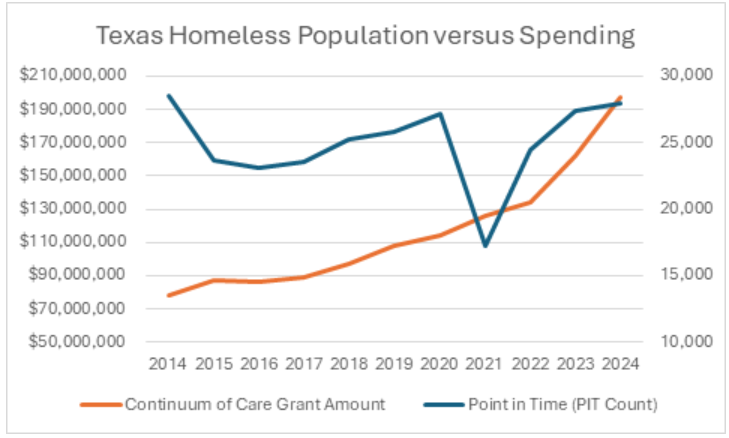
In 2010, when the Obama Administration released its strategic plan, one of its goals was to “Finish the job of ending chronic homelessness in 7 years” (National Academy of Sciences, p. 182, 2018). Even assuming the goal was more aspirational than realistic, the focus on Housing First has not even come close to achieving this goal. In 2015, the effects of Housing First began, and from 2015 to the most current available data, the only reported decrease in homelessness was during COVID-19, when there was a lack of reporting from CoCs. In Texas, federal grants have increased year over year, as shown in Figure 1.
Figure 1
Texas Homeless Population vs. Continuum of Care Grant Awards
Note. Data from Annual Homelessness Assessment Report, by U.S. Department of Housing and Urban Development, 2024 (https://www.huduser.gov/portal/datasets/ahar/2024-ahar-part-1-pit-estimates-of-homelessness-in-the-us.html); CoC Award Summary Reports by Component and Project Type, HUD Exchange, n.d.-b (https://www.hudexchange.info/programs/coc/awards-by-component/?filter_Year=2014&filter_Scope=State&filter_State=TX&filter_CoC=&program=CoC&group=AwardComp).
This illustrates a failure to implement proper policy if the goal is to reduce overall homelessness. Because federal funds draw local dollars, Texans are paying the price for a homeless system that is actively making the problem worse.
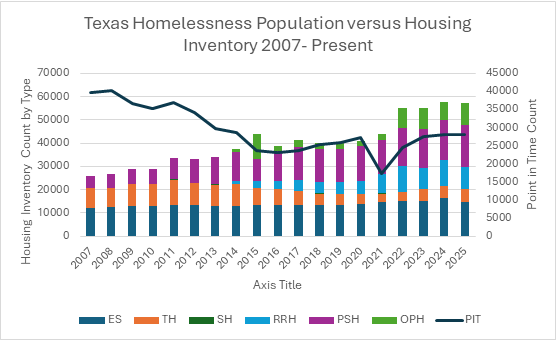
While Figure 1 shows how much money is being spent, Figure 2 shows how that money is being spent. Figure 2 tracks changes in Texas Homeless Population, as reported in the Point-in-Time Count, as the types of beds in the Housing Inventory change as a result of policy. Until 2013, federal policy relied much more heavily on Transitional Housing to address homelessness. Transitional housing is temporary housing that focuses on providing the skills necessary for program participants to attain and maintain permanent housing (HUD, n.d.-c.). While adjusting the balance among Permanent Supportive Housing, Emergency Shelter, and Transitional Housing, Texas’s homeless population decreased by nearly half. However, after Housing First Policies were implemented and funding incentives followed, Permanent Supportive Housing and Rapid-Rehousing replaced Transitional Housing, and as Transitional Housing beds disappeared, homeless Point-in-Time Counts increased (with the exception of 2021, when reporting was incomplete due to COVID-19).
Figure 2
Texas Homeless Population versus Housing Inventory 2007-Present
Note. Data1 from Annual Homelessness Assessment Reports (AHAR), by Office of Policy Development and Research (2025). https://www.huduser.gov/portal/datasets/ahar/2025-ahar-part-1-pit-estimates-of-homelessness-in-the-us.html
Housing First focused on housing with no preconditions, and funding shifted to match that policy. HUD has issued new guidelines for homelessness spending, redirecting incentives for Housing First back to Transitional Housing. This should allow CoCs to transition into providing the services that worked before.
Recommendation
In 2020, the United States Interagency Council on Homelessness observed that “one of the most menacing but easily made errors in measuring success is to measure outputs rather than outcomes” (United States Interagency Council on Homelessness, 2020, p. 12). The study differentiates between the two seemingly similar concepts, explaining that “completing a job training program is an output, finding and keeping a job is an outcome” (p. 12). For example, services that practice Housing First measure outputs rather than outcomes. Rather than measuring the number of individuals who have increased their earned income while participating in such a program, the program should be evaluated by whether these individuals are earning a living wage. In this instance, the metric of “increasing earned income” is unclear, as the dollar amount could have risen from zero to a level still below what is deemed appropriate to be truly self-sufficient.
A framework for how these audits would be conducted can be found in SB 399 from the 89th legislative session (2025). This bill authorizes the State Auditor to engage a third party to audit homelessness service providers to assess their effectiveness in advancing homeless individuals toward self-sufficiency. Self-sufficiency metrics as provided in the bill include:
- ability of the individual who received services to retain housing
- employment or employment training
- participation in mental health and substance abuse treatment
- and involvement with the criminal justice system (SB 399, 2025, Section 1, Subsection 2).
The audit must take place in a 90-day window, and the results must be displayed on the State Auditor’s website. Service providers that are found ineffective in advancing self-sufficiency would be eliminated in favor of those that are effective (SB 399, 2025, Section 1, Subsection 2).
Conclusion
It is the duty of the government to be proper stewards of taxpayer money. For the sake of those who have fallen into hard times, homelessness programs should address the individual trauma that leads to homelessness and equip those under their care to be fully self-sufficient, both of which can be assessed through outcome-based audits. The 90th Texas Legislature should enact legislation mandating statewide audits of homelessness services to ensure that these programs focus on outcomes that lead participants toward self-sufficiency.
References
HUD Exchange. (2014). What is a continuum of care? U.S. Department of Housing and Urban Development. https://www.hudexchange.info/faqs/1545/what-is-a-continuum-of-care/
HUD Exchange. (n.d.-b). Point-in-Time count and housing inventory count. Retrieved March 31, 2026, from https://www.hudexchange.info/programs/hdx/pit-hic/#2024-pit-count-and-hic-guidance-and-training
HUD Exchange. (n.d.-a). CoC award summary reports by component and project type. U.S. Department of Housing and Urban Development. Retrieved March 31, 2026, from https://www.hudexchange.info/programs/coc/awards-by-component/?filter_Year=2014&filter_Scope=State&filter_State=TX&filter_CoC=&program=CoC&group=AwardComp
HUD Exchange. (n.d.-c). Transitional housing. U.S. Department of Housing and Urban Development. https://www.hudexchange.info/homelessness-assistance/coc-esg-virtual-binders/coc-program-components/transitional-housing/
Inman, R. (2008). The flypaper effect. National Bureau of Economic Research. https://www.nber.org/system/files/working_papers/w14579/w14579.pdf
NAEH. (2022). Protecting the use of Housing First. National Alliance to End Homelessness. https://endhomelessness.org/resources/policy-information/protecting-the-use-of-housing-first/
National Academies of Sciences. (2011). Permanent Supportive Housing: Evaluating the Evidence for Improving Health Outcomes Among People Experiencing Homelessness. National Academies Press. https://www.ncbi.nlm.nih.gov/books/NBK519594/pdf/Bookshelf_NBK519594.pdf
U.S. Department of Housing and Urban Development (HUD). (2024). Annual homelessness assessment report. https://www.huduser.gov/portal/datasets/ahar/2024-ahar-part-1-pit-estimates-of-homelessness-in-the-us.html
U.S. Interagency Council on Homelessness. (2020). Expanding the toolbox: The whole-of-government response to homelessness. www.texaspolicy.com/wp-content/uploads/2021/09/USICH-2020-report401.pdf