The 86th Texas Legislature sought to enhance public debt transparency through the creation of Voter Information Documents (VID). However, this instrument is not accurately providing debt amounts and needs reform.
Key points:
- Governments are manipulating the VID methodology to deny voters accurate tax impact estimates.
- Many VIDs are dissimilar, making comparative analysis challenging. There is no standard template for use across all entities.
- Governments often avoid clearly displaying VIDs on their website, making debt transparency efforts less effective.
The 90th Texas Legislature should strengthen the VID by reworking its methodology, adding more context, and adopting a clear and organized format for use by all.
Executive Summary
This study examines Texas’ Voter Information Document, its purpose and contents, and the reasons for its creation in 2019. It also explores ways that governmental entities are eroding their utility through methodological manipulation, unclear formatting, and missing context. Finally, this paper offers recommendations for how the Texas Legislature can improve the quality and integrity of the debt detail provided to the public.
Introduction
In 2019, the 86th Texas Legislature passed House Bill (HB) 477 (2019) with the goal of improving public debt transparency. The law requires political subdivisions with more than 250 registered voters to prepare a Voter Information Document (VID) for each proposition put before the public and mandated that it include the following information (HB 477 Bill Analysis, 2019, p. 2):
- “The language that would appear on the ballot;
- A table with the principal, estimated interest, and estimated combined principal and interest required for full payment of the proposed bonds and the principal, estimated interest, and estimated combined principal and interest required for full payment of all outstanding bonds as of the date the political subdivision adopted the debt obligation order;
- The estimated maximum annual increase in taxes that would be imposed on a residence homestead with an appraised value of $100,000, based on certain assumptions made by the governing body of the political subdivision detailed in the bill; and
- Any other information considered relevant or necessary to explain the other information in the document.”
Per Section 1251.052 (b), Texas Government Code, the information specified above is required to be posted in the same manner as the debt obligation election order1 and may be included as part of the order as well. When presented to the public, best practices stipulate that the information should be “formatted as a table” (Texas Secretary of State, 2023, p. 25).
VID Challenges
Despite the Legislature’s effort to provide the public with timely and pertinent public debt information through the VID instrument, local governing bodies have not done well to implement the concept in a manner consistent with the spirit of the law. The current challenges with the VID exist primarily in three categories: 1) methodological manipulation, 2) unclear formatting, and 3) missing context.
Methodological Manipulation
Part of HB 477’s intent was to inform voters about “the property tax impact of new debt issuances” (HB 477 Bill Analysis, 2019, p. 4). To bring about this effect, the enrolled version of HB 477 included a provision requiring bond-seeking entities to estimate the maximum tax increase that residents could expect if the measure is successfully passed. The exact statutory language requires:
“the estimated maximum annual increase in the amount of taxes that would be imposed on a residence homestead in the political subdivision with an appraised value of $100,000 to repay the debt obligations to be authorized, if approved, based upon assumptions made by the governing body of the political subdivision” [emphasis mine] (HB 477, 2019).
Governments—but especially independent school districts (ISDs)—have interpreted and applied this language in such a way that the projected tax impact estimate is often understated or even eliminated entirely. This manipulation is possible due to the misapplication of the bolded text above (i.e., “a residence homestead…with an appraised value of $100,000”). Rather than provide a straightforward estimate, ISDs have construed the term “residence homestead” to imply the existence of a property tax exemption that, in its current form, is greater than the $100,000 appraised value articulated in statute.
As of 2026, the Texas Constitution (Tex. Const. art. VIII, § 1‑b, 2025) authorizes qualifying residents to receive a homestead exemption of $140,000 for school tax purposes. The availability of this sizeable tax exemption has enticed ISDs to assume it in the tax impact calculation. Thus, for the purpose of determining how a bond might increase a homeowner’s taxes, ISDs will first subtract the $140,000 exemption from the statutorily-prescribed $100,000 appraised value. This figure is then multiplied by any tax rate change, which produces an estimate of $0, irrespective of the amount borrowed or the magnitude of the rate hike considered. The result is that any proposed rate change multiplied by a $0 value will produce a $0 tax bill change.
To illustrate this sleight of hand further, let’s consider several recent real-world examples, including Dallas and Celina ISDs as well as Hays Consolidated Independent School District (CISD).
Dallas ISD
In May 2026, Dallas ISD asked voters to decide on four bond proposals. Proposition A was the largest possible issuance, with principal debt estimated at $5.9 billion and interest costs estimated at nearly $6 billion. The bond’s total repayment costs were projected to be $12.2 billion (Dallas Independent School District, 2026, pp. 90-91). Likewise, Proposition B’s total principal and interest costs were estimated at $288 million; Proposition C’s total cost was $285.3 million; and Proposition D totaled $52.2 million (Dallas Independent School District, 2026, pp. 92-97). Altogether, Dallas ISD’s four propositions carried a total cost of $12.8 billion.
Despite Dallas ISD proposal to pay almost $13 billion, the district’s VIDs for Proposition A, B, C, and D all stated that there would be a $0 tax increase for Dallas residents (Dallas Independent School District, 2026, pp. 90-97) (see Images 1 and 2). As readily acknowledged on the VID, the district came to this conclusion by “assum[ing] application of a homestead exemption of $140,000” (Dallas Independent School District, 2026, pp. 95). By using this $140,000 value, the district can effectively eliminate the statutorily prescribed $100,000 appraised value and claim a $0 tax impact.
If the district were to use a more representative property estimate, then it would note that the median property value for a single family residence in the area is $285,460 (Dallas Central Appraisal District, 2025) and subtract the $140,000 exemption from the overall value, providing a $145,460 in median taxable estimate with which to use in its calculation.2
Under false pretenses, each proposition carried with significant approval. There was a total of 38,413 voters for Proposition A, with 28,544 voting in favor and 9,869 voting against it—a 74.3% passing rate (Texas Bond Review Board, n.d.). Similarly, Proposition B carried with 28,684 voters in favor and 9,661 voters against—a 74.8% passing rate; Proposition C carried with 27,566 in favor and 10,654 against—a 72.1% passing rate; and Proposition D carried with 27,216 voters in favor and 11,095 against—a 71% passing rate. (Texas Bond Review Board, n.d.).
Images 1 and 2
Dallas ISD Proposition A, 2026
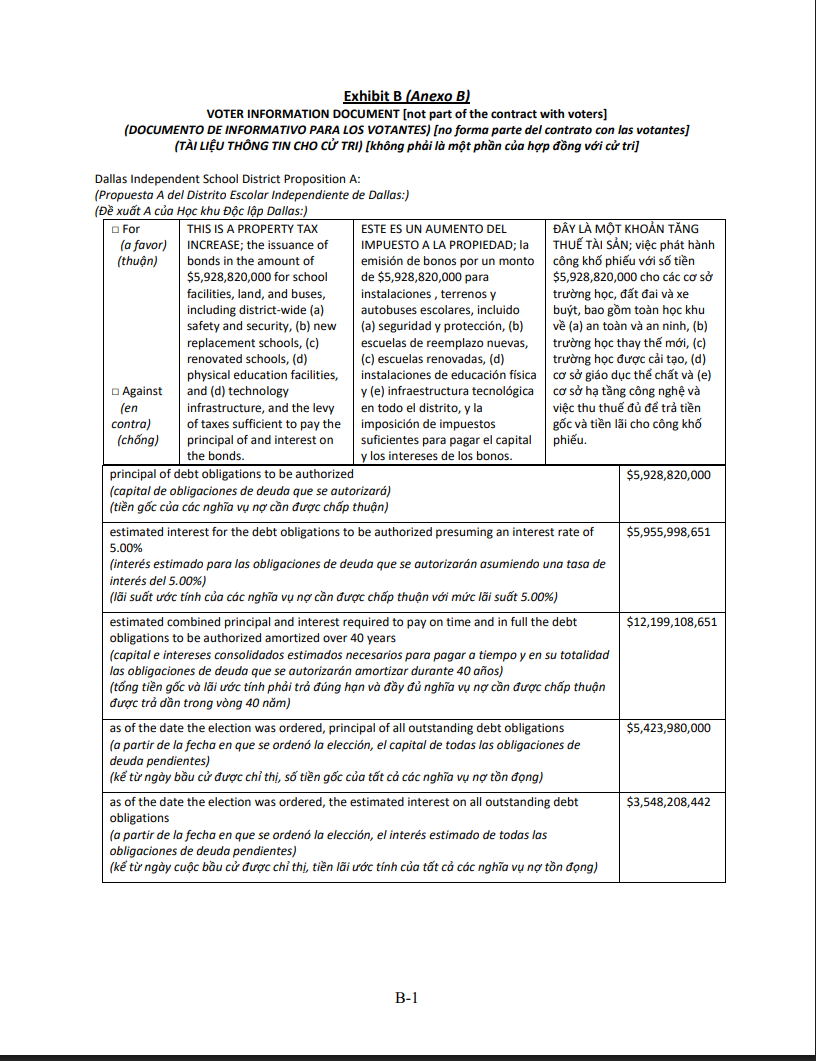
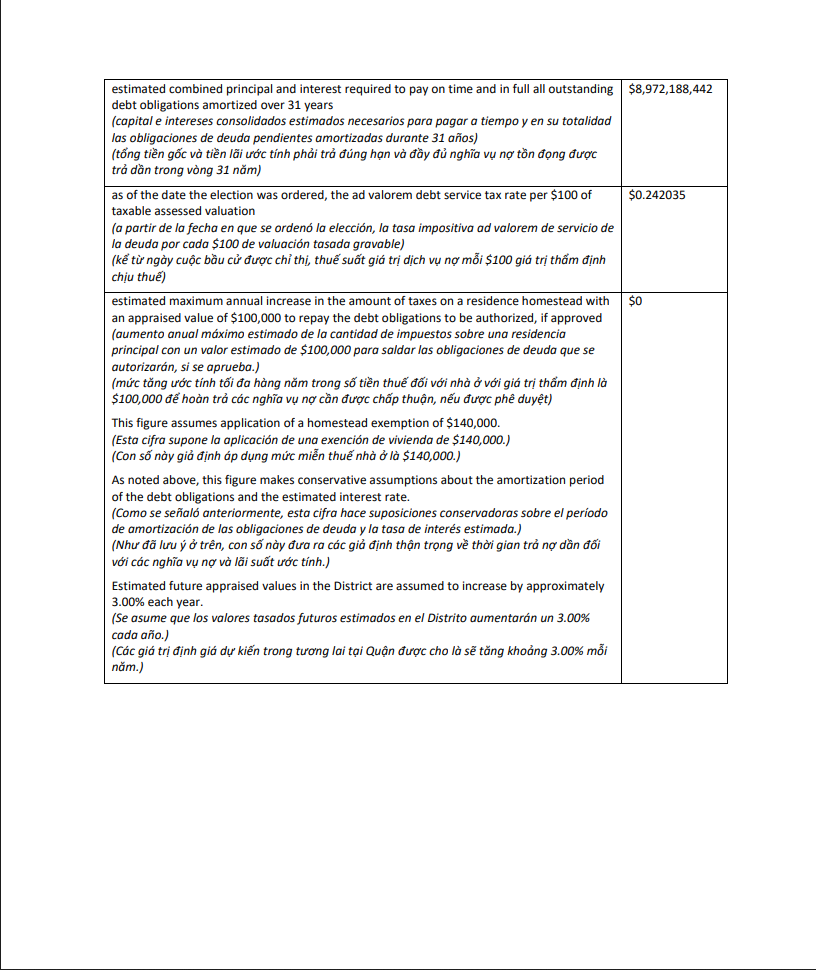
Note: Images attained through Dallas ISD’s Order of Bond Election page (Dallas Independent School District, 2026, pp. 90-91)
Celina ISD
Under the old model, Celina ISD held an election for two bonds in May 2025. Proposition A was projected to cost its residents $2.3 billion from its principal debt obligation and a total of $4.5 billion over 30 years, with an estimated interest rate of 5% (Celina Independent School District, 2025, p. 11) (see Image 3). Proposition B’s principal debt obligation was $20 million over 10 years with an estimated interest rate of 4%, totaling $24.7 million in debt obligations (Celina Independent School District, 2025, p. 12).
Celina ISD stated in their VIDs that borrowing a total of $2.3 billion would increase property tax amounts by $0. There are no official public data sources available for the median appraised property value in Celina ISD, but Celina ISD serves Collin and Denton counties, where the median price for residential properties in 2025 totaled $460,000 (Texas Real Estate Research Center, n.d.-a) and $445,000, respectively (Texas Real Estate Research Center, n.d.-b). This means that the approximate median taxable amount after applying the $100,000 homestead should have ranged between $360,000 and $345,000.3
Both Proposition A and Proposition B carried with immense support. There was a total of 1,970 voters for Proposition A, with 1,413 residents voting in favor and 557 voting against—a 72% passing rate (Texas Bond Review Board, n.d.). Proposition B had a total of 1,973 residents vote, with 1,379 voting in favor and 594 voting against—a 70% passing rate (Texas Bond Review Board, n.d.).
Image 3
Celina ISD Proposition A, 2025
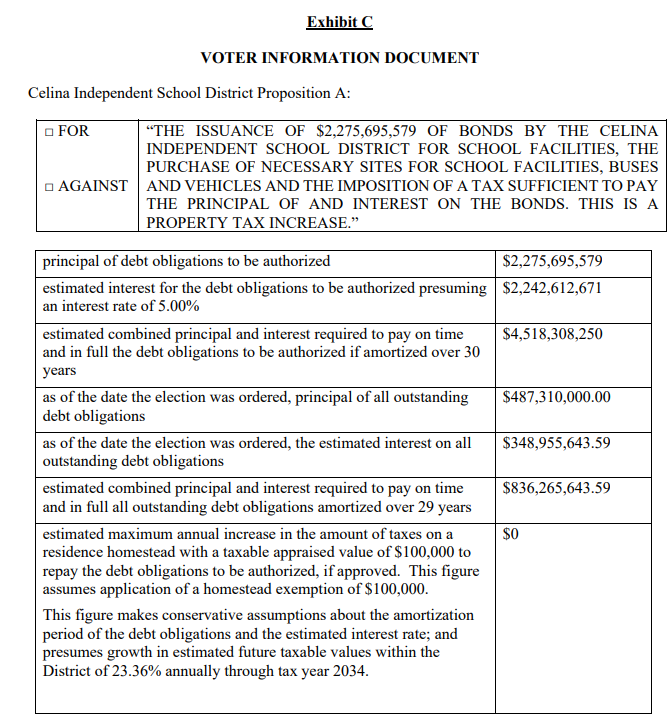
Note: Image attained from Celina’s ISD’s Bond Election Proposition page (Celina Independent School District, 2025, p. 11)
Hays CISD
In May 2025, Hays CISD held an election for five propositions. Proposition A was set to cost its residents $499 million from principal debt obligation and a total of $977 million over 30 years (see Image 4), with an estimated 5.125% interest rate (Hays CISD, 2025, pp. 18-19). Proposition B’s total principal and interest costs were estimated to be $775.6 million (Hays CISD, 2025, pp. 21–22); Proposition C’s estimated total cost was $12 million (Hays CISD, 2025, pp. 23–24); Proposition D’s estimated total cost was $100.6 million (Hays CISD, 2025, pp. 25–26); and Proposition E’s estimated total cost was $20.7 million (Hays CISD, 2025, pp. 27–28). In total, Propositions A, B, C, D, and E were set to cost Hays residents a total of $1.89 billion.
Using the same faulty methodology as Celina ISD, Hays CISD stated in their VIDs that paying $1.89 billion would increase property tax amounts by $0. Propositions A, B, D, and E were carried and totaled $963 million in principal debt. Only Proposition C was defeated, which was the smallest bond Hays CISD proposed. It was also very close to passing, with 1,227 residents voting in favor of Proposition C and 1,341 voting against it—a 4.4 percentage point difference with only 2,568 total votes (Texas Bond Review Board, n.d.).
Image 4
Hays CISD Proposition A, 2025
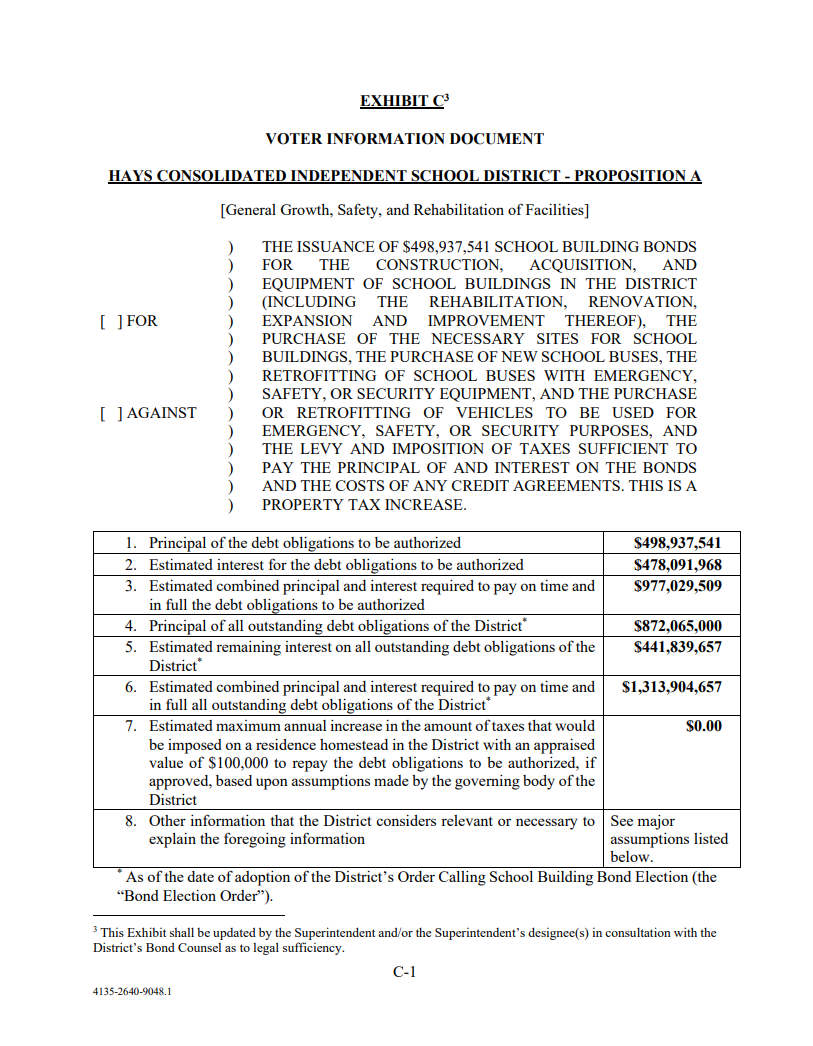
Note. Image attained from Hays CISD’s Order Calling School Building Bond Election page (Hays CISD, 2025, p. 18)
Location and Presentation Problems
Section 1251.052 (d) requires political subdivisions that maintain an internet website to “provide the information described by Subsection (b) on its website in an easily accessible manner…” Despite what Texas statute requires, many VIDs are not easily discoverable or accessible, which means that the instrument has limited value since residents either cannot find it or do not know of its existence.
For example, Hood County’s 2025 general obligation bond proposition required voters to navigate within their website database to find the VID. To access it, voters had to click on “2025 Bond Program,” then click on “Documents.” Hood County’s document page provided a search bar, making it easier to sort through all the various items. However, typing in “Voter Information Document” resulted in 500 search results (see Image 5) unless the voter changed the search filter from “Any Word” to “Exact Phrase.” If the voter changed the search filter, they would have encountered 10 results with none of the documents being titled “Voter Information Document” (Hood County, Texas, n.d.). If their search continued and voters clicked “2025 Bond Election Notice_English,” they would have finally found Hood County’s 2025 VID, starting on page 6 of the 7 total pages.
The City of West University Place’s general obligation bond in 2025 also required its voters to navigate through its website. Voters needed to begin their search by hovering over the “Departments” tab. They then had to click “Elections” found underneath the subheading “City Secretary’s Office.” Once completed, instead of providing VIDs at the top of the page, the voters arrived at the city’s “Election” page, where they had to scroll down and find “Ordinance No. 3080 – Ordering a Special Bond Election” in either English, Spanish, Vietnamese, or Chinese (see Image 6).
Image 5
Hood County’s Document Database
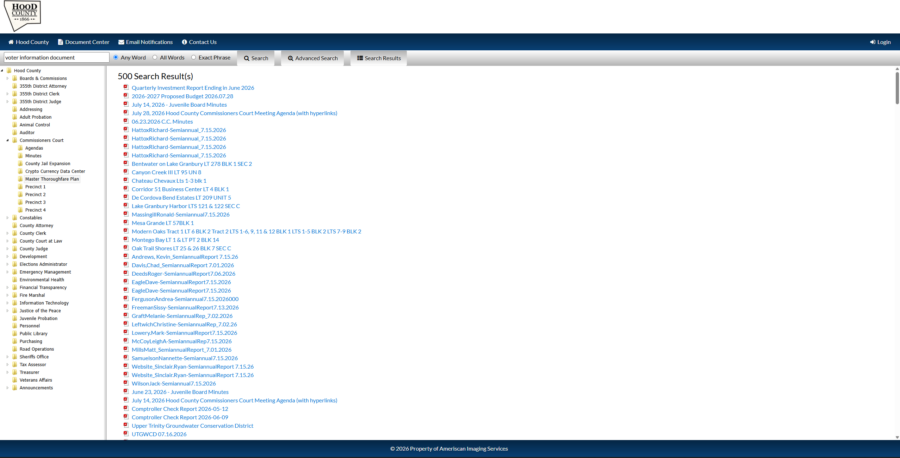
Note. Image from Hood County’s Documents on Demand page (Hood County, Texas, n.d.)
Image 6
City of West University’s Election Page
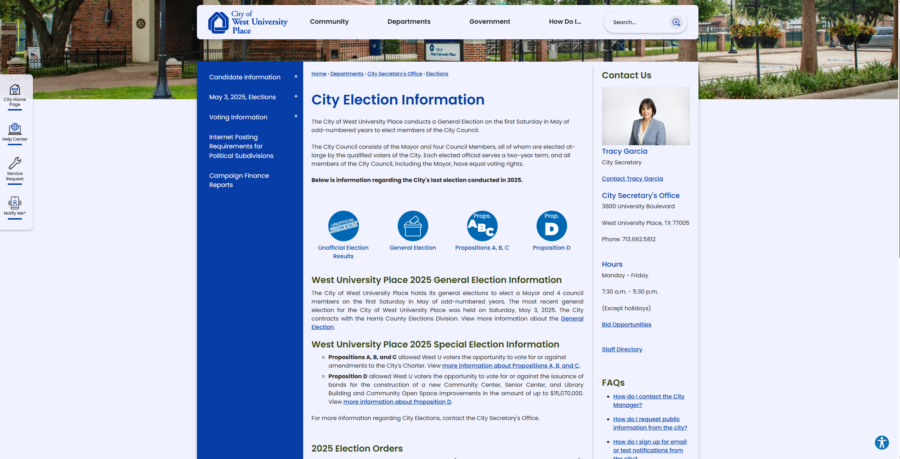
Note. Image from City of West University’s Elections Page (City of West University Place, n.d.)
Another challenge with the current VID arrangement is the lack of uniformity in presenting the material to the public. Other than what is explicitly required under state law, the state has no standardized format for how political subdivisions should display VIDs, thereby complicating any comparative analysis between jurisdictions.
As an example, the City of Killeen’s recent VID (2025, p. 7) included the legally required information—i.e., principal of debt obligation, estimated interest rate, estimated interest on all outstanding debt, among other specifications—in both English and Spanish with no separation, making it more difficult to read than if they had divided it into two distinct documents (see Image 7). Groesbeck ISD (2025, p. 9) scattered important tax information relevant to the voter throughout the document. They also added important information, such as estimates are “subject to change” and “interest rates represented are strictly conservative estimates,” in a footnote with smaller text (2025, p. 9). (see Image 8).
Image 7
City of Killeen, Proposition B
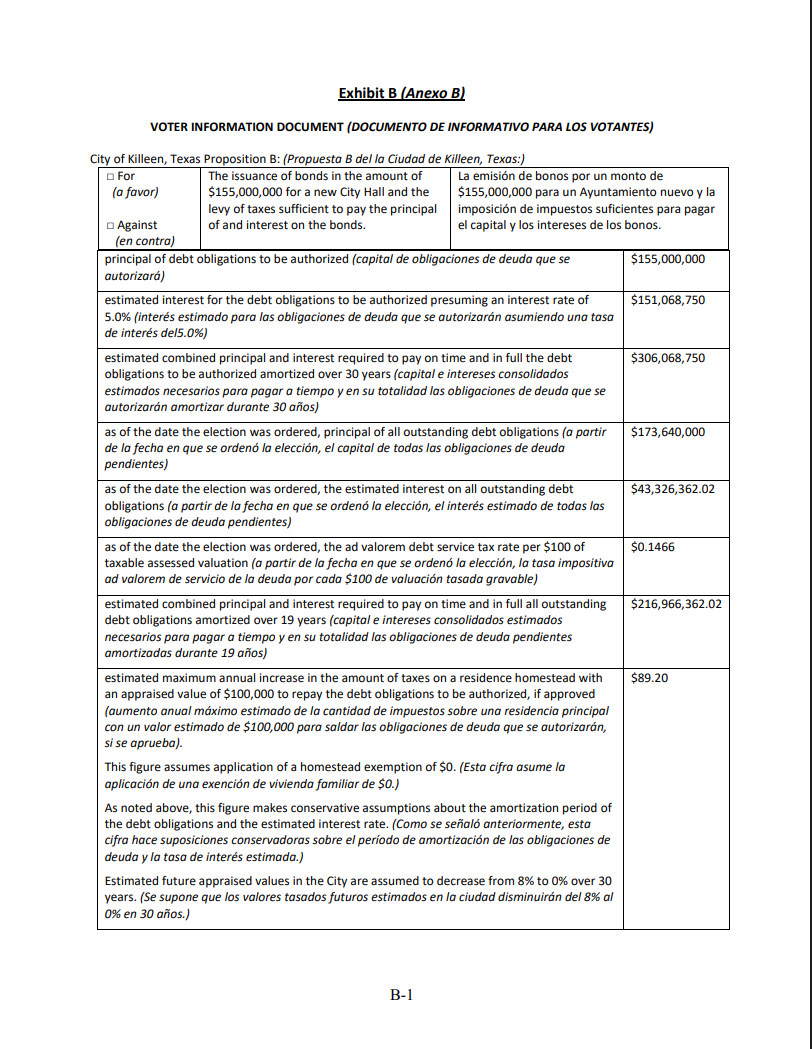
Note. Image attained from City of Killeen’s Notice of Bond Election page (City of Killeen, Texas, 2025)
Image 8
Groesbeck IDS, Proposition A
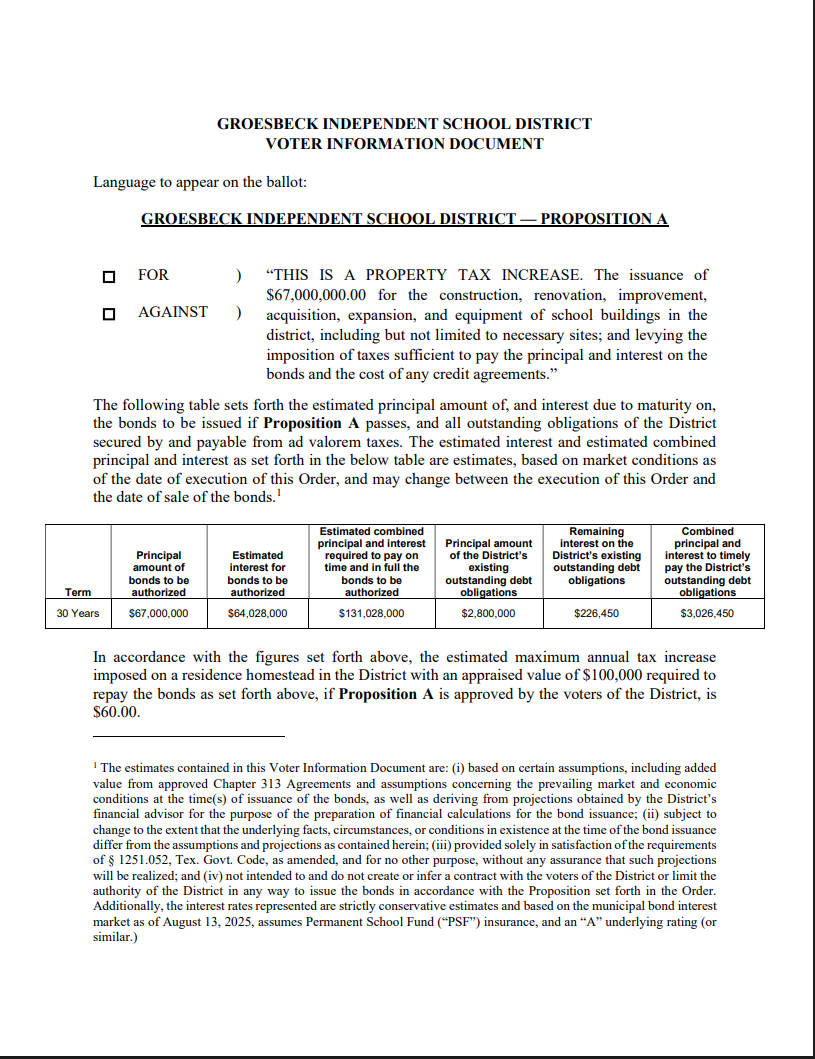
Note. Image attained from Groesbeck ISD’s Notice of Bond Election page (Groesbeck Independent School District, 2025)
Missing Context
A key issue in establishing clearer VIDs is for political subdivisions to estimate the tax burdens affecting the average voter within their jurisdiction. Typically, political subdivisions only provide how a proposition adds to local debt and does not personalize them in any significant way.
John Locke, whose principles of limited government were paramount in America’s founding, believed that good governance required voluntary compliance between the government and its citizens. Political subdivisions violate this Lockean principle when they manipulate or veil the information needed to equip a well-informed citizenry, and voters—not government—pay the price. An example of this problem is provided by Gretchen Gardner, an Austin artist who purchased a bungalow in 1991, who exclaimed that she had “voted for every park, every library, all the school improvements, for light rail, for anything that will make this city better,” but because her property tax soared to $8,500 annually, she cannot “afford to live here anymore” (Quintero, 2019). Gardner is one of many Texans who struggle with affordability given the rapid increase in property taxes, and her story is a testament to the responsibility that political subdivisions have in informing their citizens of the benefits and drawbacks of a given proposition.
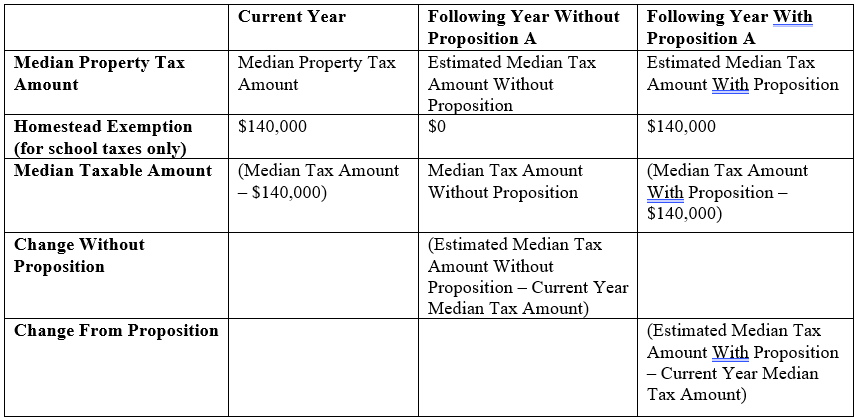
To ensure transparency, political subdivisions should provide their voters with a straightforward table illustrating current and potential tax burdens if a given proposition were to pass. Table 1 is a template that could be used in future ISD VIDs.4 This template includes the median person’s tax bill as it stands, the estimated median tax burden if a given proposition were to be denied, and the estimated median tax burden if a given proposition were to be carried. It ensures transparency by not only including total tax burdens, but also tailors how total taxes impact the typical homeowner.
Table 1
Template For Future VIDs
Recommendations
Lawmakers in the 90th Texas Legislature should consider the following ways to improve VIDs. Doing so will equip Texas citizens with the knowledge needed to make timely and accurate decisions that will shape the future of their communities.
Pursuing superior methodology, lawmakers should:
- Replace the statutorily prescribed $100,000 appraised value with an appraised value equal to the median taxable value in the jurisdiction, as determined by the county appraisal district; and
- Require political subdivisions to disclose all assumptions used to calculate the tax impact estimate.
Pursuing accessible VIDs, lawmakers should:
- Require political subdivisions to prominently display their VID(s) on their website’s homepage or bond election information page; and
- Require political subdivisions to present VIDs at the voting booth.
Pursuing clear and consistent VIDs, lawmakers should:
- Require the Texas Comptroller to establish a clear template for every political subdivision to use; and
- Require political subdivisions to include the following in their VIDs: the average person’s tax bill as it stands today, the estimated median tax burden if a given proposition fails, and the estimated median tax burden if a given proposition succeeds.
All these recommendations strengthen the mechanisms created by the 86th Texas Legislature to increase public debt transparency.
References
Celina Independent School District (2025). Bond Election Proposition May 3, 2025). https://www.texaspolicy.com/wp-content/uploads/2026/06/Celina-ISD-2025-Bond-Election-Proposition.pdf
City of Killeen, Texas. (2025). Notice of bond election (English). https://www.killeentexas.gov/DocumentCenter/View/12024/Notice-of-Bond-Election—English-PDF
City of West University Place, Texas. (n.d.). Elections. Retrieved March 19, 2026, from https://www.westutx.gov/160/Elections
Dallas Central Appraisal District, (2025) Median House Values (SFR) https://www.dallascad.org/MedHouseVal.aspx
Dallas Independent School District. (2026). Order of bond election (May 2, 2026). https://www.dallascountyvotes.org/wp-content/uploads/2026/03/DISD-Order-of-Bond-Election-050226.pdf
Groesbeck Independent School District. (2025). Notice of bond election (Groesbeck ISD) [PDF]. Falls County, TX. https://web.archive.org/web/20260317091339/https:/www.co.falls.tx.us/upload/page/0358/2025/Groesbeck%20ISD%20Notice%20of%20Election%20jhgf.pdf
Hays Consolidated Independent School District. (2025). Order calling school building bond election (Hays, Caldwell, and Travis Counties). https://votetravis.gov/wp-content/uploads/Hays-Order-Combo-Updated.pdf
Hood County, Texas. (n.d.). Hood County documents on demand [Online document portal]. Retrieved March 19, 2026, from https://hoodcountytx.documents‑on‑demand.com/?l=2fc4b9068582ef11a420000c29a59557
HB 477. Enrolled. 86th Texas Legislature. Regular. (2019). https://capitol.texas.gov/tlodocs/86R/billtext/pdf/HB00477F.pdf
HB 477 Bill Analysis. House Research Organization. 86th Texas Legislature. Regular. (2019, April). https://hro.house.texas.gov/pdf/ba86r/hb0477.pdf
Quintero, J. (2019, February 26). Testimony before the Senate Committee on Property Tax: SB 462 [PDF]. Texas Public Policy Foundation. https://www.texaspolicy.com/wp-content/uploads/2019/02/2019-02-26-T-CLG-Quintero-SB462-Property-Tax.pdf
Texas Bond Review Board. (n.d.). Local government bond elections search. Texas Bond Review Board Data Center. Retrieved March 19, 2026, from https://debtsearch.brb.texas.gov/bond_elections_search.aspx
Texas Constitution. art. VIII, § 1-b.
https://statutes.capitol.texas.gov/Docs/CN/htm/CN.8.htm
Texas Government Code § 1251.051 (2019).
https://statutes.capitol.texas.gov/Docs/GV/htm/GV.1251.htm
Texas Government Code § 1251.052 (2019).
https://statutes.capitol.texas.gov/Docs/GV/htm/GV.1251.htm
Texas Real Estate Research Center. (n.d.-a). Housing activity: Collin County. Texas A&M University. https://trerc.tamu.edu/data/housing-activity/?data-County=Collin+County
Texas Real Estate Research Center. (n.d.-b). Housing activity: Denton County. Texas A&M University https://trerc.tamu.edu/data/housing-activity/?data-County=Denton+County
Texas Secretary of State. (2023). Breakout sessions for other political subdivisions (35th Annual Election Law Seminar). https://www.sos.state.tx.us/elections/forms/seminar/2023/35th/breakout-sessions-for-other-political-subdivisions.pdf