As the Texas State Board of Education prepares to approve standards for the new required Personal Financial Literacy course, the California nonprofit that pushed the course, Next Gen Personal Finance, has been outed as promoting instructional materials that advance racial grievance, in addition to taking an overall shallow approach to financial literacy.
The State Board of Education should reject materials from any organization that produces Critical Race Theory-adjacent curriculum, and instead teach students not only how to manage money but how our economic system works.
The State Board of Education has been put in a tough position with regards to the new Personal Financial Literacy course. In 2022, the SBOE modernized the required economics course to include the role and benefits of free markets and enterprise in American society, as well as basic economic principles. In the 2025 legislative session, however, the Texas Legislature mandated that all students must take a personal financial literacy course, relegating economics to an elective. Now, the SBOE must decide whether it can spare the space to explain to students how public policy affects their economic fortunes, in a time when young people increasingly embrace the failed ideas of socialism, in between lessons on how to responsibly budget and use credit.
Unfortunately, Next Gen Personal Finance, for an organization that touts practical education, offers a shockingly superficial program of study. The lessons cover basic facts about financial systems and instruments, such as checking and savings accounts, but does not teach students the forces behind prices, wages, and interest rates. Taxes are just a line on your paystub.
We are seeing the consequences of this economic illiteracy in cities like New York and Chicago, where voters cannot see that the cost of regulation and taxation raises the cost of living, and rent-control restricts supply.
Next Gen’s problems do not end there, though, because there is one societal force Next Gen is dedicated to talking about: Racism. Next Gen offers an entire unit on Racial Discrimination in Finance. Not only is this unit irrelevant to personal finance, but its approach is also a reminder of why you can refer to Critical Race Theory as CR-Me. The unit discusses racial discrimination in financial wealth, banking, housing, education, and employment, but every phenomenon is treated as a particular affront to racial minorities, even when they were not the primary group affected.
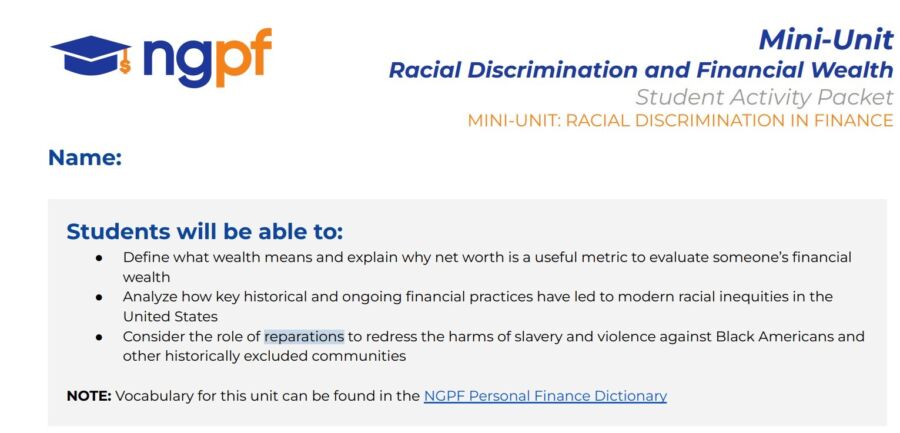
The unit explains to students that black Americans suffer financial harm because of discriminatory practices from 50 to 100 years ago, like redlining and sharecropping. Did you know that 85% of households “redlined” by banks were white? Or that two-thirds of sharecroppers were white? You still won’t after taking Next Gen’s course. You also will not be told that the federal government’s meddling in the housing market to make it “more fair” was a major contributor to the 2008 financial crisis. The sole focus of these lessons is to blame the racism and oppression of the United States for the lack of financial success of certain minority groups. The unit ends with an activity encouraging our newly minted revolutionaries to “take action.”
HB 27 instructs the SBOE to identify open-source curricula for schools to use, and the SBOE should obviously not approve Next Gen Personal Finance. Instead, the SBOE should recommend curricula that teach the principles of applied personal financial literacy. Next Gen teaches students how to manage money, but applied PFL teaches students how money works. Students should learn not only how to spend and save wisely, but how supply and demand and free enterprise shape their opportunities in the Texas economy.
As mentioned earlier, public policy affects almost every aspect of the economy, and an informed citizenry will better evaluate the economic consequences of the actions of their elected officials. Moreover, left-wing activists preach an ideology of pessimism that frames the economy as unfair, and financial success impossible without heavy government intervention.
Real financial literacy should inspire students see themselves as future entrepreneurs, investors, and employers, not paralyzed them with hopelessness.
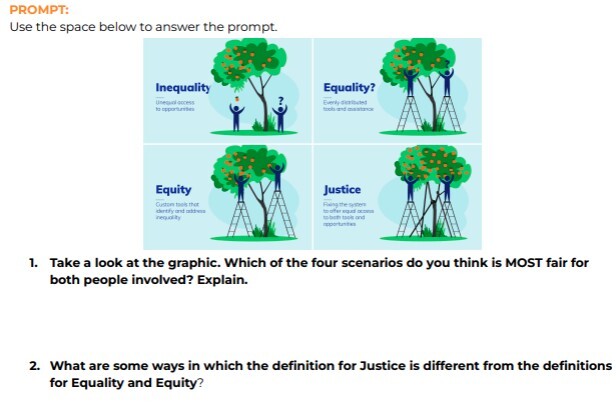
Next Gen Personal Finance doesn’t just teach financial literacy. It tries to influence how you see distributive justice.
Leaving these economic principles out of financial literacy weakens students’ understanding of the economic system that has made Texas and America prosperous. Without learning private property, free enterprise, opportunity cost, and the wealth-creating power of markets, students are less prepared to evaluate competing economic philosophies including socialism and Marxism.
Texas should ensure every graduate understands the principles that have produced prosperity, expanded opportunity, and made this state’s economy one of the strongest in the world.