Many city, county, and school district officials are right now deciding where to set tax rates for the next fiscal year. In some cases, these local decisions will push property taxes higher, creating new challenges for families struggling with affordability.
Given the very real prospect of tax hikes on the horizon, now is the time for Texans to learn what their local elected officials are doing and get involved in the decision-making process—while there’s still time to push for taxpayer-friendly alternatives.
To better illustrate what may be around the bend, let’s consider the city of Mineral Wells, a relatively small community located about 50 miles west of Fort Worth.
According to its latest Notice of Public Hearing on Tax Increase, Mineral Wells’ city council has proposed a total tax rate of $0.7007075 per $100 of value, which is a massive 22.55% increase over the previous year. With home values expected to climb by 56.45%, the act of pairing a huge rate hike with higher property values will result in soaring tax bills.
Based on the city’s own estimates, the adoption of the proposed tax rate will cause the typical homeowner’s annual tax bill to grow from $535.95 this year to $1,027.59 next year. That is a one-year tax hike of $491.64 per household or 91.73%.
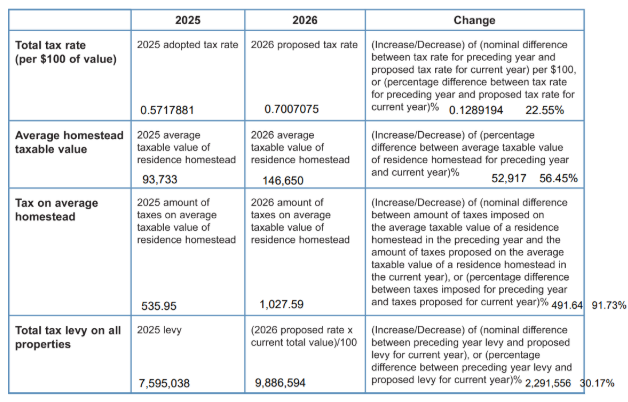
Source: Notice of Public Hearing on Tax Increase
Of course, there is no requirement that Mineral Wells officials adopt the proposed tax rate. In fact, they have the discretion to choose a better, friendlier option in the form of the no-new-revenue (NNR) tax rate. The NNR rate is the tax rate that would effectively hold tax receipts constant and “giv[e] homeowners and businesses a chance to catch their breath.”
For residents interested in seeing officials adopt the NNR tax rate, the city is hosting an upcoming forum to solicit public input and give taxpayers a chance to voice their concerns. The details are as follows:
