American Society of Mexico – Keynote Speech
By Greg Sindelar, Chief Executive Officer, Texas Public Policy Foundation
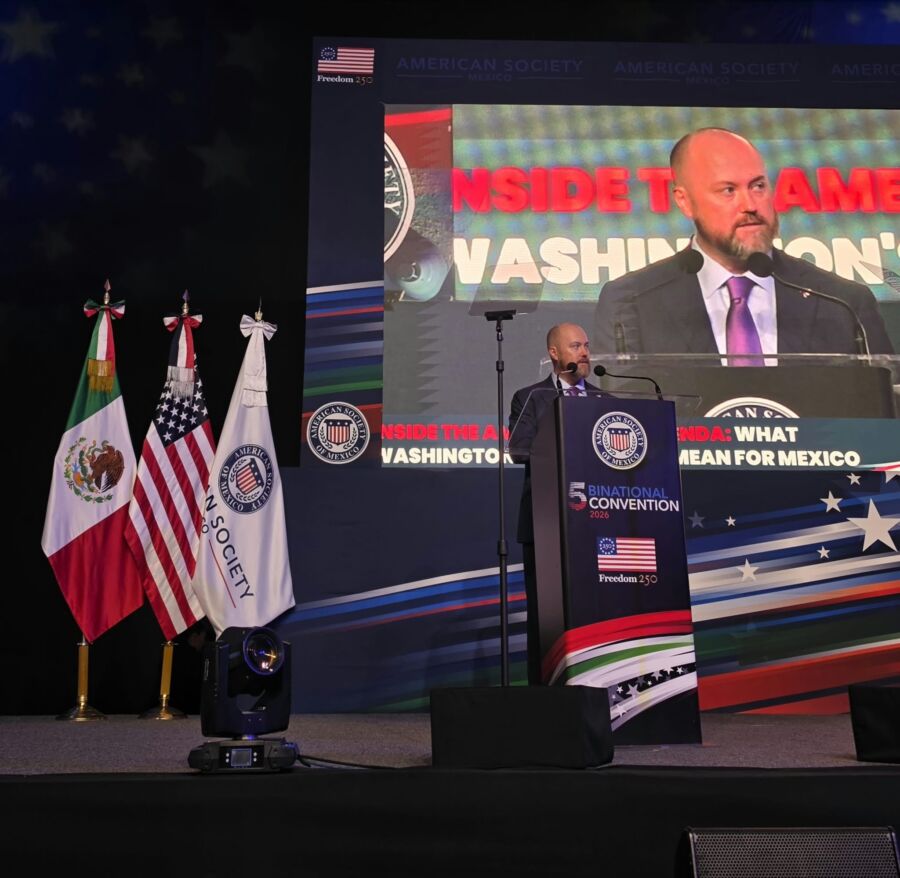
I want to thank the American Society of Mexico for the opportunity to speak with you all today. I also want to personally thank Larry Rubin, Glenn Hamer, and all the American Society team for their friendship, their graciousness, and especially their dedication to the U.S.-Mexico relationship.
As a Texan — and as the CEO of the Texas Public Policy Foundation — the relationship between the United States and Mexico is always at the forefront of our concerns. The issues connecting our state and your nation are so numerous that it is impossible to mention them all. You all, especially you all in the business community, live them every day.
You know that the shared history of Texas and Mexico, encompassing both triumph and tragedy alike, is a constant presence in our relationship.
You know that the entwined economies of Texas and Mexico, a phenomenon going back to the Spanish settlement of the eighteenth century and the old Camino Real, affect lives and livelihoods on both sides of the border.
You know that there are several million Mexicans in Texas, both by nationality and by ethnicity — and that there are several million Americans in Mexico, both as a business proposition and as a lifestyle. And you know that we are fated to be neighbors, for all time — and whether that fate is a blessing or a curse is up to us.
Of course, I don’t speak here just as a Texan. Just as important, I am an American, un estadounidense, and so all our concerns with Mexico are American concerns too. In my other role as President of the America First Policy Institute, I contend with this every day — as do the scholars and colleagues who work with me.
The United States of America looms large in the Mexican civic consciousness: much larger, in fact, than does Mexico in the American civic consciousness. And I want to speak candidly about that today, because understanding that difference is essential to understanding the forces behind policymaking, both in Mexico City and in Washington, D.C.
Let me be very clear: I do not come to you with a special insight or unique prediction of the Trump Administration’s next moves. No one does, and no one can. This White House is qualitatively unique in American history to the extent that it keeps its cards close. That’s proper and necessary.
In the policy world, we see our role as informing the work of governance: but we are not governance ourselves. But you need no special insight to understand where American policy is headed, or why it is headed in that direction. The public record is sufficient — and sufficiently explanatory.
I would describe it in three pillars:
The first is Mexican-regime perception, and consequent action, of and toward the United States of America.
The second is American-political perception, and consequent action, of and toward Mexico and especially the Mexican regime.
And the third is the basis for hope and optimism — even now, even when relations are at their most difficult in nearly a century.
That’s a simple truth that should be stated plainly:
We are in the midst of the most grave crisis in U.S.-Mexico relations in nearly a century.
But before we talk about why, let me be clear about what this crisis is not. We are not in this crisis because the United States seeks to undermine or end Mexican sovereignty, nor because of some grand American design on Mexican civics, resources, or territory. Those interpretations are, in my view, fundamentally mistaken.
Let me state plainly that I do not dismiss Mexican strategic thought on the risk attendant to neighboring the United States. Just days back you commemorated the Heroic Young Men of Chapultepec, who gave their lives in defense against an American invasion, and as a Texan I both admire and appreciate that valor and patriotism.
Nevertheless, this is the twenty-first century, not the nineteenth: and it is past time to move beyond 1847 as the template for events.
We are also not in this crisis because Mexico and the Mexican regime are a cartel-controlled narco state.
This may surprise some of you who have paid close attention to the work done by my colleagues at both TPPF and AFPI, who have exposited at length on the criminal ties within the Morena party and the Mexican state at large. I agree with all of that work, and the charges raised are unfortunately accurate.
Yet that is not the whole story.
Yes, Morena in particular has severe challenges with narco ties at its highest level — and we focus upon it because it is the party of government, repeatedly endorsed across the past decade by overwhelming Mexican-voter majorities.
But hear me clearly: no major Mexican political party can claim a clean record in this respect, and what afflicts Morena is ultimately an affliction of Mexican civics at large.
Furthermore, it is simply not the case that any given Morena senior officeholder may be assumed a cartel associate. I will tell you directly that I do not believe President Claudia Sheinbaum is among them, nor do I believe the advisors and counselors she trusts are among them.
That, in itself, is a reason for hope.
Hear me clearly on this too: it is not the role nor the purpose of any American to engage in Mexican party politics, nor to prefer one to the other.
We speak of Morena because it governs Mexico, and that is the extent and source of our concern. Andrés Manuel López Obrador (AMLO) disrespected American civics by attempting to sway Mexican-American voters in the United States to prefer one political party to another. We do not disrespect Mexican civics in return. Who governs, and how, is for Mexicans to decide. As Americans, our concern extends to how it affects us.
This leads directly to my first item: Mexican-regime perception of the United States of America.
That perception is, to be absolutely candid, frequently unreal and unmoored from reality.
I’ve already spoken of the paranoia underlying much of the interpretation of U.S.-government action toward Mexico. I have also acknowledged that it does not come from nowhere: it is true that the United States and Mexico have made war upon one another more than once, and that the United States has usually — though not always — won, with consequences for Mexican territory and sovereignty.
Yet the tradition in Mexican politics that believes the relationships of 1847 and 1914 are current now, in 2026, is a tradition that must be laid to rest if the future of the binational relationship is to be secured.
Mexican fears of American invasion of Mexico, and the overthrow of Mexican sovereignty, are in the present day as real and well-founded as French fears of German invasion, or American fears of Canadian invasion, in 2026.
There is no American plan or aspiration to control Mexico. There is no American scheme to control Mexican politics. There is no American desire to elevate or overthrow any Mexican political party. Anyone, Mexican or American, who tells you these things should be dismissed from the conversation, so that the conversation can proceed in reality.
This leads directly to my second item, which is American perception of the Mexican regime and its actions.
Mexican civics routinely misapprehends the signal American aspiration in Mexico.
Let me share it with you:
It is to not have to think about Mexico. To have Mexico as a good neighbor with whom we trade, prosper, vacation, and retire — and whose sovereignty we respect.
That is it.
It is the tragedy of Mexican misgovernance since 2006, and accelerated massively since 2018, that America has been forced to think a great deal about Mexico, in detail, in ways we have not in nearly a century.
Concurrent with this is a fact that requires emphasis, especially now, and especially in the context of this very difficult 2026:
There is no bigger supporter of Mexican sovereignty than the United States of America.
Contrary to what you hear, over and over again, from so much of the political class, it is the United States that wants Mexico and the Mexican state fully sovereign and fully in control of every square centimeter of its territory.
It is the United States that offers its aid and assistance in Mexico’s own efforts at excising narco-terrorists and cartel control from Mexican communities, Mexican cities, and Mexican states.
And it is the United States that holds to account the politicians who betray their public trust and their nation in cooperating with, and enriching themselves from, the cartels and criminals.
There are those who have said that the United States will not be satisfied until it dictates the terms of Mexican political life.
You heard that after the April indictments of Governor Ruben Rocha Moya, and Senator Enrique Inzunza, among others.
You heard that after the news that U.S. visas, including that of Andres Manuel Lopez Beltran, were revoked.
You heard that, and you know who you heard it from.
Those who say that are wrong.
The United States wishes to protect itself, it’s true.
The United States seeks consequences for the partners of criminal cartels, known and suspected, it’s true.
But think back to the fundamental American goal of not having to worry about Mexico:
Does the United States seek a controlling role in Mexican civics? In Mexican politics? In Mexican public life?
No. No. And no.
The very idea is preposterous.
What the United States seeks, in the long run — as Mexico assumes full sovereignty and full responsibility for its territory and its civics alike — is a scenario in which American security concern, and American security involvement, and American indictments and prosecution, are totally unnecessary.
I want to be very explicit: The ideal American involvement in Mexican affairs, outside of trade and friendly relations, is zero.
We aren’t at that ideal state yet. In fact, it might seem like we’re further from it than ever.
I said earlier that U.S.-Mexico relations are at their worst point in nearly a century. I stand by that.
The events of this year have been extraordinary:
We have all seen the revelations of CIA activity in Mexico — working alongside both Mexican-state and Mexican-federal personnel.
We have all seen the unprecedented U.S. indictments of Mexican officeholders.
We have all seen the denunciations of the American President by the former Mexican President.
We have all seen the denunciation of American intentions by the current Mexican President.
And we have all seen the tension and paranoia surrounding the question of further indictments, and further action.
I wish I could tell you we’re near the end of this crisis — but we are not.
I don’t know how it ends, but I know two things are certain.
The first is that the United States Department of Justice will get its man.
An indictment is not a negotiating point. An indictment is forever, and the only way out of it is a fair trial — or a negotiated plea. The American record of accountability and pursuit is crystal clear: though it may take years, or even decades, no indicted figure may rest easy on the run. I don’t know what course the indicted persons may take: I only know that they will, eventually, answer to American justice.
The second certainty is that the seeds of repair — of a better relationship — are already evident and present, if we want to nurture and grow them.
And that brings me to my third and final item:
There is, even now, a basis for hope and optimism.
You see, two things can be true at once.
One thing that is true is that the Mexican government has tied itself into knots resisting, avoiding, and obscuring accountability for the indicted narco-politicians in its ranks. From this standpoint, Mexico is governed by a regime that cannot bring itself to excise the rot close to its own core — because it sees that excision as an existential threat to itself. The specter of the United States is more grave and menacing to it than is the specter of the narco. This is a strategic challenge, at the heart of all else.
But the other thing that is true is that the very same Mexican government has delivered on operational and tactical cooperation with the United States.
Under the leadership of both President Sheinbaum and Omar Garcia Harfuch, it has delivered real wins in the fight against the cartels that plague our binational relationship.
This is why I said, earlier, that those who characterize Mexico as an outright narco-state are simplistic and wrong. Mexico is not its cartels. Mexico is not its politicians. And Mexico is not reducible to its government.
Mexico and the Mexican state still have powerful and substantive elements, reaching up to the highest levels, that genuinely want to fight for their country, for the rule of law, and yes, for sovereignty — and do so in cooperation with the Americans.
Let’s not overlook their wins:
Labs destroyed.
Narcos arrested and extradited.
Narco-terrorists curbed.
And let’s especially remember the people who have made those victories possible.
Mexican soldiers, sailors, Marines, and law-enforcement personnel have laid down their lives in these operations.
They died as patriots — just as much as were the Heroic Young Men of Chapultepec — defending their country.
In fighting the narcos, they were defending my country too. And as an American, I want you to know that we honor every one of them.
This is the basis for hope and optimism, even now:
The Mexican regime can choose to build upon that admirable record, laid down since October 2024, and expand it into the realm of the strategic. It can bring to justice the criminals not just in the cartels, but those in office as well. It may seem unimaginable now — but imagining it is the first step to doing it.
And this is where each of you comes in.
You, each of you here, have the power to help make it happen.
I have neither influence nor counsel in Mexican governance — and I shouldn’t. I’m a foreigner.
But this is your country, and your voice matters. Even now, especially now, it matters.
Let no silence mar the record of who pushed Mexico to stand up and defend itself against the criminals and the corrupt.
We are fated to be neighbors, for all time — and whether that fate is a blessing or a curse is up to us. But I believe we have it in our power to make it a blessing, as indeed it has been in so many ways.
What is required is vision, statecraft, wisdom — and patriotism.
Because an American patriotism that puts America first, and a Mexican patriotism that puts Mexico first, need not put us at odds.
They can be the foundation of a genuine partnership.
America First does not require an America that dominates its neighbors. Mexico First does not require a Mexico that distrusts its neighbors.
It requires two sovereign nations, secure in their own interests, confident in their own identities, and strong enough to work together.
This Society — the American Society of Mexico — was created during the Second World War, and one of its first acts was funding the purchase of a fighter aircraft for Mexico’s famous Squadron 201. Those brave Mexican aviators flew and fought along Americans against the Axis powers: two nations, not just neighbors, but allies in war.
We can be allies in peace too.
That is the relationship I believe Americans and Mexicans should want.
Not merely neighbors, but partners.
And the future is ours if we wish it — all that is needed is to make it so.
Thank you.