Bring Home the Mississippi Miracle: A Texas Triumph in Early Literacy
Texas lacks a coherent third-grade literacy standard and statewide implementation system. Restoring a mastery-based promotion gate and aligning coaching, screening, and funding can reverse stagnating reading outcomes.
Key points:
- Texas removed its third-grade promotion requirement, weakening the connection between reading mastery and grade advancement.
- Mississippi’s gains resulted from aligning statutory standards with statewide coaching, screening, intervention infrastructure, and retention.
- Texas lacks a mandatory literacy coaching network, statutory individual reading plans (IRPs), summer academies, and a clear third-grade proficiency gate.
Executive Summary
Education and an educated citizenry are among the key pillars of Western civilization. From the ancients, like Plato and Aristotle, to the Enlightenment thinkers, such as John Locke, the necessity of a populace becoming properly educated is what creates, ultimately sustains, and secures a just society.
The original framers of the Texas Constitution sought to cement education as part of the new Republic, and directed the Legislature to provide Texans with a “general diffusion of knowledge” as it is “essential to the preservation of the liberties and rights of the people[.]” (Tex. Const. Art. 7. sec. 7) This obligation has been duly observed by policymakers from a funding perspective, but over the last few decades, the quality of education has not kept pace, as evidenced by the fact that literacy rates among the youngest among us have remained middling.
Texas is currently facing an inflection point. Fourth-grade reading outcomes have stagnated over the past decade, and a significant share of students advance beyond third grade without mastering foundational reading skills (Nations Report Card, 2024). While Texas has implemented important reforms including science-of-reading training through Reading Academies, the state still lacks a coherent structure that aligns standards, accountability, instructional capacity, and funding around a clear and enforceable expectation (Texas Education Agency, n.d.).
The “Mississippi Miracle” proved that a state can rise from 49th in fourth-grade reading in 2013 in national rankings to 9th by 2024. The Literacy-Based Promotion Act (LBPA) of 2013 implemented a number of levers, including science-of-reading reforms, teacher development, reading coaches, and, most importantly, grade retention for students who did not meet grade-level reading standards (Mississippi Department of Education, 2017). Mississippi established a third-grade promotion standard within a statewide infrastructure that included universal screening, mandatory Individual Reading Plans (IRPs), literacy coaching networks, structured professional development, summer reading academies, and stable annual appropriations.
Texas once maintained a similar mastery-based promotion system under the Student Success Initiative (SSI), but its removal of student retention requirements diminished the urgency around early literacy (Texas Education Agency, 2025). The education infrastructure in Texas already possesses many of the foundations associated with literacy reform. The Texas Education Agency’s (TEA’s) 2025 Texas State Literacy Plan outlines a statewide framework that centers on science-of-reading instruction, high-quality instructional material, early screening, and professional development for teachers (Texas Education Agency, 2025). While the Texas Reading Academies, Research-Based Instructional Strategies (RBIS), Strong Foundations Planning grants, and state-developed Bluebonnet Learning curriculum are aligned with the Texas Essential Knowledge and Skills (TEKS), each initiative operates without clear statutory promotion standards that tie early literacy mastery to grade advancement.
The ability to read and write is foundational to becoming a productive citizen and, in turn, to creating a prosperous society. In an effort to bring about the “Texas Triumph,” turning the page on previous unsuccessful methods of reading instruction is vital. Literacy improvement efforts in Mississippi have shown that it can be done, and they provide the framework for bringing that success home. The 90th Texas Legislature can restore consistency by reinstating a third-grade proficiency requirement and pairing it with a statewide early literacy delivery system.
BACKGROUND
I. The Literacy Crisis in Texas
Performance Trends
The transition from Texas Assessment of Knowledge and Skills (TAKS) to State of Texas Assessments of Academic Readiness (STAAR) fundamentally restructured Texas’s accountability system. Under TAKS, testing relied on grade-level assessments that sampled the curriculum. STAAR replaced that model in 2012 with course-specific end-of-course exams. This shift tightened the alignment between daily instruction and accountability by making tested courses the primary measure of performance (Texas Education Agency, 2012). STAAR was framed as more rigorous, with cut scores intended to reflect college- and career-readiness. Test results became central to A–F campus ratings, which drive public comparisons and trigger state interventions. Periodic recalibrations of the A–F framework further institutionalized the state’s authority to redefine performance standards.
As accountability was magnified, low ratings increasingly justified sanctions, including mandated improvement plans and potential state intervention in district governance. Assessment thus evolved from an evaluative instrument into the backbone of a performance-based governance system. At the same time, the removal of automatic third-grade retention under the SSI marked a retreat from a clear accountability lever. The state maintained testing and reporting, but relinquished the statutory consequence that once tied early literacy to promotion policy.
Implemented between 1999 and the early 2000s, SSI formed the early literacy accountability framework of Texas’s modern education system. Texas first moved against social promotion in 1984 when state law required that grade advancement be based on academic achievement rather than student age alone. This principle later became embedded within the Texas Education Code’s broader promotion statutes. In 1999, the Legislature significantly strengthened this approach by enacting the SSI, a policy package designed to ensure that students acquired foundational reading and mathematics skills before advancing to higher grade levels, which also aligned with the No Child Left Behind Act in 2001 (Texas Education Agency, 2021).
The promotion gates established by SSI remained in place for nearly two decades but were suspended during the COVID-19 pandemic. In the 2019–2020 school year, the TEA waived SSI promotion requirements due to widespread school closures. Students in grades five and eight still took the state assessments once, but were not subject to automatic retention or retesting requirements.
In the 2020–2021 school year, the Commissioner of Education again used waiver authority to suspend the statutory promotion requirements, thereby eliminating the mandatory retesting provisions associated with SSI. Promotion decisions during this period relied on local criteria, including course grades, teacher recommendations, and available assessment data. Following the pandemic, the statutory promotion gates were not reinstated (Texas Education Agency, 2024). After that year, HB 4545 eliminated the retesting and retention requirements for fifth and eighth grades and shifted Texas toward an accelerated-instruction model. Later, other changes expanded parental authority to request grade repetition or course retaking. Data trends suggest that this structural shift coincided with stagnation in early literacy performance (National Center for Education Statistics, 2023).
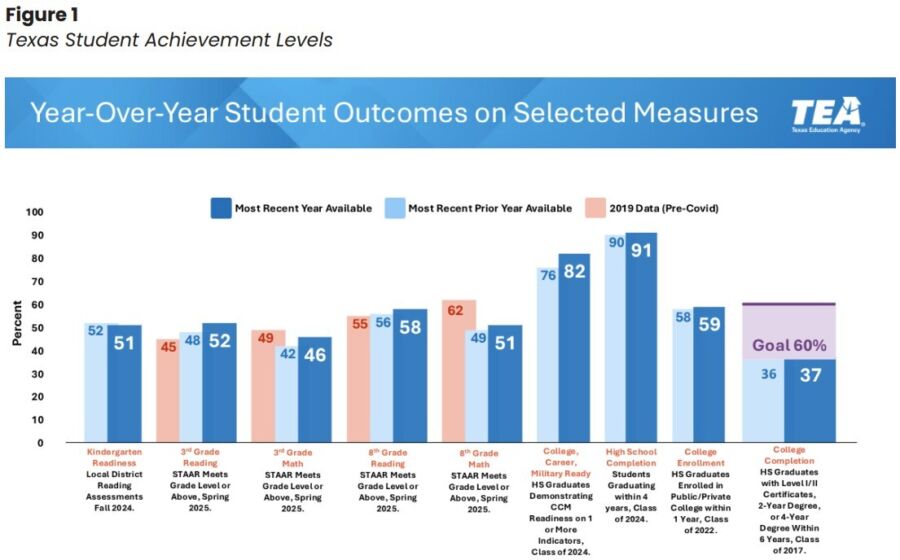
Figure 1
Texas Achievement Levels vs. National Achievement Levels
Note. Data from Texas Education Agency, 2026.
While Texas remains near the national average in fourth-grade reading, it has not experienced sustained upward movement relative to other states.
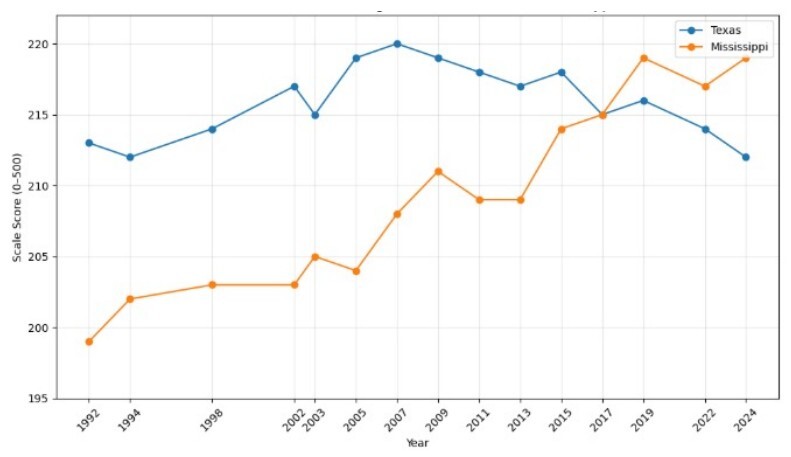
In contrast, Mississippi, which embedded mastery requirements within structured literacy systems, experienced measurable gains. The post-pandemic period further exposed systemic vulnerability, with National Assessment of Educational Progress (NAEP) results showing declines in reading proficiency nationwide, and Texas being unable to demonstrate resilience beyond national trends.
Graph 1
NAEP 4th Grade Reading Scale Scores: Texas vs. Mississippi
Note. Data from National Center for Education Statistics, 2022.
Often called “The Nation’s Report Card,” NAEP is a congressionally mandated testing program administered by the National Center for Education Statistics that has measured U.S. reading and mathematics achievement since the late 1960s. It assesses representative samples of students in grades four, eight, and twelve using a common national test, and reports results only at aggregate levels, such as states, large districts, and demographic subgroups. Because its scoring scale and achievement levels remain stable across states and over time, NAEP provides the most consistent benchmark for tracking long-term literacy trends and comparing reading performance nationwide (Wolfe, 2025).
Beyond aggregate averages, subgroup performance reveals persistent gaps among economically disadvantaged students and English learners (EdSurge, 2025). These patterns reinforce that early decoding and fluency acquisition remain uneven and insufficiently institutionalized. Without structural reform, these disparities will likely persist.
Why Third Grade Matters Structurally
The significance of third-grade literacy cannot be overstated. It is in the third grade when students go from learning to read to reading to learn.
Cognitive research indicates that early elementary years are critical for phonemic awareness, decoding fluency, and vocabulary acquisition (Ukrainetz et al., 2000). By fourth grade, when the curriculum shifts toward comprehension across content areas, students are assumed to have foundational reading competence. Students who enter that phase without mastery encounter compounding difficulty, often requiring remediation that is less effective and more costly. Research consistently demonstrates that students not proficient by third grade are significantly more likely to drop out of high school, with poverty compounding the effect (Hernandez, 2011).
Early literacy, therefore, functions as both an academic and economic determinant. The fiscal implications are equally significant. Remediation in middle and high school requires substantial instructional resources yet yields diminishing returns compared to early intervention. Public expenditures on dropout recovery, social services, and workforce retraining often trace back to foundational skill deficits established in elementary school (Hollands et al., 2013).
Winters (2017) argues that prior research has substantially overstated the fiscal cost of grade retention by assuming that retention produces a full additional year of schooling and by failing to discount future expenditures. This is because retained students often spend less than a full additional year in school on average, and the additional expenditure occurs years later, reducing the immediate fiscal burden (Winters, 2017). Additional research corroborates the finding that “the cost increases are considerably smaller than average annual per-pupil expenditures,” as previously understood when compared to baseline expenditures (Mariano et al., 2018, p. 23). Early literacy reform, therefore, is a structural investment in long-term state capacity.
Texas’s Current Literacy Infrastructure
Over the past decade, Texas has constructed a complex instructional framework intended to support early literacy development. The 2025 Texas State Literacy Plan describes this framework as:
interlocking systems of support based on the science of reading and learning. These systems of support encompass high-quality early literacy supports, high-quality instructional materials and student supports, high-quality professional development and leadership supports to maximize literacy instruction and to propel Texas to become the state with the highest literacy rates in the United States (Texas Education Agency, 2025, p. 6).
Major components of the Literacy Plan include Texas Reading Academies (established in 2019 through House Bill (HB) 3), which provide required science-of-reading training for K–3 teachers. The RBIS establishes four pillars for student success: foundational skills, text complexity, knowledge coherence, and text-based responses. “The goal of the RBIS training is to provide training across the state to ensure district and campus leaders understand how students learn to read and the pillars that must be present for strong literacy instruction” (TEA, 2025).
Additionally, the Literacy Plan details how high-quality instruction materials, facilitated through the Instructional Materials Review and Approval process, ensure that state-approved curricula align with research-based literacy instruction. Texas also developed Bluebonnet Learning, a state-owned open educational resource curriculum emphasizing phonics, vocabulary, and knowledge-building through content-rich texts.
Texas Education Code (TEC) §28.006 already requires school districts to administer reading instruments in kindergarten through third grade to diagnose reading development and comprehension and to identify students at risk for reading difficulties. Furthermore, beginning with the implementation of TEC §28.0063, schools are required to administer foundational literacy instruments in K–3 at specified points in the year (beginning of year (BOY), middle of year (MOY), end of year (EOY)) to measure early reading (Texas Education Code § 28.0063, 2024).
During the 89th Legislature, lawmakers sought to build upon earlier reforms (like with HB 3) by expanding early literacy screening, teacher training, and targeted interventions through HB 123 (2025) The bill would have required districts to administer short diagnostic reading and mathematics screeners up to three times annually to identify skill deficiencies early, while mandating teacher participation in expanded Literacy and Math Academies focused on evidence-based instructional practices, including strategies for English learners and students with disabilities. Additionally, HB 123 would have required school districts to notify parents of screening results within 30 days and to provide targeted interventions for students identified as struggling readers. HB 123 was passed in the Texas House and reported favorably out of the Texas Senate Education K-16 Committee, yet the bill did not receive a floor vote.
Despite this extensive infrastructure, Texas lacks a single policy mechanism tying these instructional systems to a clear statutory expectation that students demonstrate reading mastery before advancing beyond third grade.
II. The “Mississippi Miracle” Model
Prior to the passage of the LBPA, Mississippi consistently ranked near the bottom nationally in fourth grade reading performance on the NAEP. In 2013, Mississippi’s fourth grade reading score was 209, significantly below the national average of 221 (the NAEP assessment uses a scale from 0 to 500), placing the state 49th in the nation (National Center for Education Statistics, 2013). At that time, more than 40% of Mississippi fourth graders performed below the NAEP Basic level. After the enactment of the LBPA in 2013, Mississippi shot up to 9th in the nation.
Early Foundations in Mississippi
Prior to the literacy improvements that led to the “Mississippi Miracle,” a number of pieces of legislation were passed that focused on teacher preparation, early literacy instruction, and statewide coordination of reading policy. It was following the release of the National Reading Panel report in 2000 that Mississippi lawmakers began examining how the state’s reading instruction was taught in both schools and teacher preparation programs (Javorsky et al., 2024). The report identified five essential components of reading instruction: phonemic awareness, phonics, fluency, vocabulary, and comprehension (National Institute of Child Health and Human Development, 2000).
In 2005, Mississippi’s State Board of Education adopted a policy requiring all accredited teacher preparation programs to complete six hours of early literacy coursework as a condition of teacher licensure. In response, these programs partnered with the Mississippi Department of Education to establish the Higher Education Literacy Council, which developed shared course syllabi centered on the five core reading components from the National Reading Panel’s report (Javorsky et al., 2024).
The unified strategy of aligning teacher preparation, classroom instruction, and statewide policy expectations were the early reforms that laid the groundwork for what became the “Mississippi Miracle” and its statewide literacy accountability system.
Legislative Action: Literacy-Based Promotion Act
In 2013, Mississippi enacted the LBPA, which initiated a comprehensive plan of tying screening, intervention, and promotion into a unified framework. The law mandated universal K–3 screening using approved instruments to identify reading deficiencies early. Students demonstrating substantial reading deficiencies were required to receive IRPs that specified diagnostic findings, targeted interventions, measurable growth goals, and progress monitoring schedules. Parents were notified and provided resources to support literacy at home (ExcelinEd, 2019).
LBPA Initiatives
- Statewide K-3 universal screening requirements.
- Mandatory IRPs for struggling students.
- Parent notification protocols.
- Literacy coach hiring and training.
- Science-of-reading professional development.
- Curriculum alignment with phonics-based instruction.
Most critically, the LBPA established a third-grade promotion requirement tied to demonstrated proficiency. Students who failed to meet the benchmark were retained unless they qualified for enumerated good-cause exemptions. Importantly, retention triggered the provision of structured services, including summer reading camps and intensive intervention plans.
Literacy Improvement Plan
- At least 90 minutes per day of reading instruction grounded in the science of reading, covering phonemic awareness, phonics, fluency, vocabulary, and comprehension.
- Intensive interventions with progress monitoring tailored to individual student needs.
- Individual reading plans for retained students.
- Summer reading camp opportunities and extended school year options for students who do not initially meet the promotion cut score on the third-grade reading assessment, allowing remediation and additional test attempts.
The promotion gate tied advancement to mastery, compelling districts to prioritize early literacy investments.
Institutional Architecture
Mississippi’s Department of Education established a Division of Literacy to coordinate statewide implementation. The division supervised literacy coaches, regional coordinators, professional development alignment, and data reporting systems.
The state-funded literacy coaches are deployed to campuses to provide job-embedded instructional support (ExcelinEd, 2024). Coaches conducted classroom observations, modeled lessons, facilitated data meetings, and reinforced science-of-reading practices (ExcelinEd, 2019). This ensured that professional development translated into instructional change.
In 2016, Mississippi amended state law to require teacher candidates seeking elementary education licensure to pass the Foundations of Reading exam, which is a standardized assessment designed to measure knowledge of evidence-based reading instruction. The exam is meant to “ensure that each licensed educator has the subject matter knowledge essential for entry-level teaching in the field” (National Evaluation Series, n.d.). When Mississippi’s Foundations of Reading exam was first administered, just over half (54%) of pre-service teachers cleared the bar on their initial attempt. Then by 2023, the initial pass rate climbed to 65%, and the cumulative historical pass rate reached 69%, even as the state raised the minimum passing score from 229 to 233 in 2021 (Javorsky et al., 2024).
Mississippi also invested in early childhood literacy through the Early Learning Collaboratives Act of 2013, which established a state-funded prekindergarten program for four-year-olds. The MDE started with 11 programs in 2013 and expanded to 35 by 2024 (Mississippi First, n.d.). It was then, in 2018, that these early literacy initiatives also began to require screeners in K-3 to identify specific foundational reading deficits, including phonemic awareness, decoding, and vocabulary development. At-risk students were placed on IRPs with instructional interventions and ongoing progress monitoring (Javorsky et al., 2024).
Mississippi adopted an approach that prioritized strong hires and deliberate implementation before rapid expansion. This prevented reform from collapsing under uneven execution.
Third-Grade Assessment and Promotion Threshold
Mississippi’s promotion standard is enforced through the Mississippi Academic Assessment Program (MAAP). The statewide standardized assessment is based on a 1 through 5 scale. Students must achieve at least a Basic proficiency level on the MAAP reading assessment to qualify for promotion to fourth grade. Students who do not meet the threshold (initially scoring 2 or above) are provided remediation opportunities and may retake the assessment. In 2015, 85% of students passed the exam; then in 2018, that number jumped to 93.2%; and in the 2019-2020 school year, the required achievement level score was raised to 3 for grade promotion (Javorsky et al., 2024).
With the passage of the LBPA and the establishment of promotion gates and literacy-level requirements, Mississippi ended the practice of “social promotion,” instead opting for academic performance as an indicator of student readiness.
Funding
Mississippi dedicated $9.5 million in fiscal year (FY) 2014 (the first full year of LBPA implementation) to literacy initiatives, rising to $15 million annually starting in FY2015, a level sustained through recent years. Rather than relying on federal grants or temporary pilot funding, the state embedded literacy appropriations within its regular budget cycle (Jackson, 2023).
Measurable Gains
In 2015, Mississippi’s fourth-grade reading score rose to 215, representing a six-point increase from 2013. The state’s ranking improved from 49th to 39th nationally. By 2017, the score increased again to 219, approaching the national average of 220. Mississippi continued to climb in national rankings, demonstrating gains in overall scores and among historically disadvantaged student groups. Mississippi’s fourth-grade reading score reached 219 in 2019, placing the state among the top-performing states nationally in reading growth since the passage of the LBPA. Equally significant was the reduction in the proportion of students performing below the NAEP Basic level. In 2024, Mississippi fourth graders had a reading score of 239.
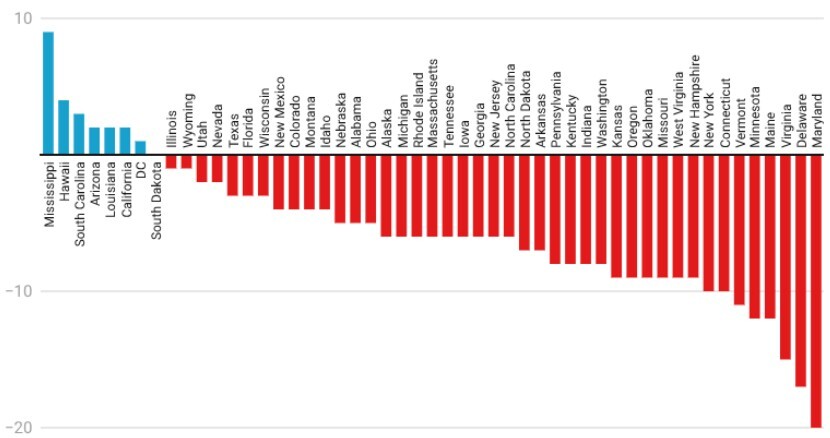
Graph 2
Change in State NAEP Fourth Grade Reading Scores, 2013-2022
Note. Data from Patrinos, 2025.
Students also showed resilience during the COVID-19 pandemic and the disrupted learning environment. In the 2022 NAEP administration, Mississippi maintained performance near the national average, despite widespread national declines.
III. Texas’s Structural Differences
The Student Success Initiative Era
Texas has a historical precedent for mastery-based governance. The SSI, introduced in 1999, required third-grade students to demonstrate reading proficiency prior to promotion. Students were provided with multiple testing opportunities and structured appeals through Grade Placement Committees. Retention triggered targeted instructional support.
The SSI era demonstrated that Texas could implement and sustain promotion standards within its accountability system. It also provided mechanisms for due process and individualized consideration. But when the third-grade promotion requirement was removed, the state shifted toward an intervention-based approach without a mastery gate. House Bill 4545, passed in 2021, required accelerated instruction for students who failed assessments but did not tie promotion to proficiency (Texas Education Agency, 2021).
The Split in Standards
While Texas and Mississippi have both adopted elements of the science of reading reform, the two states diverge significantly in how those reforms are implemented. Texas has implemented teacher training requirements and universal reading screeners, but it stops short of the structural accountability mechanisms that are the hallmark of Mississippi’s system. The result is a policy framework that identifies reading deficiencies but does not consistently require mastery before advancing to the next grade.
The most consequential difference between the Texas and Mississippi literacy frameworks concerns grade advancement. Mississippi’s LBPA established a clear third-grade promotion standard requiring students to demonstrate reading proficiency before advancing to fourth grade. Students who fail to meet the benchmark are retained unless they qualify for statutory good-cause exemptions (e.g., reading disabilities, limited English proficiency).
During the early years of implementation, roughly 8-10% of Mississippi third graders were retained under the law, compared to approximately 3% prior to the LBPA (Mississippi Department of Education, 2019). Research studies on Mississippi’s promotion gate found that students who were held back scored higher on sixth-grade reading assessments than their peers who were not retained (Mumma & Winters, 2023). Texas previously maintained a similar standard under SSI, requiring third-grade students to pass a reading assessment before promotion. However, that requirement was removed.
Current Texas law allows students to advance even when reading proficiency has not been demonstrated, provided they receive accelerated instruction or intervention services. In 2019, HB 3 and subsequent reforms, including HB 1416, passed in 2023, expanded teacher training and early screening but did not restore the promotion requirement (Texas Education Agency, 2024).
Literacy Coaching Support
Mississippi’s literacy reforms included a statewide network of trained literacy coaches deployed to low-performing schools. These coaches work directly with teachers, modeling instruction, observing classrooms, and helping educators translate reading research into practice.
Texas also recognizes the value of literacy coaching, but current policy treats it largely as optional. Literacy coaches may be funded through grants or local district decisions, but the state does not mandate a statewide coaching network or establish minimum ratios of coaches to campuses (ExcelinEd, 2024).
Currently, some schools deploy experienced literacy specialists who provide sustained instructional feedback, while others rely primarily on periodic professional development sessions (Texas Education Agency, 2025). Research on instructional improvement consistently shows that coaching and job-embedded support are among the most effective mechanisms for translating teacher training into classroom practice (Institute of Education Sciences, 2025).
Screening and Individualized Intervention Systems
Texas law requires school districts to administer early reading instruments in kindergarten through third grade. These screeners are designed to identify students who may struggle with foundational reading skills such as phonemic awareness and decoding. Once identified, students receive accelerated instruction or district-determined intervention services.
Mississippi’s approach extends further by mandating IRPs for students identified with reading deficiencies. These plans serve as structured intervention blueprints that specify diagnostic findings, targeted skill development goals, instructional strategies, and progress-monitoring schedules. Parents are notified of deficiencies and provided with guidance on supporting literacy development at home (Javorsky et al., 2024).
Mississippi also administers multiple screening assessments throughout the school year to track progress and adjust interventions accordingly. Texas has established a strong screening foundation, but the absence of a uniform statewide requirement for individualized reading plans means that intervention structures can vary significantly between districts.
Legislative Options for the 90th Session
Texas has already implemented many of the instructional components associated with successful literacy reform, including science-of-reading teacher training, early literacy screening instruments, and curriculum alignment initiatives. However, these efforts currently operate without the statutory framework necessary to ensure that early literacy mastery translates into consistent student outcomes. The Mississippi legislature allocated just $9.5 million to implement the LBPA reforms in the first year and $15 million in subsequent years, with further initiatives, reflecting the relatively low cost of massive literacy gains (Jackson, 2023).
Restore the Third-Grade Promotion Standard
The most essential reform is reinstating a statutory requirement for third-grade reading promotion. Current law under Texas Education Code §28.021 requires that promotion decisions consider academic achievement, but does not mandate that students demonstrate reading proficiency before advancing to fourth grade. The former promotion gate established under the SSI was suspended during the COVID-19 pandemic and never reinstated (Texas Education Code § 28.021, 2024).
The Legislature should amend §28.021 to establish a clear third-grade reading requirement tied to performance on the STAAR or similar state reading assessment. Students who do not initially meet the proficiency threshold should receive structured intervention before a final promotion decision is made.
The statute amendment should also include good-cause exceptions (for reading disabilities), appeal procedures, multiple testing opportunities, and a mandated remediation structure for retained students.
Establish a Division of Early Literacy
Texas currently administers early literacy initiatives across multiple TEA offices, education service centers, and grant programs. The Legislature should establish, within the TEA, a Division of Early Literacy, consolidating existing programs, through a new statutory provision in TEC Chapter 7 (2024).
This new division would be responsible for approving literacy screening instruments, implementing IRPs, coordinating a statewide literacy coaching network, administering summer literacy academies, managing literacy data systems, and publishing reports on outcomes. The production of an annual Texas Early Literacy Report Card would also be the new division’s responsibility, detailing results, participation, deployment, and outcomes across districts and campuses.
Mandate Universal Screening and Individual Reading Plans
Texas law currently requires school districts to administer reading instruments in kindergarten through third grade under TEC §28.006. However, the statute does not require a uniform statewide response when a student is identified with a reading deficiency, leaving intervention practices largely to district discretion (Texas Education Code § 28.006, 2024).
The Legislature should amend §28.006 to require that every student identified through screening instruments as having a reading deficiency receive a mandatory IRP within a defined timeframe. The TEA should develop a statewide template and require districts to report compliance data annually. Additionally, the screening process should occur three times annually (BOY, MOY, EOY).
Establish Summer Literacy Academies
Texas currently requires accelerated instruction for students who fail state assessments under TEC §28.0211. However, this provision does not establish a dedicated statewide summer literacy program. The Legislature should amend §28.0211 to create a Summer Literacy Academy program for third-grade students who do not meet the reading promotion standard on their first assessment attempt (Texas Education Code § 28.0211, 2024).
Strengthen Teacher Literacy Requirements
The Legislature should amend Texas Education Code §21.044 to strengthen literacy preparation requirements for prospective elementary teachers. Reforms can include requiring educator preparation programs to include a minimum number of semester hours dedicated to early literacy instruction or requiring candidates seeking elementary certification to pass a validated reading instruction assessment as a condition of licensure (Texas Education Code § 21.044, 2024).
References
ExcelinEd. (2019). Mississippi’s literacy-based promotion act: An inside look (ERIC Document No. ED544895). Foundation for Excellence in Education. https://excelined.org/wp-content/uploads/2019/03/ExcelinEd.MSGatewaytoSuccess.March2019.pdf
ExcelinEd. (2024). Mississippi early literacy policy implementation report. https://earlyliteracymatters.org/wp-content/uploads/2024/02/Mississippi_ImplementationReport_Final_.pdf
ExcelinEd. (2024). Texas early literacy policy implementation report. https://earlyliteracymatters.org/wp-content/uploads/2024/02/Texas_ImplementationReport_Final.pdf
Hernandez, D. J. (2011). Double jeopardy: How third-grade reading skills and poverty influence high school graduation. Annie E. Casey Foundation. https://eric.ed.gov/?id=ED518818
Hollands, F. M., Pan, Y., Shand, R., Cheng, H., Levin, H. M., Belfield, C. R., Kieffer, M. J., Bowden, A. B., & Hanisch-Cerda, B. (2013). Improving early literacy: Cost-effectiveness analysis of effective reading programs. Center for Benefit-Cost Studies of Education, Teachers College, Columbia University. https://repository.upenn.edu/server/api/core/bitstreams/000d74b0-2893-4e20-9c9d-ee56824055ac/content
Jackson, T. (2023, August 25). More hard work than miracle: Mississippi’s reading gains have a 20-year history. Mississippi Free Press. https://www.mississippifreepress.org/more-hard-work-than-miracle-mississippis-reading-gains-have-a-20-year-history/
Javorsky, K., Fondren, K., Mulkana, A., & Smith, K. (2024, May 13). Effectiveness of early literacy policies when statewide efforts support them. Southern Regional Education Board. https://www.sreb.org/post/effectiveness-early-literacy-policies-when-statewide-efforts-support-them
Mariano, L. T., Martorell, P., & Berglund, T. (2018, July 30). The effects of grade retention on high school outcomes: Evidence from New York City schools (RAND Working Paper WR-1259-DEIES). RAND Corporation. https://www.rand.org/pubs/working_papers/WR1259.html
Mississippi Department of Education. (2016). Mississippi Literacy-Based Promotion Act Implementation Guide. https://www.mdek12.org/sites/default/files/documents/OAE/Literacy/ResourcesForAdmin/revised-11-09-16-lbpa-implementation-guide_feb17_20170223084950_172860.pdf
Mississippi Department of Education. (2019). Literacy-Based Promotion Act annual report of performance and student retention. https://www.mdek12.org/sites/default/files/Offices/MDE/SSE/lbpa_summary_2018.pdf
Mississippi First. (n.d.). Early Learning Collaborative Act. Retrieved May 20, 2026. https://web.archive.org/web/20240627231303/https://www.mississippifirst.org/we-support/early-education/early-learning-collaborative-act/
Mumma, K. S., & Winters, M. A. (2023). The effect of retention under Mississippi’s test-based promotion policy (Policy brief). Wheelock Educational Policy Center, Boston University. https://wheelockpolicycenter.org/wp-content/uploads/2023/02/WEPC-MS-Retention-Policy-Brief-02-03-2023.pdf
National Center for Education Statistics. (2013). The Nation’s Report Card: 2013 reading state snapshot report—Mississippi, grade 4 (public schools). U.S. Department of Education, Institute of Education Sciences. https://files.eric.ed.gov/fulltext/ED544895.pdf
National Center for Education Statistics. (2022). Average National Assessment of Educational Progress (NAEP) reading scale score of 4th-grade public school students, by state or jurisdiction: Selected years, 1992 through 2022 (Digest of Education Statistics, Table 221.40). U.S. Department of Education, Institute of Education Sciences. https://nces.ed.gov/programs/digest/d22/tables/dt22_221.40.asp
National Center for Education Statistics. (2023). NAEP 2022 reading state snapshot report: Texas grade 4 public schools. Institute of Education Sciences, U.S. Department of Education. https://nces.ed.gov/nationsreportcard/subject/publications/stt2022/pdf/2023010TX4.pdf
National Center for Education Statistics. (2024). NAEP 2024 reading state snapshot report: Texas grade 4 public schools (NCES 2024). U.S. Department of Education, Institute of Education Sciences. https://nces.ed.gov/nationsreportcard/subject/publications/stt2024/pdf/2024220TX4.pdf
National Center for Education Statistics. (2024). NAEP state profile: Texas overview. The Nation’s Report Card, Institute of Education Sciences, U.S. Department of Education. https://www.nationsreportcard.gov/profiles/stateprofile/overview/tx
National Evaluation Series. (n.d.). Mississippi: National Evaluation Series testing requirements. Pearson Education. Retrieved May 20, 2026. https://www.nestest.com/state/ms
National Institute of Child Health and Human Development. (2000). National Reading Panel: Teaching children to read—An evidence-based assessment of the scientific research literature on reading and its implications for reading instruction (NIH Publication No. 00-4769). U.S. Department of Health and Human Services, National Institutes of Health. https://www.nichd.nih.gov/sites/default/files/publications/pubs/nrp/Documents/report.pdf
Patrinos, H. A. (2025, March 26). Mississippi’s education miracle: A model for global literacy reform. The Conversation. https://theconversation.com/mississippis-education-miracle-a-model-for-global-literacy-reform-251895
Institute of Education Sciences. (n.d.). Improving teacher performance through instructional coaching (Infographic). Retrieved May 20, 2026. U.S. Department of Education. https://ies.ed.gov/sites/default/files/migrated/rel/infographics/pdf/REL_PA_Improving_Teacher_Performance_Through_Instructional_Coaching.pdf
Tamez-Robledo, N. (2025, February 6). Reading skills are in sharp decline. Rescuing them won’t be easy. EdSurge. https://www.edsurge.com/news/2025-02-06-reading-skills-are-in-sharp-decline-rescuing-them-won-t-be-easy
Texas Education Agency. (2012). Technical digest 2010–2011: Chapter 1—Historical overview of assessment in Texas. https://teadev.tea.texas.gov/sites/default/files/digest11-chap01.pdf
Texas Education Agency. (2021). History of promotion policies in Texas through 2019–20. https://tea.texas.gov/reports-and-data/school-performance/accountability-research/retention-history-2019-20.pdf
Texas Education Agency. (2021). House Bill 4545 overview. https://tea.texas.gov/texas-schools/health-safety-discipline/covid/hb-4545-overview.pdf
Texas Education Agency. (2024). Texas Reading Academies compliance rules,. https://tea.texas.gov/academics/early-childhood-education/reading/hb3-compliance-2024-25.pdf
Texas Education Agency. (2024). History of promotion policies in Texas through 2022–23. https://tea.texas.gov/reports-and-data/school-performance/accountability-research/retention-history-2022-23.pdf
Texas Education Agency. (2025). Grade-level retention and student performance in Texas public schools, 2023–24 (Document No. GE26 601 06). https://tea.texas.gov/reports-and-data/school-performance/accountability-research/retention-student-performance-2023-24.pdf
Texas Education Agency. (2025). Texas State Literacy Plan. https://tea.texas.gov/academics/instructional-materials/2025-texas-state-literacy-plan.pdf
Texas Education Agency. (n.d.). Reading practices. Retrieved May 20, 2026. https://tea.texas.gov/academics/early-childhood-education/reading
Texas Education Code Ch. 7. (2024). State administration. https://statutes.capitol.texas.gov/Docs/ED/htm/ED.7.htm
Texas Education Code § 21.044. (2024). https://statutes.capitol.texas.gov/Docs/ED/htm/ED.21.htm#21.044
Texas Education Code § 28.006. (2024). https://statutes.capitol.texas.gov/Docs/ED/htm/ED.28.htm#28.006
Texas Education Code § 28.0063. (2024). https://statutes.capitol.texas.gov/Docs/ED/htm/ED.28.htm#28.0063
Texas Education Code § 28.021. (2024). https://statutes.capitol.texas.gov/Docs/ED/htm/ED.28.htm#28.021
Texas Education Code § 28.0211. (2024). https://statutes.capitol.texas.gov/Docs/ED/htm/ED.28.htm#28.0211
Texas Legislative Council. (n.d.). The Texas Constitution (Publication No. CN.7). Texas Legislative Council. https://tcss.legis.texas.gov/resources/cn/pdf/cn.7.pdf
Ukrainetz, T. A., Cooney, M. H., Dyer, S. K., Kysar, A. J., & Harris, T. J. (2000). An investigation into teaching phonemic awareness through shared reading and writing. Early Childhood Research Quarterly, 15(3), 331–355. https://doi.org/10.1016/S0885-2006(00)00070-3
Winters, M. A. (2017). The cost of grade retention for taxpayers and students (Working paper). Boston University, Wheelock College of Education & Human Development. https://sites.bu.edu/marcuswinters/files/2018/10/Cost-of-Grade-Retention-for-Taxpayers-and-Students-Working-Paper.pdf
Wolfe, C. (2025, September 8). National assessment of educational progress: The basics. Bipartisan Policy Center. https://bipartisanpolicy.org/explainer/national-assessment-of-educational-progress-the-basics/