By its own account, “Austin ISD is navigating a difficult budget season,” with district officials recently approving a 2026-27 budget containing “nearly $186 million in spending reductions.” What led to this unfortunate occasion was almost entirely out of the district’s control, according to the sitting superintendent.
Last month, he publicly stated:
“Over the past seven years, Austin ISD has faced a widening gap between state funding and the actual cost of educating our students. Despite historic inflation, and a multi-billion dollar state surplus, Texas left its basic student allotment stagnant from 2019 through 2025. Last year, the 89th Legislature approved only a fraction of the funding required to catch up with escalating costs.
On top of that, since adopting the 2025-26 budget, several critical factors have shifted: Austin property values declined more than expected, enrollment dipped—largely due to the current climate around immigration—and we have faced rising operating costs alongside delayed real estate sales.”
Based on this complaint, it would seem that Austin ISD is the victim of state stinginess, a simmering real estate market, changing demographics, and even loose monetary policy. Further, there’s a subtle implication that the district has done its part to keep spending within reason.
But a recent story in the Austin American-Statesman appears to contradict this framing.
On Monday, the Austin American-Statesman published an article titled “Austin ISD’s top 30 highest-paid employees,” which explores administrative compensation for district elites. In addition to identifying the names, titles, and salary amounts for those at the top-end, the article also takes the extra step of specifying the various stipends awarded to each person. When combined, the exaggerated salary and stipend amounts paint a very different picture of the district’s finances than the one portrayed by the superintendent.
Among Austin ISD’s top 30 highest paid employees, the total compensation amounts ranged from $397,020 at the upper end (i.e., superintendent position) to $163,050 at the low end (i.e., central office administrators. Importantly, these amounts do not appear to include the value of certain benefits, like subsidized healthcare, generous retirement plans, and other smaller perks.
Remarkably, “[t]he combined total pay for all top 30 employees was about $5.9 million.”
To get a better sense of these totals, an abbreviated list can be found below that examines Austin ISD’s top 10 highest paid administrators
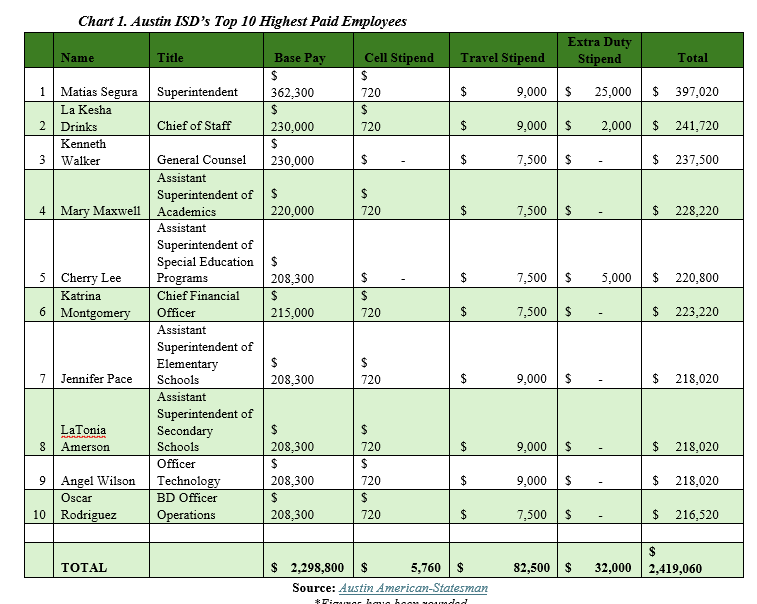
This type of salary detail is revealing in a few different ways.
First, it punctures the carefully crafted narrative that many education elites constantly push—one that would have you believe that public education is underfunded (it’s not; annual funding per student exceeded $16,000 per student in the 2023-24 school year) and that school district budgeteers have stretched every dollar, cut every corner. But clearly, this data suggests otherwise.
Second, it exposes one likely reason why administrators fight tooth-and-nail to protect the status quo and, if anything, see the gravy train continue. Based on the most recent superintendent salary data for all districts, it’s easy to see how these attitudes might take root.
Third, it demonstrates the degree to which money is not flowing to the classroom. And considering that Austin ISD is on the verge for a state takeover due to persistent academic failure, it’s not clear what value parents and students are getting from this diversion either.
Lastly, it highlights the need for public sector compensation reform, if for no other reason than to ensure that public service remains about serving, not being served. In past legislative sessions, state lawmakers have attempted to advance proposals of this type (e.g., HBs 974, 1740, 2562, 4627 and SB 721, to name a few), but efforts have fallen short—in large part due to taxpayer-funded lobbying. But perhaps the next Texas Legislature will prove more fruitful ground.
Austin ISD is certainly not the public school district facing fiscal difficulty. But if the Austin American-Statesman’s latest article reminds us of anything, it’s this: There’s a lot more fat that can and should be cut in school budgets.