Transformational Healthcare Reform
Key Points
- As hospitals and insurance systems have consolidated, patients have faced rising costs and narrower choices, while physicians have lost independence, and control has shifted to a handful of large corporate systems.
- Price transparency alone is not enough: patients and employers need clear disclosure of actual prices, fees, commissions, conflicts of interest, and facility charges.
- Texas can bypass ACA restrictions through Section 1332 waivers, catastrophic coverage options, expanded HSAs, portable benefits, and direct-pay alternatives.
- PBM, insurer, and hospital vertical integration should be addressed through antitrust enforcement, divestiture, anti-steering protections, and restrictions on anti-competitive contracts.
- Restoring physician independence requires stronger limits on corporate practice of medicine, performance-based interference, non-competes, and administrative control over clinical judgment.
Executive Summary
Healthcare is at a crossroads in Texas. Decades of hospital and insurer consolidation and opaque pricing have pushed costs far above overall inflation, while patient choice has narrowed and physician independence has eroded (FTC, 2024b; Gaffney et al., 2025). The United States now spends roughly twice as much per capita on healthcare as other industrialized nations yet has a lower life expectancy (OECD, 2025; UN DESA Population Division, 2024). Vertically integrated systems increasingly control care from the primary care visit through the hospital stay, using complex pricing, ownership, and opaque tactics to hide trust costs and lower-cost alternatives from patients.
Texas has addressed these problems piecemeal, one law at a time, but incremental fixes cannot repair a fundamentally broken market; instead, Texas should pursue transformational healthcare reform. Reform that promotes greater competition, transparency, and accountability would place downward pressure on prices, improve access, and allow medical decisions to be driven by patient needs rather than government or corporate financial incentives. This paper recommends that the Texas Legislature pursue the following reforms:
- Require full transparency. Require disclosure of actual prices, fees, commissions, rebates, ownership relationships, and conflicts of interest.
- Expand ACA alternatives. Pursue Section 1332 waivers to open the market to more affordable, higher-quality alternatives to ACA-regulated plans.
- Restore individual purchasing power. Expand portable benefits, direct primary care, health savings accounts, and direct-pay options so patients can control their own healthcare dollars.
- Protect physician-led medical decision-making. Strengthen protections for physician independence and limit bureaucratic overreach in medical decisions.
- Reform the prescription drug market. Prohibit spread pricing, coercive steering, and require disclosure of drug net prices and financial incentives that increase costs.
- Restore healthcare competition. Restrict anticompetitive contracts, network barriers, and inappropriate facility fees, and prevent further vertical integration that limits patient choice and raises costs.
Part I: Introduction
Texas is at a healthcare crossroads: either enact transformational reform or face a worsening budget crisis. Texas can either cut services, ration healthcare, or raise taxes. Healthcare is a case study in the negative consequences of market consolidation, anti-competitive and unfair monopolistic practices, and government market interference (Bai, 2025c). Healthcare costs are rising astronomically, while patient options are shrinking and the quality of care is worsening, despite the United States having some of the most advanced medical care in the world. The true costs and access to care are convoluted, obscured, and even secretive.
Texas, however, has the opportunity to lead the nation in healthcare reform and incentivize high-quality, affordable medical care with transparency and healthcare freedom. Better healthcare access can be achieved by returning financial control to individuals, thereby exerting downward pressure on prices and improving the quality of medical care.
Arguments against patient choice, physician independence, and reform often defend centralized decision-making or the financial interests of incumbent insurers, hospital systems, PBMs, and other healthcare intermediaries that benefit from the existing system. Reform is not necessarily difficult, but resistance from those benefiting from the status quo is staggering.
Without reform, the electorate is susceptible to those offering easy, false promises of single-payer or “Medicare for all” options, which enrich the few and become de facto socialized government medicine, leading to rationing, poor quality, and higher costs (Atlas et al., 2024).
Healthcare reform will be successful, nonetheless, if it is based on creating open and transparent healthcare markets that can bypass the restrictive Affordable Care Act (ACA or Obamacare), which worsened monopolistic, anti-competitive market consolidation and continues to drive up costs.
The Cost of Consolidation: Higher Prices, Less Choice, and Weaker Care
The COVID pandemic revealed and intensified longstanding problems in the American healthcare industry, including market consolidation, bureaucratic control, diminished physician independence, and limited patient choice. A small number of government and corporate organizations now dominate the sector. This concentration enabled top-down government policies that worsened the COVID response, contributed to preventable deaths, undermined trust in medicine, further restricted patient choices, and opened the door to billions of dollars in fraud and waste (Atlas et al., 2024).
Data in Figure 1 highlight what anyone needing medical care already knows. The growth in administrators is revealing, as they justify their positions to meet the demands of insurance and government regulations, and command greater control over medicine (Gaffney et al., 2025).
Figure 1
Administrative Growth vs. Physician Growth in U.S. Healthcare (1970-2024)
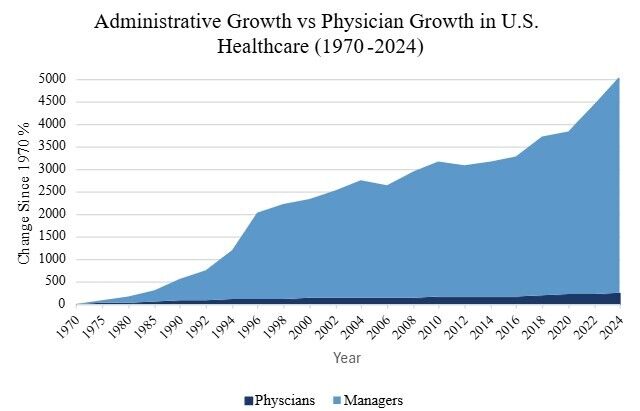
Note. Adapted from Figure 6, “Growth in the Numbers of Physicians and Health-Care Managers, 1970–2024,” in “Health Care in the USA: Money Has Become the Mission,” by A. Gaffney, S. Woolhandler, D. U. Himmelstein, and D. McCormick, 2025, The Lancet, 406(10519), 2588–2600. Original figure based on an unpublished analysis by D. U. Himmelstein and S. Woolhandler of data from the Current Population Survey, U.S. Bureau of Labor Statistics, and National Center for Health Statistics.
Administrators, be they government or corporate, often rationalize their roles as necessary to make healthcare more efficient and improve medical care. However, excessive or duplicative government regulations impose compliance costs that increase administrative burdens and raise the cost of delivering care (Scott, 2025; Centers for Medicare & Medicaid Services, 2025).
Figure 2
Price Changes for Selected U.S. Consumer Goods and Services and Average Hourly Wages, January 2000–June 2025
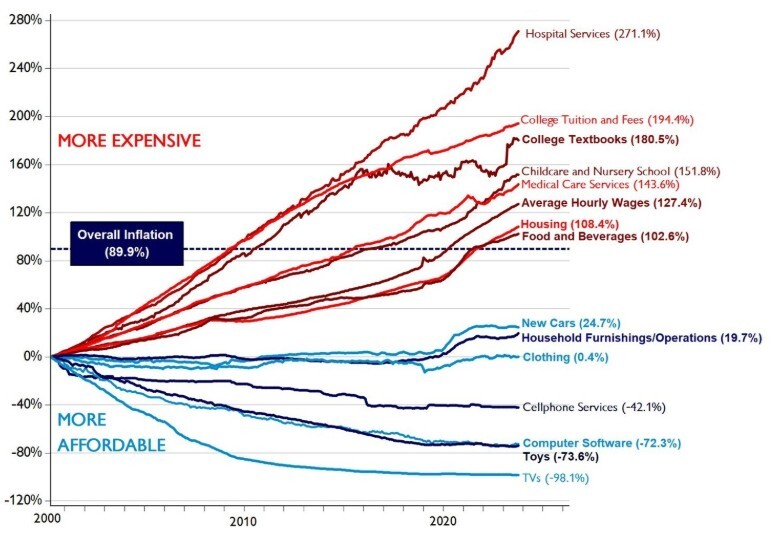
Note. Reprinted from “Time Pricing Mark Perry’s Latest Chart of the Century,” by G. L. Pooley, 2025, Human Progress. Original chart by M. J. Perry using data from the U.S. Bureau of Labor Statistics.
If the rising costs correlated with better medical care, society might tolerate higher costs. However, the United States spends twice as much as other industrialized countries do, with worse life expectancy (OECD, 2025; UN DESA Population Division, 2024).
Figure 3
Life Expectancy vs. Health Spending per Capita in Selected High-Income Countries, 1970–2023
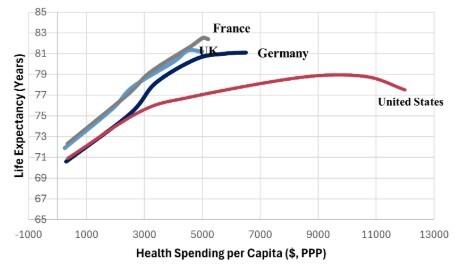
Note. Author’s calculations using life expectancy data from the United Nations, Department of Economic and Social Affairs, Population Division (2024), World Population Prospects 2024, and health expenditure data from OECD (2025), OECD Health Statistics 2025.
Restoring affordable, high-quality care requires coordinated reforms to disrupt industry consolidation and its negative consequences. Large hospital systems, insurance companies, and pharmacy benefit managers (also known as PBMs, which are drug middlemen that control most insurance) control all levels of care—from initial primary or urgent care to inpatient hospital care—thereby restricting patient choice and options (FTC, 2024b). Greater control over all levels of healthcare (also known as vertical integration) is the explicitly stated strategy of these corporations, such as Ascension, HCA, and insurers like Optum/United (Emerson, 2025).
Figure 4
Vertical Business Relationships Among Insurers, PBMs, Specialty Pharmacies, and Providers, 2022
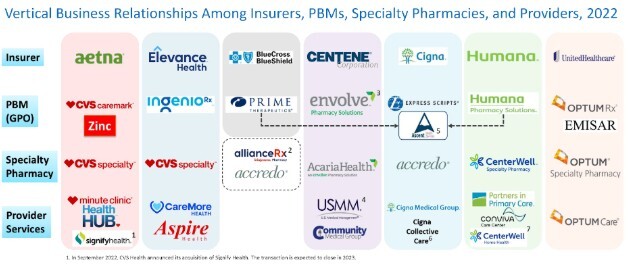
Note. Reprinted from “Mapping the Vertical Integration of Insurers, PBMs, Specialty Pharmacies, and Providers: A 2022 Update,” by A. J. Fein, 2022, Drug Channels (https://www.drugchannels.net/2022/10/mapping-vertical-integration-of.html).
Healthcare costs predictably rise as corporations consolidate ownership of facilities and clinics, often through private equity investors. Their investments are financed by increasing patient volume and billing, while decreasing the quality of care. Trust in medicine is undermined as physicians sacrifice time and independence needed for good medical care. Consolidation undercuts the independence of physicians, clinics, pharmacies, and all healthcare professionals. Physicians, as in any industry, work for those who pay them, which is now insurance or private equity investors (Gaffney et al., 2025)
During COVID, for example, vertically integrated hospital systems required patients to go to their ERs instead of their outpatient clinics, which allowed the hospitals to bill ten times higher (Ho et al., 2017). Costs are inflated in other ways, as well: cash prices for X-rays are only $50-60, but copays with insurance are easily double for the patient. In another example, this year a patient from Texas Direct Medical Care was charged $130 for an EpiPen at CVS, which was required by his insurance (Aetna). He offered to pay cash but was told the cash price was $500. Costs quickly rise with multiple layers of middlemen. Copays for generic drugs may seem low at $10, but common generic medications are often less than $1 per month—a 1,000% markup. In these examples, insurers pass the costs along to patients in the form of higher premiums for the next year.
Transformational Reforms
Restoring choice and lowering costs require several concurrent reforms: transparency in all aspects of healthcare, options beyond ACA, individual agency (such as monetary control and HSA expansions), drug reforms, antitrust enforcement, banning anti-competitive practices with penalties, and banning the corporate practice of medicine that has so badly harmed medical care.
- Transparency in All Aspects of Healthcare: More than price transparency alone, transparency in all aspects of the healthcare industry is essential for patient choice and robust healthcare markets. Lack of transparency is a hallmark of unhealthy economies and markets, reflected in opaque and deceptive healthcare costs. Beyond retail prices, transparency reforms should include insurance fiduciary responsibility to patients; requiring disclosure of conflicts of interest related to kickbacks or commissions; requiring site neutrality (i.e., surprise hospital fees charged for outpatient clinics); and further consumer incentives to shop for better and cheaper care. Additional reforms include medical liability for harm caused by medically inappropriate prior authorization and claims denials. Physicians take the Hippocratic Oath; administrators and insurers should too.
- Bypass the Affordable Care Act: Bypassing the restrictions and problems with the ACA will create independent healthcare options in Texas. Expensive ACA Marketplace plans are unnecessary for most people with high deductibles and poor coverage, enriching insurance conglomerates while remaining a crushing burden on the self-employed and small businesses. Businesses with high-cost employee benefit plans also need options outside ACA restrictions. Even highly subsidized ACA options for lower-income families still have high copay costs and extra billing (such as facility fees) just to have the privilege of possibly using the coverage, and 85% of people never meet their annual deductible (Bai, 2025c). Healthcare costs cause inflationary pressure throughout the economy. There are better options for Texas. Catastrophic-only plans, waivers from ACA regulations, expanded HSA options, cost-sharing options, and removing barriers to healthcare markets, including across state lines, will all put downward pressure on prices and improve actual healthcare.
- Restore Individual Agency: portable benefits and expanding HSAs. Several reform options can remove tax barriers, create incentives for individuals’ plan options, and restore more choices in healthcare. “Portable benefits” is the concept of allowing contractors, temporary workers, vendors, and other types of “gig-economy” workers to have plans outside of the ACA marketplace or tied to a job, and with employer contribution options as well. Portable benefits provide both healthcare coverage and employment flexibility, thereby increasing individual economic freedom. Furthermore, Health Savings Accounts (HSAs) can be expanded and bring cash-pay market pressure to reduce costs. Expanding HSAs in state-controlled plans gives state employees and teachers direct purchasing power. Such a policy would be a de facto pay raise and bring market competition and options throughout the state, including to rural areas. Restoring individual control over healthcare plans restores choices, competition, and reduces administrative burden on businesses.
- Drug Costs: Drug costs for patients are staggering despite their cheap wholesale costs. Drug markets badly lack transparency, with 80% of the market being controlled by three PBMs (FTC, 2024ab). Several states are pursuing antitrust legislation to address PBM consolidation and control and offer the possibility of dramatic reductions in pharmacy prices. Direct physician dispensing is permitted in some form in 45 other states and the District of Columbia, but not in Texas (Dispense Doc, n.d.; Texas Medical Association, 2026). Direct dispensing for acute care (e.g., steroid inhalers, antibiotics, epinephrine) and “biologic/biosimilar” drugs (e.g., autoimmune infusion drugs) are lifesaving but are restricted by PBMs, patent protections, and market-exclusivity rules. At the same time, branded-drug list prices increased 159% from 2007 to 2018, while the prices manufacturers received after rebates and discounts increased only 60% (Hernandez et al., 2020). Similarly, annual list prices increased by approximately 12%, compared with only 3% for net prices, as rebates grew throughout the drug supply chain (Kakani et al., 2020). This widening gap makes it harder for patients and employers to know the true cost of a drug and can leave patients paying prices that do not reflect the discounts negotiated behind the scenes. Drug costs are perhaps the most visible way that patients are held hostage to their own health.
- Antitrust and Reversing Vertical Integration: Extensive research data shows how market consolidation causes increased costs and worsened medical care (FTC, 2024b). Enforcing well-established and existing antitrust principles will begin to restore market competition, along with targeted state actions requiring divestiture where clear antitrust laws are violated. Divestiture in all areas of healthcare vertical integration is nonetheless needed; otherwise, there are no choices. Transparency by a monopoly is meaningless if there are no patient options. Targeted reform will remove anti-competitive, monopolistic practices by both hospital systems and insurers, hospital and insurance network restrictions, and gag clauses that prevent transparency.
- Restoring Physician Independence and Ending Corporate Practice of Medicine: The corporate practice of medicine refers to control over medical judgment by corporations or other entities that are not licensed to practice medicine (Texas Medical Association, 2016). More than 30 states, including Texas, restrict this practice through statutes, licensing laws, court decisions, or attorney general opinions, although the scope of those restrictions varies (Subbiah & Scheffler, 2025). Despite these protections, hospitals, insurers, and other corporate organizations can still influence clinical decisions through performance measures, compensation structures, productivity requirements, and other financial incentives (Reid et al., 2022). When these measures prioritize revenue, volume, or patient-satisfaction scores over medical judgment, they can undermine physician independence and affect the quality of patient care (American Medical Association, 2025; Reid et al., 2022). Restoring independent physician control and independent clinics will dramatically improve the quality of medical care. Restricting “performance measures” in all medical practices, including in hospitals, will free patients and healthcare professionals alike from improper financial influences.
Regulatory reform alone will be unsuccessful. Taxi-cab companies, for example, were heavily over-regulated. They did not reform; ride-sharing (Uber, Lyft, Waymo, etc.) emerged, bypassed them, and most taxi companies are now out of business. Texas can do the same for healthcare: transformational reform with more choices and fewer regulations. Patient choice in a transparent healthcare market will both reduce costs and improve the quality of medical care. A lesson from ancient history is our model: Alexander the Great did not untangle the Gordian Knot; he just cut it. The healthcare Gordian Knot needs the same treatment.
Part II: Non-Transparent & Anti-Competitive Causes
Healthcare has not become complex and opaque by accident; government policy, consolidation, and administrative control have steadily weakened competition, obscured costs, and limited patient choice. In both Texas and the United States as a whole, market consolidation is enabled by government and the ACA, forcing independent and small hospitals, clinics, and insurers out of the market or into being swallowed up by larger corporations. Administrative burden is more easily absorbed by larger corporations, leaving smaller businesses unable to compete. In many regions of Texas, there are only one or two major hospital systems or insurers, creating regional monopolies that lead to predictable cost increases and reduced access to care (Health Care Cost Institute, 2024). The consequences of restricted markets have been described by every economist since Adam Smith’s The Wealth of Nations in 1776. The medical and healthcare consequences are predictably poor. More perniciously, the unhealthy market conditions have gradually eroded trust in medicine itself. All of these and multiple factors have led to steadily rising healthcare inflation.
Figure 5
Average Annual Premiums for Single and Family Coverage, 1999-2025
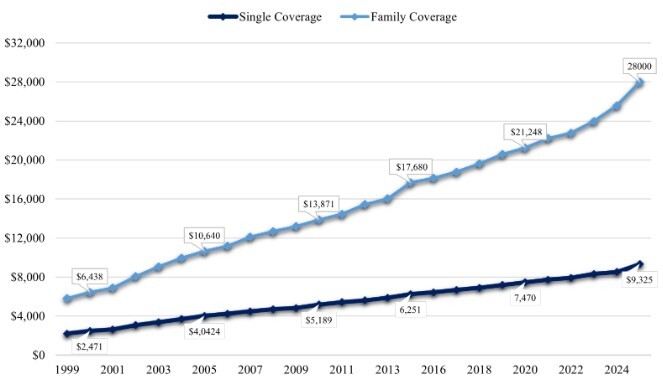
Note. Average annual premiums for employer-sponsored health insurance. Data from the 2025 Employer Health Benefits Survey, by KFF, 2025 (https://www.kff.org/health-costs/2025-employer-health-benefits-survey/), and the author’s calculations.
Corporate Practice of Medicine
The manifestation of corporate control and overreach is the previously mentioned “corporate practice of medicine” (CPM). Corporate and government bureaucracies may legitimately manage business functions such as staffing, budgeting, billing, compliance, and scheduling because medical practices must remain financially and operationally viable (Hellyer, 2020; Lo & Grady, 2021). The line is crossed when those same functions are used to interfere with or override a physician’s independent medical judgment or to penalize a physician for advocating for appropriate patient care. Texas law reflects this distinction: nonphysician entities may provide administrative and management services, but physicians must retain control over medical services and patient care. Texas courts have upheld legitimate business-management arrangements in which physicians retained control of care but have invalidated arrangements in which a corporation controlled staffing, revenues, and the use of a physician’s medical license (McCoy v. FemPartners, Inc., 2015; Flynn Bros., Inc. v. First Med. Assocs., 1986).
However, both government and corporate bureaucracies have sidestepped these protections and still influence the practice of medicine through other controls. Instead of direct corporate orders, other metrics indirectly influence the practice of medicine through performance measures, customer-satisfaction scores, and productivity targets. Physicians are familiar with measures such as relative value units (RVUs), Healthcare Effectiveness Data and Information Set (HEDIS) measures, Press Ganey customer-satisfaction scores, and productivity tracking. These measures can improve quality, efficiency, and other business operations; they become excessive corporate practice when employment status or financial incentives pressure physicians to satisfy a metric at the expense of a patient’s medical needs (Hunt et al., 2019; Marathe et al., 2020). The cynical description for this in medicine is “treating the numbers and not the patient” (Montori, 2011).
The negative medical consequences of chasing metrics and profits are well recognized, driving up costs and worsening access (Fuse Brown & Hall, 2024). In 2017, for example, Hospital Corporations of America (HCA) expanded its urgent care operations in Austin, Texas. The regional medical director pressured the practice physicians to achieve 5-star online reviews, stating that “retail” medicine requires different prescribing patterns, which was understood to mean more freely prescribing what the customer wants, such as antibiotics and DEA medications (narcotics and sedatives). The physicians were incentivized with bonuses for good reviews in their contracts. Poor prescribing standards risk antibiotic resistance and drug addiction, both of which can be deadly and are malpractice. Holding physicians to these types of metrics means physicians can be fired, lose bonuses, and sometimes be forced to move out of their city because of non-compete clauses in their contracts (Schneider et al., 2020). An extraordinary case occurred in 2025 where the owner and the medical director were both fined and convicted for conspiring to distribute controlled stimulants (Adderall) using new and inexperienced nurse practitioners incentivized to prescribe stimulants, essentially becoming an online telehealth Adderall pill mill (U.S. Department of Justice, 2025). It is important to note that Adderall and similar stimulants are addictive with significant side effects on adults, including worsening anxiety, insomnia, and potentially deadly effects on the heart. In both of these examples, the administrators had no medical liability; the physicians and mid-level clinicians, however, retained malpractice liability.
In the case of government-managed healthcare, metrics are also heavily used and a source of interference with individual medical care. A 2014 unpublished research study into polypharmacy in a combat brigade found 3-5% of the 4000-man brigade were essentially overdosed on medications, and over 25% of these cases did not meet the medical standards of care.1 The underlying cause was customer satisfaction metrics from hospital administrators, which were reported to their higher command.
There are many assessment metrics, and they usually incorporate financial factors such as profits, budgets, promotions, and bonuses, along with statistical scoring. The most common metrics remain patient volume and billing-based productivity measures (such as RVUs). Physicians and administrators understandably and promptly adjust their behavior to meet the monetary incentives or disincentives of statistic-based evaluations. Pandering to online reviews and satisfaction scores, as in the above cases, ultimately undermines the Hippocratic Oath. A generation after Hippocrates, Plato used an allegory of a chef competing with a physician to determine who was best suited to treat a person’s health before a jury of children (Plato, ca. 380 B.C.E./n.d., Gorgias, 465e). The misalignment of metrics and incentives is one of the key challenges to reforming healthcare.
Pandemic Healthcare Revelations
The COVID pandemic showed the dangers of a bureaucratized medical system. Public health officials and government authorities adopted a top-down approach that actively prevented and attacked alternate treatment approaches (Atlas et al., 2024). In some states, public-health agencies and licensing boards also restricted or discouraged physicians’ use of specific off-label COVID-19 treatments. Nevada, for example, temporarily prohibited outpatient prescribing and dispensing of chloroquine and hydroxychloroquine for COVID-19, while the Washington Medical Commission warned physicians about prescribing ivermectin and hydroxychloroquine outside accepted standards of care (Nevada State Board of Pharmacy, 2020; Washington Medical Commission, 2021). The reasons were primarily two-fold. First, public health leadership at the national level believed they could eliminate COVID by strict enforcement mechanisms, which predictably failed. Secondly, under the CARES Act, corporations were incentivized to bill the government and insurers at much higher rates for COVID care in hospitals than in outpatient clinics. As a result, early outpatient treatment, including non-controversial medications, was often delayed or discouraged. Government and corporate authorities also supported policies that restricted medical freedom by limiting physicians’ treatment discretion and patients’ ability to pursue alternative treatment options. One of the longer-lasting effects has been distrust of public health leaders, and an industry has blossomed of alternative treatments and almost religious devotion both for and against various vaccines or treatment options.
Independent medical practices, on the other hand, using the same research and early evidence, developed faster and cheaper treatments that saved countless lives, primarily with oxygen and inhaled steroid therapy (Ramakrishnan et al., 2021; Yu et al., 2021). As the virus evolved, so did treatment options. Independent medical practices were often positioned to adapt quickly as evidence about outpatient COVID-19 treatment evolved. Randomized trials found that early treatment with inhaled budesonide shortened recovery time and may have reduced the need for urgent medical care among some patients with early COVID-19 (Ramakrishnan et al., 2021; Yu et al., 2021). Early interest in chloroquine and hydroxychloroquine arose partly from a 2005 laboratory study showing that chloroquine inhibited the original SARS coronavirus in cultured cells (Vincent et al., 2005). But results in randomized trials of early outpatient treatment showed no clinical benefit from hydroxychloroquine (Johnston et al., 2021; Skipper et al., 2020). The rapid development and deployment of monoclonal antibodies in Texas enabled early intervention. When used against susceptible variants, casirivimab and imdevimab reduced COVID-19-related hospitalization or death by approximately 70% among high-risk outpatients (Weinreich et al., 2021). Other states and corporate clinics, however, required patients to go through multiple steps and wait for disease severity to worsen prior to treatment, and predictably worsened outcomes and even deaths (Atlas et al., 2024).
During the pandemic, the author’s Texas direct primary care clinics received telehealth requests from patients in Massachusetts, New York, Michigan, California, and other states who reported that COVID treatment had been refused or delayed locally. This account reflects the demand for adaptable outpatient care. Independent direct primary care practices grew from fewer than 1,400 nationally in 2019 to over 3,000 by 2025 (DPC Frontier, n.d.).
Vertical Integration
COVID responses contrast sharply between large organizational bureaucracies and independent clinics. The systemic issues with large organizations have worsened with “Vertical integration”—the term often used to describe healthcare industry consolidation and increasing corporate control at all levels of care, from a patient’s entry into medical care in outpatient clinics up to advanced inpatient medical care. Insurers similarly are controlling increasing segments of healthcare, with Optum/UnitedHealth controlling 10% of physicians in the United States as direct employees or contractors. Further, over 70% of physicians are employed under large corporations, and the loss of independence makes them essentially under the control of corporate practice of medicine (U.S. Government Accountability Office, 2025).
Extensive research shows the obvious: market consolidation increases costs and worsens medical care (FTC, 2024b). The structures of these corporations have become progressively complex and confusing and not readily recognizable as consolidated markets. For example, although Optum Rx and UnitedHealthcare may appear to be different entities, they are under the same corporate umbrella holding company (“UnitedHealth Group”), along with Emisar Pharma Services, an Optum-affiliated group purchasing organization (GPO) organized as a Delaware limited liability company with operations in the U.S. but also offshore in Ireland (FTC, 2023; Fein, 2023; OptumRx et al., 2024). The UnitedHealth Group CEO in 2025 used terms like “synergy” and restoring the company’s “swagger” in market dominance on investor quarterly earnings calls (UnitedHealth Group, 2025; Emerson, 2025).
There are several interconnected causes for market consolidation, some predating ACA, such as the formation of PBMs, exacerbated by ACA, or new problems created by ACA (Paragon Health Institute, 2024). ACA coverage mandates have eliminated most catastrophic-only plans, forcing many smaller insurance companies out of business or to merge with larger insurers. Now, a relatively small number of large national and regional parent companies dominate private insurance markets, although the leading insurers vary by state and market segment (Rakshit et al., 2025). In the years immediately following ACA implementation, Texas adopted similar coverage mandate laws to align with ACA requirements, to the detriment of options. Innovative small-business plans, such as those offered by Decent Insurance, combined ACA-compliant health coverage with direct primary care to provide more affordable options for small businesses and self-employed individuals. In November 2020, however, the Texas Department of Insurance informed Decent Insurance that, because of an unresolved federal court ruling affecting association health plans, it could no longer offer the arrangement to self-employed individuals without employees or to businesses across different industries (Collins & Crusius, 2022; Gruca, 2020).
A similar regulatory addition with far-reaching consequences is the ACA cap on insurers’ earnings from premiums called the Medical Loss-Ratio, MLR (Pate et al., 2025). Although the rhetorical purpose was to stop profiteering by insurers and keep costs down, it has had the opposite effect. By capping profits as a percentage of premiums, an insurer reduces profits when it lowers premiums. Consequently, insurers have no incentive to lower premiums, and premiums continue to rise every year (see Figure 5).
Similarly, hospital systems are increasingly vertically integrated, allowing them to control multiple stages of a patient’s care. In 2019, HCA Healthcare purchased 24 MedSpring urgent care centers in Austin, Dallas, and Houston and rebranded them as CareNow, expanding its ownership of outpatient clinics alongside its hospitals and emergency departments (HCA Healthcare, 2019). CareNow acknowledges that diagnostic testing at its urgent care clinics may result in a patient being transferred to an emergency department when a higher level of care is considered necessary (CareNow, n.d.). Although such transfers may be clinically appropriate, the financial incentives differ considerably by treatment setting. A Texas claims study found that, among patients with the same diagnosis, emergency department prices were nearly 10 times higher than urgent care prices (Ho et al., 2017). Recent national research also estimated that nearly 40% of emergency department visits were medically nonurgent (Giannouchos et al., 2024). Together, these differences create a potential financial incentive for vertically integrated systems to direct lower-acuity patients toward more expensive emergency departments rather than treating them in outpatient settings. This worsened during COVID, when urgent care clinics were not treating cases early and instead deferred to the ER, where the CARES Act provided hospitals with higher reimbursement (Atlas et al., 2024). It is a fundamental principle in medicine to treat conditions early before they become more severe. Yet, incentives in healthcare encourage delaying treatment to increase billing.
Primary care clinics should manage most medical conditions and lead prevention efforts. Primary care has been consistently shown to improve medical and preventive care in research (U.S. Government Accountability Office, 2025). However, the progressive pressures in healthcare have made timely treatment difficult, leading to the rise of the urgent care industry. Primary care, instead, has become a battleground for control of patients by insurers and hospital systems: insurers control primary care, making physicians and midlevel providers gatekeepers to healthcare, while hospitals use them for billing and referrals to generate income. True primary care physicians are being squeezed by both in efforts to force them under their respective vertically integrated systems and networks (Jabbarpour et al., 2025).
PBM and Insurance Corporate Consolidation
Insurance vertical integration has created unique problems with the rise and power of the PBMs, as well as traditional consequences of market restrictions. PBM and group purchasing entities were granted exemptions from the Anti-Kickback Act (AKA) in 1999, which allowed the PBMs and GPOs to negotiate on behalf of customers with pharmaceutical manufacturers (Hammond, 2026). The intent was to drive down prices, but it had the opposite effect and worsened with ACA-driven insurance market consolidation. PBMs profit by earning a percentage of drug costs through rebates and fees, as well as by paying low reimbursements to independent pharmacies, then keeping the difference, called “spread pricing.” Similarly to the MLR incentive effect on premiums, PBMs make more money when allowing more expensive medications onto a plan medication formulary (the list of drugs an insurer will cover), similar to a waiter’s tip being bigger with more expensive meals and drinks. Again, higher costs lead to greater profits, and the PBM has no incentive to seek lower costs. Further, because the three largest PBMs are also insurers (see Figure 4), the PBM-insurer corporations control the pipeline from pharmaceutical manufacturers to patients. Higher drug costs are simply passed through to next year’s premium increase, further increasing the corporate profit percentage. Efforts by patients to find cheaper alternatives are further frustrated by reports of collusion between PBMs and online price-comparison tools like GoodRx, which also undercuts independent pharmacies (Pierson, 2024).
There have been various Federal and State efforts to enforce transparency of the rebate costs through regulations and laws. These PBM-insurer entities, however, use foreign-headquartered GPOs to add administrative fees, further shroud the true costs in mystery, and allow revenue to remain outside ordinary U.S. transparency requirements (U.S. House Committee on Oversight and Government Reform, 2025). Pharmaceutical manufacturers essentially have to compete by offering higher rebates to PBMs to obtain formulary placement and ensure their drugs reach pharmacies and patients (FTC, 2024b; U.S. House Committee on Oversight and Accountability, 2024).
PBM Control of Pharmacies
PBM control of pharmacies has further worsened market conditions. CVS Health, for example, combines the retail pharmacy CVS, the PBM CVS Caremark, and the insurer Aetna within the same corporate conglomerate. Federal investigations have found that dominant PBMs can steer patients toward affiliated pharmacies while reimbursing independent pharmacies at lower rates, sometimes below their drug acquisition costs (FTC, 2024b; U.S. House Committee on Oversight and Accountability, 2024). The House Judiciary Committee also found that CVS used pharmacy-network rules, audits, cease-and-desist letters, and threats of termination to restrict independent pharmacies from working with competing pharmacy-service platforms. The Committee concluded that this conduct restricted competition and may have violated federal antitrust law (U.S. House Committee on the Judiciary, 2026).
Similar practices have drawn scrutiny at both the state and federal levels. The Tennessee Department of Commerce and Insurance found that OptumRx reimbursed its affiliated mail-orPBMder and specialty pharmacies more than nonaffiliated Tennessee pharmacies for the same drugs (TDCI, 2026). The U.S. Office of Personnel Management’s Office of the Inspector General (OIG) also questioned more than $615 million in Federal Employees Health Benefits Program costs involving CVS Caremark and the Blue Cross Blue Shield Association, including discounts, credits, and other financial benefits that the OIG concluded were not fully passed through. Both entities dispute the audit findings (OPM OIG, 2026). These pricing distortions are also visible to Texas patients. In one recent example, a Texas physician reported that EpiPens cost $300 or more despite the relatively low cost of epinephrine itself (Porter, 2026).
Physician Control Replaced with Private Investors
Another anti-competitive and consolidation incentive was created by Section 6001 of the ACA, which narrowed the Stark Law exceptions available to physician-owned hospitals. New physician-owned hospitals generally cannot qualify for Medicare reimbursement for services resulting from referrals by physician owners, while existing physician-owned hospitals face restrictions on increasing physician ownership and expanding their numbers of beds, operating rooms, and procedure rooms. Because Medicare participation is essential for most hospitals, these restrictions have largely prevented new physician-owned hospitals from entering the market and constrained the expansion of existing facilities, reducing competition with incumbent hospital systems (42 U.S.C. § 1395nn; Centers for Medicare & Medicaid Services, 2026). These restrictions have reduced physicians’ opportunities to own and control hospitals, while hospital ownership has become increasingly concentrated among large nonprofit, investor-owned, and government systems. Proponents of the ACA argued physicians had a conflict of interest, yet the potential conflicts of interest of private equity investors, with no loyalty to the Hippocratic Oath, were disregarded. By contrast, only lawyers own law firms and only accountants own accounting firms. Physician-owned hospitals that remained (grandfathered in prior to ACA enactment) have better measurable medical outcomes than private or government hospitals (Miller et al., 2021). Multiple studies show that private equity taking over control of hospitals has worsened medical care (Kannan et al., 2025).
Private investors have flooded into the vacuum of physician leadership. Formerly physician-led hospitals are progressively being controlled by fewer corporations, such as Baylor Scott and White, HCA, and Ascension. When these hospitals become non-profit, they become far more lucrative by avoiding taxes, and instead of profits, the excess income goes into investments controlled by the investors and often very high executive salaries. Although non-profit status presumes the community benefits from charity care, in practice this has been woefully inadequate (Antoni & Balat, 2023).
Investors looking at medicine as an investment opportunity are not constrained by Hippocratic principles and essentially hold patients hostage to their own health. After all, what would a person pay for their own health when sick? A variety of tactics are increasing costs further as well as degrading medical care. Various unfair business practices have resulted in worsened network restrictions, surprise hospital fees, anti-competitive contracts, steering clauses, and even gag orders on direct pay options for patients.
Network Restrictions
Network restrictions are a challenge for physicians and patients alike, imposed by both insurers and hospitals—both trying to leverage control over patient care to dictate charges and billing. Hospital systems use networks to capture patients within the corporate structure, and referrals add to hospital income. Hospitals increase their footprint by buying primary and specialist practices, creating regional monopolies, particularly in smaller or rural markets. Then, the practices can be considered part of the “hospital” and bill insurance or Medicare higher for a patient visit as a hospital-based visit, charged as a “facility fee.” This is a common bill coding maneuver. The patient is often liable to pay the facility fee since the fee is rarely in their insurance plan, and insurers only cover the outpatient visit at a previously agreed-to contracted rate. Reforms aimed to stop this billing site bias, called “site neutrality,” have been resisted mostly successfully by hospitals’ lobbying efforts to this point (Perkins et al., 2026). Even military Tricare dependents have received surprise bills using this tactic in Texas.
Insurers, on the other hand, use networks to restrict where patients go to decrease claims and other costs. There are further revenue avenues for where patients are directed, including referrals, other commissions, and various administrative fees or arrangements (Blumberg & Watts, 2024). Tighter network restrictions exist for HMO (Health Maintenance Organization) and Medicare Advantage plans that refuse to accept referrals or medical orders from out-of-network physicians and clinics. These plans work by tightly controlling access to care. A variety of explanations are provided for refusing out-of-network medical orders, but this is part of cost control and essentially a form of rationing care (Forbush, 2026). Patient access to care is further hindered by health plans with inadequate networks, called “ghost networks” (Corlette et al., 2026). Independent and out-of-network clinics are excluded from helping patients in these plans for financial rather than medical reasons.
Gag Clauses: Silencing the Market
The return of gag clauses in contracts is a disturbing tactic in which a clinic or service is banned from informing patients about or accepting cheaper direct-pay options. Although Texas has prohibited certain gag clauses involving pharmacies, those protections do not necessarily extend to services provided by clinics, imaging centers, or laboratories. These restrictions limit patients’ access to competitive options, and insurance copay fees can easily be higher than the actual service itself. Astoundingly patients on insurance may pay twice as much for MRI or X-ray copays compared to the direct cash price. If the patient does not utilize insurance, then the middlemen do not get paid, creating an incentive for middlemen to keep patients in the dark about cheaper options or force the use of insurance. In one case from the author’s direct primary care practice, a patient reported that an imaging center administrator warned that she could face legal consequences and be sued if she did not disclose her insurance coverage. Her insurance copay for the X-ray was $109, while the cash price at the same facility was $65. In a separate account provided to the author, a health benefits advisor reported that a San Antonio clinic refused to provide an itemized bill if she paid directly and instead instructed her to bill the service through insurance. Such restrictions serve no medical purpose and prevent patients from making fully informed financial decisions about their care.
Anti-Competitive Effects
The various anti-competitive market forces cause patient harm through delayed or denied care due to cost barriers, short appointments that are inadequate for complex cases, long travel times and delays for “in network” providers, and the frustrating increase in prior authorization delays and denials. The short appointments leave little time for the patient to discuss all issues and often require a copay for each visit, rather than having everything covered in a single visit, which drives up costs. Restricted networks with appointment delays risk worsening medical conditions or leading to visits with specialists who may not have the right experience. For medications, 27% of adults reported not filling a prescription because of cost, and 19% reported cutting pills in half or skipping doses because of cost in the past 12 months (Sparks et al., 2026). Prior authorizations for medications, procedures, and imaging (like MRI’s) further cause delays. Importantly, insurers never “deny” medical care; they only deny coverage. However, many people lack the savings or resources to afford expensive procedures or medications (Sparks et al., 2026). Since insurance promises coverage in advertisements and sales pitches, it can feel like betrayal to a patient when insurance refuses coverage.
For healthcare professionals, these market forces are equally frustrating, including claims denials, prior authorization delays or denials, inadequate time to see patients, and improper interference in or influence on medical decision-making. It is estimated that 30% of medical practices experience early physician retirements or physicians leaving medicine due to what is known as “burnout” (Jackson Physician Search, 2022). In 5-10-minute primary care appointments, there is only time for a quick assessment and deciding whether to prescribe a drug or refer to a specialist. This is not what good primary care should be. Similarly, specialists are equally frustrated with insurance denials and interference, or hospital and practice administrators tracking billing and procedure codes to determine productivity and compensation (ACEP, n.d.; AMN Healthcare, 2021).
The term “physician burnout” is too often used, but it is better to describe what is happening in medicine as “moral injury” (Damania, 2019). Physicians and all healthcare professionals are in a system that requires them to practice fast, at high volume, and to provide substandard medical care. Patients and most people in healthcare are angry, and this anger was tragically highlighted by the murder of an insurance executive in 2024, whose murder was then celebrated by many (itself another type of moral failure). This sign (Figure 6) is in a Texas gynecology medical clinic. The warning not to raise additional issues is not a medical consideration; it is a billing requirement set by the administrators. Refusing to discuss or charging extra for a woman’s health issues goes to the heart of the problems of American healthcare.
The business of healthcare remains unhealthy. Reform is nonetheless possible.
Figure 6
Front Desk Patient Warning on Extra Billing
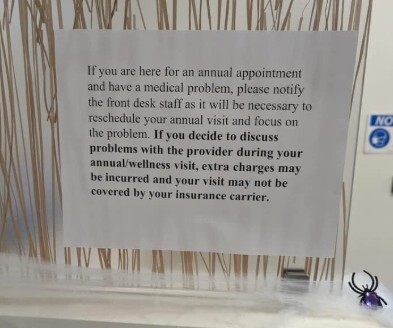
Note. Photo taken by State of Texas Employee October 2025.
Part III: Reform
Transformational reform is founded on transparency, healthcare options, competition, and the removal of anti-competitive barriers. There are many detailed reforms that will open up the path to change, within the broad themes of transparency, bypassing the ACA, restoring individual and physician control, reducing drug costs, and antitrust policies.
Transparency in All Aspects of Healthcare
There have been many attempts to force transparency on the industry through various federal and state initiatives, generally focused on list or retail prices, with some enforcement measures (Blase, 2023). Beyond retail list prices, transparency reforms must also address misaligned incentives in healthcare, expose conflicts of interest, and address the exploitation of patient illness.
Transparency may seem straightforward to achieve, but the industry has resisted it at every step (Roberts & Rollins, 2021). Federal penalties were started under the first Trump Administration and increased under the Biden Administration, but were too low to have a significant impact (Overton & Balat, 2021). The current Trump Administration is looking to further extend enforcement. Patients, however, continue to have little idea of true costs or even reasonable estimates. Price estimates from hospitals are consistently lower than the actual costs billed to patients after services are provided. Hospital administrations maintain that more precise cost estimates are too difficult to obtain and machine-readable data files are too complex, although advances in artificial intelligence suggest otherwise (Rosenthal, 2026). Hospitals post list prices to comply with transparency requirements, but these list prices function only as estimates, not the net price of actual charges billed. The difference in costs is highly variable, as seen by any patient reviewing a billing statement with different insurance rates, reimbursement rates, or the actual cash price paid (Rosenthal, 2026; Overton & Balat, 2021).
Texas passed SB 331 during the 89th Legislative Session to begin imposing penalties for noncompliance (SB 331, 2025). Other states are strengthening transparency requirements and penalties, without which market pressures remain ineffective. Ohio, for example, added stricter definitions of pricing to prevent vague estimates that hide higher-than-advertised actual billing (Heinbaugh, 2025). The enormous profits realized through the lack of transparency, however, will remain a challenge without more options for patients. Efforts to expose misaligned incentives are needed, such as requiring disclosure of all commissions and kickbacks in healthcare, which are currently legal for healthcare businesses but not for physicians under the Stark laws. Insurance brokers, for example, are not required to disclose the commissions they receive for the insurance plans they are selling, nor whether there are conflicts of interest. In 2026, brokers received three times the commission selling Medicare Advantage versus PPO plans.
Solutions are possible with required disclosure of actual prices, fees, and relationships, along with stronger enforcement with penalties. Ultimately, competition is the best enforcement of transparency. Hospital systems and clinics alike are very transparent when both individuals and businesses have options to go elsewhere.
Transparency in Business Plans
Another form of transparency among self-funded business plans is businesses’ fiduciary responsibility for their employees’ health plan costs. Employee funds are used for health plans, and the business is therefore responsible for spending them in employees’ best interests. Some businesses are now facing litigation as failed fiduciaries for failing to spend funds on benefits responsibilities.
Mark Cuban routinely warns business leaders to carefully audit their healthcare plans. After salaries, benefits are the costliest expense. Business and government leaders (including the Trustees of TRS and ERS) should be demanding transparency on all costs, claims, and fees—not the least of which is commissions and all other forms of “revenue avenues” from business steering and additional commissions. A.J. Gallagher, for example, was accused of hiding $4 million in kickbacks from Florida’s Osceola County School District in 2021. Gallagher faced litigation from the district for what Gallagher euphemistically referred to as “supplemental compensation” in a footnote of their contract. They settled prior to going to trial (Pinder, 2023).
Importantly, the failure to understand the costs and monitor these various forms of kickbacks can expose the business to litigation as a failed fiduciary of the employees’ money. Businesses like Johnson & Johnson, Mayo Clinic, and Wells Fargo are facing class action lawsuits from their own employees alleging they failed as fiduciaries for the prescription drug plan (Lumelight, 2025).
Currently, brokers and insurers do not have a fiduciary obligation to anyone other than their investors and stockholders. Brokers routinely include clauses in contracts that prevent outside parties from auditing and maintain “proprietary” control over claims and costs (Carleson, 2026b). Such contracts are close to a blank check for the insurer, leaving the business and its employees with another surprise bill at renewal. Such contracts are not tolerated in other industries, and it remains astounding that they are tolerated in our own healthcare. Proposed legislation by the America First Policy Institute is a good step toward enforcing transparency in all fees and costs (America First Policy Institute, 2025). Even without legislation, businesses should insist on extending the fiduciary responsibility of their brokers to their customers and investors alike and make complete transparency a part of the contract.
Defending Transparency
There are other aspects to creating transparency and competition than just pricing obfuscations. As mentioned in the introduction, hospital facility fees are based on clinic classification rather than on the service. Consequently, a clinic owned by a hospital adds facility fees, even if the clinic is not physically in a hospital or offering hospital-based services. Clinics can be miles away from the hospital and provide the same services as any other clinic, yet charge an additional $300-400 facility fee. The Texas Hospital Association (THA) does not deny this practice and, in fact, states these fees are necessary to prevent hospital closures. Further, the THA argues that the fees are needed to cover the overhead costs of managing smaller clinics that are unable to meet the administrative requirements for staying open, even though these requirements are set by hospital administrators as performance measures and other metrics (Texas Hospital Association, n.d.). The purpose of acquiring clinics has led to additional fees, and hospital-controlled networks prevent patients from seeking cheaper, better options (Torres, 2025). When hospital systems take over clinics, research consistently shows prices rise as a direct consequence of regional vertical integration (Cummings, 2025).
There are two options to confront these rising costs and worsening consolidation: first, to ban billing patients different fees for the same services (“site neutrality”); and, second, to encourage competitive alternatives and consider antitrust action to force hospitals to divest from clinics. Then, hospital systems cannot arbitrarily hold patients hostage to higher fees, for which draft legislation already exists in other states (Hensley-Quinn & Veltri, 2025).
Gag clauses perhaps show the most overt disregard for transparency, such as misleading patients that higher costs and insurance are required. Both federal and state efforts have targeted gag clause practices. For pharmacies specifically, Texas Senate Bill 493 prohibits contracts that block pharmacists from disclosing lower cash prices (SB 493, 2025). Logically, extending the ban on gag clauses to make all costs transparent is a straightforward sunshine disinfectant for these anticompetitive business practices. Further, the natural extension of anti-gag legislation gives patients options to avoid pointless higher costs. This reform is important for defending the cash-pay market and direct-pay options. Requiring insurance to be used simply subsidizes an unnecessary intermediary, marginalizes better direct-pay options, and serves the purpose of profiting from another’s illness.
Bypass the Affordable Care Act
The convoluted corporate systems, with their lack of transparency and competition, can be easily addressed by bypassing many of the restrictions of the ACA. Expensive ACA Marketplace plans are unnecessary for most people with high deductibles and poor coverage, while remaining a crushing burden on the self-employed and small businesses. Businesses with high-cost employee benefit plans also need options outside ACA restrictions. Even highly subsidized ACA options for lower-income families can still have high copay costs and extra billing (like facility fees) just to have the privilege of possibly using the coverage, yet 85% of people never meet their annual deductible (Bai, 2025c).
Section 1332 of the ACA allows states to request waivers to the ACA, within parameters, and is a path forward and around the ACA.
The ACA currently restricts the types of coverage available and channels individuals into standardized, high-cost plans that do not necessarily reflect individual and family needs. Texas can restore flexibility by expanding access to lower-cost catastrophic coverage, dramatically expanding the use of Health Savings Accounts (HSAs, like a 401(k) for medical costs), and fostering a competitive market beyond the traditional exchange structure. Texas can reduce regulatory barriers, encourage competition, and allow patients to select coverage that better aligns with their financial and medical circumstances. The result is a more dynamic, patient-centered system that prioritizes affordability, increases choice, and challenges entrenched insurer dominance without expanding government dependency (O’Shea & Balat, 2022).
HSA eligibility is currently limited to high-deductible health plans (HDHPs), such as ACA marketplace bronze plans, and business plans considered HDHPs under IRS definitions. The One Big Beautiful Bill (OB3) allows more use of HSA’s and direct pay options. With ACA waivers, Texas can further expand HSAs to all plans, lower the income threshold for HDHPs, remove arbitrary income restrictions, and raise limits on both individual and business contributions. This expands the direct pay market, adding both options and more payors, including in rural markets, under the patient’s control. One potential mechanism is to expand eligibility to HSA or similar tax-exempt accounts in Texas, along with a broad redefinition of HSA-eligible plans.
Equally important is restoring simpler coverage options, which is what most people need, such as catastrophic plans (Bai, 2025a). These types of plans, combined with HSAs, offer excellent coverage options for a fraction of the cost of ACA plans, reducing the need for ACA subsidies or reliance on Medicaid.
There are multiple existing types of plans in addition that are restricted by the ACA and can be easily expanded to further market options, such as Basic Health Plans (BHPs) only eligible to Medicaid-eligible individuals or allowing Texans to access ACA-exempt plans that are currently allowed in U.S. territories. These territorial plans were exempted from Obamacare, ironically, by President Obama. Texas can also directly extend short-term plans to 364 days and renew them up to three years. With these innovations and restored options with qualified health plans (QHPs), small businesses and individual contractors (gig workers) can have better non-ACA, cheaper healthcare. In each of these cases, market options can be unleashed.
Restore Individual Control: Portable Benefits and Expanding HSAs
Texas has other reform options as well to remove tax barriers or create incentives for individuals’ plan options. “Portable benefits” is the concept of allowing contractors, temporary workers, vendors, and other “gig-economy” workers to have plans outside the ACA marketplace or tied to a job (i.e., portability), with tax-incentivized employer contributions. Currently, most contractors are excluded from business plans, or businesses are prohibited from providing benefits for non-employees. By clarifying independent worker or contractor status, they can participate in business plans and even receive tax-exempt contributions to purchase healthcare, thereby making their healthcare portable and no longer tied to a specific business. Employment flexibility is preserved along with individual economic freedom. DoorDash has experimented with this concept in Pennsylvania and Georgia, with Pennsylvania participants reporting increased financial security and access to benefits (DoorDash, 2025; Palagashvili, 2025). Those states only allow temporary pilot programs, but Texas can adopt and implement portable benefits during the next legislative session.
Texas can likewise expand healthcare choices for public employees by offering HSA-eligible health plan options to state and public education employees participating in ERS or TRS. HSAs provide direct purchasing power to state employees and teachers, and such a policy would effectively be a pay raise with lower premiums, bringing market competition and options throughout the state, including rural areas. Restoring individual control over healthcare plans restores choices, competition, and reduces administrative burden on businesses and the State.
Incentivizing patients, as consumers, to shop for services in any plan can begin to break the monopolistic grip that hospitals and insurers have in so many areas of Texas. Such legislation was previously offered, but it did not advance at the time; it may do so in the next session as pressure for reform increases (SB 884, 2025).
Equally important to note is that the cash and direct pay options were not as extensive 15 years ago as they are today, post-COVID. Technology has advanced, and we do not need expensive plans for long hospital stays. Outpatient surgeries and treatments are now commonplace at a fraction of the cost. A total knee replacement in a hospital setting can exceed $100,000 with extra billing but can be done with an upfront price of $20,000 in all major cities in Texas. During the debates over the ACA, the cash-price market was ignored. Today, it is a growing opportunity for patients and healthcare professionals alike.
These various reform ideas would blunt regional monopolistic and anti-competitive advantages. Options like Farm Bureau or association plans for smaller groups and individuals (MEWAs) will be viable as qualified health plans (QHPs) with ACA waivers. Farm Bureau plan expansion, for example, has been successful in other states, like Tennessee (Texas Public Policy Foundation, 2021).
In all of these reform examples, individuals can bypass ACA or business-sponsored options to decide for themselves, in both rural and urban populations. These options drive down costs and increase competition for better healthcare.
Drug Costs
Drug costs for patients are staggering despite the cheap wholesale costs of all generic drugs, which are 95% of prescribed medications. As stated earlier, drug markets badly lack transparency and are inflated by 10 to 30 times the pharmaceutical manufacturer price. Drug costs are perhaps the most visible and frequent way patients feel the pain of healthcare inflation (Sparks et al., 2026).
There are many well-established policy initiatives in Texas and other states that provide a blueprint for reform. The underlying theme is direct patient access, bypassing all intermediaries and gatekeepers. Opposition to these reforms has been frequently discredited, leaving financial industry protection as the only reason to resist reform. (Drug costs are discussed in more detail in forthcoming publications.)
Antitrust legislation to address PBM consolidation could lead to dramatic reductions in pharmacy prices and prevent the loss of independent pharmacies to monopolistic undercutting. Requiring PBMs to divest from pharmacy ownership will break a significant monopolistic market practice, and follow laws passed in Arkansas and Tennessee already and being considered in Ohio, Louisiana, and others. PBM reform can also target the lack of transparency and fiduciary misalignment by requiring complete transparency on all conflicts of interest and fees, including disclosure of the net price, rather than an arbitrary and usually inaccurate retail list price from the pharmaceutical manufacturer. The threat to the PBM’s control is so severe that CVS offered $13,000 to influencers to fight reform bills in Tennessee (Carleson, 2026a).
Direct access for medications from clinics and physicians is allowed in 46 other states, but not in Texas simply to protect markets. Direct dispensing of acute-care medications is potentially lifesaving when they can be given immediately at a clinic (e.g., steroid inhalers, antibiotics, and epinephrine). For example, a pair of EpiPens costs $120-300, yet the equivalent can be given directly for less than $10. The inhaler Flovent is over $200 but $20 direct from suppliers. Common antibiotics are often less than a dollar, but copays can be ten times higher, and there are delays in starting therapy just to go to a pharmacy, when an infection or asthma can worsen within hours while waiting to fill a prescription.
Some reforms may require federal changes, although Texas can explore options for “biologic vs biosimilar” drugs (e.g., autoimmune infusion drugs) that are lifesaving but are restricted by PBMs and FDA patent restrictions, forcing patients to often pay 10 times the cost. The “biosimilar” drugs are essentially generics and are allowed to substitute like generic drugs in Europe, but not yet in the United States (Bai, 2025b). The Texas Legislature, nonetheless, can prevent PBMs and insurers from requiring patients to pay for brand names when a physician orders an equally or more effective and cheaper “biosimilar.” It is worth repeating here that PBMs can make more money with rebate kickbacks by requiring a more expensive medication, even if less expensive.
Although PBM-insurer entities drive most costs for outpatient medications, hospitals should also be subject to audits of government-subsidized programs such as the 340B program. The 340B program was designed to help safety-net providers stretch limited resources and serve more low-income and underserved patients (Nikpay et al., 2026). Instead, it has also become a source of substantial revenue for some hospitals, particularly nonprofit hospitals, which purchase drugs at a substantial discount and bill insurance-covered patients at standard reimbursement rates, retaining the difference as profit (Knox et al., 2023; Conti & Bach, 2014; Levengood et al., 2024). In fact, 340B hospitals have marked up drugs at a median of more than six times the rate of physician practices (Robinson et al., 2024).
In all cases, costs plummet when the true costs are revealed, and patients have direct access to medications from physicians without all the corporate and government interference.
Antitrust and Reversing Vertical Integration
Reforms to open markets have great promise. Nonetheless, reform legislation also requires enforcing well-established antitrust principles and laws, along with targeted state actions requiring the breakup and divestiture of monopolistic entities.
Antitrust litigation is time-consuming and slow. The FTC initiated an enforcement action in 2024 against the three largest PBMs and their affiliated GPOs for allegedly engaging in anticompetitive and unfair rebate practices that increased insulin list prices and restricted access to lower-cost products (FTC, 2024a). By 2026, the FTC had reached proposed settlements with Express Scripts and Caremark requiring changes to several of these practices, while the OptumRx practices remained under consideration (FTC, 2026a; FTC, 2026b). However, these actions do not require industrywide divestiture or separation of vertically integrated healthcare companies. Divestiture in all areas of healthcare is needed; otherwise, there are no choices. Transparency by a monopoly is meaningless if there are no patient options. Faster reform options involve blocking vertical integration at inception and requiring divestiture, similar to PBM divestiture bills proposed in other states.
Other forms of vertical integration are more subtle but felt daily by patients. Hospital and insurance network restrictions, for example, limit where a physician can refer patients for specialty care, surgeries, labs, and other diagnostic testing. Networks are often presented to patients as a “medical” requirement or a quality issue, but the fact is that which services, clinics, and physicians are available in a network is determined by who accepted the lowest contract. A hospital or insurer can simply refuse a referral, even if there is a medical order. Primary care clinics are misused by both hospitals and insurers for different reasons, but for the same financial-control motive. Hospitals use referrals to keep medical care within their system, preventing competition. Whereas insurers use referral criteria as gatekeepers to restrict specialty referrals and lower claims. Finding network access or fighting prior authorization referrals is a daily frustration for all physicians and clinics. Political recognition is gaining ground, and some states are evaluating blocking this anti-competitive practice. Maine, for example, passed legislation prohibiting insurers from denying payment for a covered service solely because the referral was made by an out-of-network direct primary care provider (2019 Me. Laws Ch. 178). Insurers and hospitals argue that removing restrictions prevents them from controlling healthcare costs and delivery, and that loosening their grip on control is the purpose of reform (Academy of Managed Care Pharmacy, 2024). Bypassing these arbitrary networks not only slows access to medical care, but also allows patients to avoid “facility fees” charged by hospital-controlled clinics.
The predictions and threats of higher costs are another form of holding patients hostage to their health. Controlling healthcare costs should not be done at the expense of patients’ health by restrictive or deceptive business practices. Patients and physicians should control costs and choose their care, not those whose metrics are financial.
Prior Authorizations
Few terms cause more angst and anger for clinics and patients than “prior authorization”. The term simply means insurers require prior authorization before covering procedures, medications, specialty referrals, and many other healthcare services. For patients and physicians to receive prior authorization approvals has become an extremely onerous, cumbersome, and time-consuming bureaucratic burden, adding an estimated $93 billion in drug costs alone nationally and adding 12-14 hours of physician and staff time weekly for an average clinic (Kirzinger et al., 2026; Henry, 2025). More seriously, these administrative burdens that delay and deny care have harmed patients, as demonstrated by multiple, repeated studies and surveys (Henry, 2025).
There have been various efforts to regulate and improve prior authorization processes, including automatic approval for physicians with a track record of high approval averages, known as the “Gold Card” rule of 90% (HB 3459, 2021; Collins, 2022). Few physicians have used this due to administrative effort, and insurers make it very difficult to meet the 90% threshold, as they determine what to reject. Nationally, insurers promised to improve the process in 2025, but it is only a promise with no requirements, obligations, or evidence of reform (Pifer Parduhn, 2025). The advent of Artificial Intelligence has made auto-denials of prior authorizations easier for insurers and has led to multiple lawsuits against insurers, including Cigna, Humana, and United (Bendix, 2023). In the last legislative session, a Texas bill was proposed to more clearly identify areas that could not be arbitrarily denied or delayed, and that would be automatically approved in some cases; the bill passed the Senate but died in the House Insurance Committee before reaching a vote (SB 1380, 2025). AI entrepreneurs are marketing AI software to help fight AI-related prior authorizations and claim denials in an AI competition between clinics and insurers.
The harm caused by prior authorization delays and denials would be malpractice for a physician. Yet, insurers are exempt because they are only denying or delaying financial coverage, which is contractual, rather than denying medical care. In practice, however, most patients cannot afford higher-cost drugs or services, and insurers advertise themselves as taking care of people. The denials and delays in care, in fact, are decisions made by insurance. It is logical that insurers share in medical liability for harm caused by prior authorizations. If insurers have real medical liability, prior authorizations would be aligned with well-established medical standards of care and malpractice case law, rather than insurance industry standards. Adding malpractice liability would dramatically alter insurers’ calculations. Combining liability legislation with bills, like Senator Paxton’s Texas Senate Bill 1380, can fundamentally shift power away from insurers and simplify the administrative burden (SB 1380, 2025).
Similarly, if insurers penalize a physician for not following their coverage guidance (i.e., what medications or treatment options are covered), are they not then dictating the practice of medicine? Then it is the practice of medicine and should have the same liability as the physician or clinician themselves.
Another benefit of approaching prior authorization and insurance medical interference with malpractice liability is that it is not an additional regulatory expansion. Malpractice law is an existing and effective system already in place.
Restoring Physician Independence and Ending Corporate Practice of Medicine
“Corporate Practice of Medicine” (CPM) is formally banned but continues in different forms. Banning the use of medical “performance measures” and other tactics by any non-physician entity will restore independent physician control, and independent clinics will improve the quality of medical care. Physicians acting in the role of corporate leadership would then share medical liability for causing harm. Restricting performance measures and similar metrics in all medical practices, including in hospitals, will free patients and healthcare professionals alike from improper financial influences. Importantly, customer satisfaction ratings should have no role and should be banned from medical practice. The only people who should judge online reviews are patients. If a healthcare professional is not meeting professional standards, that should be addressed by healthcare professionals. Peer reviews by healthcare professionals with conflicts of interest can also be addressed by laws that extend the ban on CPM, imposing legal sanctions, just like any other business or employee protection laws. Additionally, administrators should be held accountable for undue influence on medical practice that causes harm, i.e., malpractice.
There are multiple draft legislative policy ideas to limit loopholes and restore medical control, including enforcement and accountability measures targeting the very corporate structures designed to bypass the ban on CPM (Fuse Brown & Hall, 2024). Oregon has tried to increase regulatory oversight but has struggled to keep up with the tactics (Rooke-Ley & Fuse Brown, 2024). Allowing physicians legal avenues to challenge both CPM and performance measures, on the other hand, offers an enforcement mechanism without creating more regulations. Expanding market options to end non-compete restrictions allows all healthcare professionals to break free from serfdom or indentured servitude-like restrictions. Oklahoma has eliminated most forms of non-competes, and healthcare professionals cannot be shackled to the corporate structure (ContractsCounsel, n.d.).
The true performance measures for medical care should be judged by patients and physicians independent of either the government or investors.
Conclusion
Texas can solve these challenges with its initiative to restore transparency and competition in healthcare and achieve true transformation. Insurance and PBM conglomerates, as well as hospitals, argue that reform and the removal of restrictions prevent them from controlling healthcare costs and delivery, but that is precisely the point. Top-down administration, corporate or government, has failed. Lack of accountability for medical consequences by those controlling healthcare is a systemic problem, financially focused, not medically, and disregards the Hippocratic Oath. The current healthcare system essentially holds patients hostage to their own health. Returning control to patients and physicians will restore medicine. It is economic preventive medicine. Texas reform will make healthcare healthy again.
References
42 U.S.C. § 1395nn (2024). https://www.law.cornell.edu/uscode/text/42/1395nn
Academy of Managed Care Pharmacy. (2024, July). Any willing provider legislation. https://www.amcp.org/legislative-regulatory-position/any-willing-provider-legislation
America First Policy Institute. (2025, December 15). Employer Health Claims Transparency Act. https://www.americafirstpolicy.com/issues/employer-health-claims-transparency-act
American College of Emergency Physicians. (n.d.). Gauging emergency physician productivity: Are RVUs the answer? https://www.acep.org/imports/clinical-and-practice-management/resources/reimbursement-imported/gauging-emergency-physician-productivity-are-rvus-the-answer
American Medical Association. (2025). Corporate investors in health care: A review of the evidence. https://www.ama-assn.org/system/files/issue-brief-corporate-investors.pdf
AMN Healthcare. (2021, July 16). RVU-based physician compensation and productivity: Ten recommendations for determining physician compensation/productivity through relative value units. https://www.amnhealthcare.com/blog/physician/perm/rvu-based-physician-compensation-and-productivity/
An Act to Amend the Law Prohibiting the Denial by Health Insurers of Referrals by Out-of-Network Providers, 2019 Me. Laws ch. 178. https://legislature.maine.gov/legis/bills/bills_129th/chapters/PUBLIC178.asp
Antoni, M., & Balat, D. (2023). Hospital charity care in Texas. Texas Public Policy Foundation. https://www.texaspolicy.com/wp-content/uploads/2023/01/2023-01-RoH-Hospital-Charity-Care-in-Texas-AntoniBalat.pdf
Atlas, S. W., Hanke, S. H., Kerpen, P. G., & Mulligan, C. B. (2024, March 15). COVID lessons learned: A retrospective after four years. Committee to Unleash Prosperity & University of Chicago. https://ecchc.economics.uchicago.edu/project/covid-lessons-learned-a-retrospective-after-four-years-committee-to-unleash-prosperity-03-15-24/
Bai, G. (2025a, July 1). Can health savings accounts broaden patient access to care? Forbes. https://www.forbes.com/sites/gebai/2025/07/01/can-health-savings-accounts-broaden-patient-access-to-care/
Bai, G. (2025b, September 9). How can biosimilars capture market share from biologic drugs? Forbes. https://www.forbes.com/sites/gebai/2025/09/09/how-can-biosimilars-capture-market-share-from-biologic-drugs/
Bai, G. (2025c, January 29). Patient-centered healthcare. Hoover Institution. https://www.hoover.org/research/patient-centered-healthcare
Bendix, J. (2023, August 7). Cigna using AI to reject claims, lawsuit charges. Medical Economics. https://www.medicaleconomics.com/view/cigna-using-ai-to-reject-claims-lawsuit-charges
Blase, B. (2023, August 2). Health care price transparency: Achievements, challenges, and next steps. Paragon Health Institute. https://paragoninstitute.org/newsletter/health-care-price-transparency-achievements-challenges-and-next-steps/
Blumberg, L. J., & Watts, K. (2024, November 4). The incursion of profit-enhancing middlemen in U.S. health care. Center on Health Insurance Reforms. https://chir.georgetown.edu/the-incursion-of-profit-enhancing-middlemen-in-us-health-care/
CareNow. (n.d.). Diagnostic testing. Retrieved February 18, 2026, from https://www.carenow.com/specialties/diagnostic-testing
Carleson, K. (2026a). From Cameron Sexton on X—PBMs paying influencers [LinkedIn post]. LinkedIn. https://www.linkedin.com/posts/kimberlycarleson_from-cameron-sexton-on-x-pbms-paying-influencers-share-7443123299850706944-7xQa/
Carleson, K. (2026b). Wait . . . how is this allowed? [LinkedIn post]. LinkedIn. https://www.linkedin.com/posts/kimberlycarleson_waithow-is-this-allowed-this-was-on-x-from-activity-7435651658363154432-eqSb/
Centers for Medicare & Medicaid Services. (2025). Optimizing care delivery: A framework for reducing administrative burden. https://www.cms.gov/initiatives/burden-reduction/overview/optimizing-care-delivery-framework
Centers for Medicare & Medicaid Services. (2026). Physician-owned hospitals. https://www.cms.gov/medicare/regulations-guidance/physician-self-referral/physician-owned-hospitals
Collins, N. (2022, March 8). Prior authorization: When insurers practice medicine. Texas Public Policy Foundation. https://www.texaspolicy.com/prior-authorization-when-insurers-practice-medicine/
Collins, N., & Crusius, J. (2022). Multiple employer welfare arrangements: Expanding health coverage options for Texas employers. Texas Public Policy Foundation. https://www.texaspolicy.com/wp-content/uploads/2022/10/2022-10-RoH-Multiple-Employer-Welfare-Arrangements-NoelleCollinsJuliaCrusius.pdf
Conti, R. M., & Bach, P. B. (2014). The 340B Drug Discount Program: Hospitals generate profits by expanding to reach more affluent communities. Health Affairs, 33(10), 1786–1792. https://doi.org/10.1377/hlthaff.2014.0540
ContractsCounsel. (n.d.). Oklahoma noncompete agreement: What’s included and enforceability. Retrieved February 24, 2026, from https://www.contractscounsel.com/t/us/noncompete-agreement/oklahoma
Corlette, S., Levitis, J., & Murtagh, L. (2026, March 18). What’s worse than a ghost network plan? A no-network plan. Center on Health Insurance Reforms. https://chir.georgetown.edu/whats-worse-than-a-ghost-network-plan-a-no-network-plan/
Cummings, M. (2025, August 14). Hospital takeovers of physician practices drive up health care prices, study finds. Yale News. https://news.yale.edu/2025/08/14/hospital-takeovers-physician-practices-drive-health-care-prices-study-finds
Damania, Z. (2019, May 17). Moral injury (Part 2). ZDoggMD. https://zdoggmd.com/moral-injury-2/
Dispense Doc. (n.d.). State regulations. Retrieved February 15, 2026, from https://www.dispensedoc.com/resources/state-regulations/
DoorDash. (2025). Portable benefits in Pennsylvania. https://about.doordash.com/en-us/impact/portable-benefits-pennsylvania
DPC Frontier. (n.d.). Direct primary care mapper. Retrieved February 18, 2026, from https://mapper.dpcfrontier.com
Emerson, J. (2025, November 11). UnitedHealth’s new CFO details plan to restore “swagger.” Becker’s Payer Issues. https://www.beckerspayer.com/payer/unitedhealths-new-cfo-details-plan-to-restore-swagger/
Federal Trade Commission. (2023, June 8). FTC further expands inquiry into prescription drug middlemen industry practices. https://www.ftc.gov/news-events/news/press-releases/2023/06/ftc-further-expands-inquiry-prescription-drug-middlemen-industry-practices
Federal Trade Commission. (2024a, September 20). FTC sues prescription drug middlemen for artificially inflating insulin drug prices. https://www.ftc.gov/news-events/news/press-releases/2024/09/ftc-sues-prescription-drug-middlemen-artificially-inflating-insulin-drug-prices
Federal Trade Commission. (2024b, July). Pharmacy benefit managers: The powerful middlemen inflating drug costs and squeezing Main Street pharmacies. https://www.ftc.gov/system/files/ftc_gov/pdf/pharmacy-benefit-managers-staff-report.pdf
Federal Trade Commission. (2026a, February 4). FTC secures landmark settlement with Express Scripts to lower drug costs for American patients. https://www.ftc.gov/news-events/news/press-releases/2026/02/ftc-secures-landmark-settlement-express-scripts-lower-drug-costs-american-patients
Federal Trade Commission. (2026b, July 14). FTC secures major settlement with Caremark, resolving antitrust case against second drug middleman. https://www.ftc.gov/news-events/news/press-releases/2026/07/ftc-secures-major-settlement-caremark-resolving-antitrust-case-against-second-drug-middleman
Fein, A. J. (2022, October 13). Mapping the vertical integration of insurers, PBMs, specialty pharmacies, and providers: A 2022 update. Drug Channels. https://www.drugchannels.net/2022/10/mapping-vertical-integration-of.html
Fein, A. J. (2023, May 9). Five (or maybe six?) reasons that the largest PBMs are launching group purchasing organizations. Drug Channels. https://www.drugchannels.net/2023/05/five-or-maybe-six-reasons-that-largest.html
Flynn Bros., Inc. v. First Medical Associates, 715 S.W.2d 782 (Tex. App.—Dallas 1986, writ ref’d n.r.e.). https://www.leagle.com/decision/19861497715sw2d78211403
Forbush, J. (2026, February 23). Sorry, your doctor isn’t good enough for us. DPC News. https://dpcnews.com/opinion/sorry-your-doctor-isnt-good-enough-for-us/
Fuse Brown, E. C., & Hall, M. A. (2024). Private equity and the corporatization of health care. Stanford Law Review, 76, 527–596. https://review.law.stanford.edu/wp-content/uploads/sites/3/2024/03/Fuse-Brown-Hall-76-Stan.-L.-Rev.-527.pdf
Gaffney, A., Woolhandler, S., Himmelstein, D. U., & McCormick, D. (2025). Health care in the USA: Money has become the mission. The Lancet, 406(10519), 2588–2600. https://doi.org/10.1016/S0140-6736(25)01669-1
Giannouchos, T. V., Ukert, B., & Wright, B. (2024). Concordance in medical urgency classification of discharge diagnoses and reasons for visit. JAMA Network Open, 7(1), e2350522. https://doi.org/10.1001/jamanetworkopen.2023.50522
Gruca, T. (2020, December 4). Austin startup bringing affordable healthcare to small businesses. KVUE. https://www.kvue.com/article/money/economy/boomtown-2040/austin-startup-bringing-affordable-healthcare-to-small-businesses/269-7ef78280-4c75-4a1e-b821-cb51d8b7e0a3
Hammond, J. (2026, January 14). PBM 101: What they are and how they affect drug prices. Paragon Health Institute. https://paragoninstitute.org/private-health/pbm-101-what-they-are-and-how-they-affect-drug-prices/
HB 3459. Enrolled. 87th Texas Legislature. Regular. (2021). https://capitol.texas.gov/tlodocs/87R/billtext/html/HB03459F.htm
HCA Healthcare. (2019, October 1). HCA Healthcare completes purchase of 24 MedSpring urgent care centers in Texas. https://investor.hcahealthcare.com/news/news-details/2019/HCA-Healthcare-Completes-Purchase-of-24-MedSpring-Urgent-Care-Centers-in-Texas/default.aspx
Health Care Cost Institute. (2024). Healthy Marketplace Index: Concentration index. Retrieved February 17, 2026, from https://hmi.healthcostinstitute.org/#HMI-Concentration-Index
Heinbaugh, B. (2025, January 12). Hospital price transparency law empowers Ohioans to reduce crushing health care costs. Cleveland.com. https://www.cleveland.com/opinion/2025/01/hospital-price-transparency-law-empowers-ohioans-to-reduce-crushing-health-care-costs-bryce-heinbaugh.html
Hellyer, P. (2020). Corporate medicine; profit versus care. British Dental Journal, 228(11), 839. https://doi.org/10.1038/s41415-020-1714-4
Henry, T. A. (2025, April 17). Don’t fall for these myths on prior authorization. American Medical Association. https://www.ama-assn.org/practice-management/prior-authorization/don-t-fall-these-myths-prior-authorization
Hensley-Quinn, M., & Veltri, V. (2025, October 27). New site-neutral payment model legislation for states. National Academy for State Health Policy. https://nashp.org/new-site-neutral-payment-model-legislation-for-states/
Hernandez, I., San-Juan-Rodriguez, A., Good, C. B., & Gellad, W. F. (2020). Changes in list prices, net prices, and discounts for branded drugs in the United States, 2007–2018. JAMA, 323(9), 854–862. https://doi.org/10.1001/jama.2020.1012
Ho, V., Metcalfe, L., Dark, C., Vu, L., Weber, E., Shelton, G., Jr., & Underwood, H. R. (2017). Comparing utilization and costs of care in freestanding emergency departments, hospital emergency departments, and urgent care centers. Annals of Emergency Medicine, 70(6), 846–857.e3. https://doi.org/10.1016/j.annemergmed.2016.12.006
Hunt, L. M., Bell, H. S., Martinez-Hume, A. C., Odumosu, F., & Howard, H. A. (2019). Corporate logic in clinical care: The case of diabetes management. Medical Anthropology Quarterly, 33(4), 463–482. https://doi.org/10.1111/maq.12533
Jabbarpour, Y., Jetty, A., Byun, H., Siddiqi, A., & Park, J. (2025, February 18). The health of U.S. primary care: 2025 scorecard report—The cost of neglect. Milbank Memorial Fund. https://www.milbank.org/publications/the-health-of-us-primary-care-2025-scorecard-report-the-cost-of-neglect/
Jackson Physician Search. (2022). Back from burnout: Confronting the post-pandemic physician turnover crisis. https://www.jacksonphysiciansearch.com/white-papers/white-paper-back-from-burnout-confronting-the-post-pandemic-physician-turnover-crisis-survey-results/
Johnston, C., Brown, E. R., Stewart, J., Stankiewicz Karita, H. C., Kissinger, P. J., Dwyer, J., Hosek, S., Oyedele, T., Paasche-Orlow, M. K., Paolino, K., Heller, K. B., Leingang, H., Haugen, H. S., Dong, T. Q., Bershteyn, A., Sridhar, A. R., Poole, J., Noseworthy, P. A., Ackerman, M. J., . . . Baeten, J. M. (2021). Hydroxychloroquine with or without azithromycin for treatment of early SARS-CoV-2 infection among high-risk outpatient adults: A randomized clinical trial. EClinicalMedicine, 33, 100773. https://doi.org/10.1016/j.eclinm.2021.100773
Kakani, P., Chernew, M. E., & Chandra, A. (2020). Rebates in the pharmaceutical industry: Evidence from medicines sold in retail pharmacies in the U.S. (NBER Working Paper No. 26846). National Bureau of Economic Research. https://doi.org/10.3386/w26846
Kannan, S., Bruch, J. D., Zubizarreta, J. R., Stevens, J., & Song, Z. (2025). Hospital staffing and patient outcomes after private equity acquisition. Annals of Internal Medicine, 178(11), 1529–1538. https://doi.org/10.7326/ANNALS-24-03471
KFF. (2025, October 22). 2025 employer health benefits survey. https://www.kff.org/health-costs/2025-employer-health-benefits-survey/
Kirzinger, A., Montalvo, J., & Hamel, L. (2026, February 2). KFF health tracking poll: Prior authorizations rank as public’s biggest burden when getting health care. KFF. https://www.kff.org/public-opinion/kff-health-tracking-poll-prior-authorizations-rank-as-publics-biggest-burden-when-getting-health-care/
Knox, R. P., Wang, J., Feldman, W. B., Kesselheim, A. S., & Sarpatwari, A. (2023). Outcomes of the 340B Drug Pricing Program: A scoping review. JAMA Health Forum, 4(11), e233716. https://doi.org/10.1001/jamahealthforum.2023.3716
Levengood, T. W., Conti, R. M., Cahill, S., & Cole, M. B. (2024). Assessing the impact of the 340B Drug Pricing Program: A scoping review of the empirical, peer-reviewed literature. The Milbank Quarterly, 102(2), 429–462. https://doi.org/10.1111/1468-0009.12691
Lo, B., & Grady, D. (2021). Financial profit: Not the mission of medicine. Annals of Internal Medicine, 174(10), 1466–1467. https://doi.org/10.7326/M21-3220
Lumelight. (2025, May 19). The battlefield of fiduciary litigation: Where do we stand? https://lumelight.com/the-battlefield-of-fiduciary-litigation-where-do-we-stand/
Marathe, S., Hunter, B. M., Chakravarthi, I., Shukla, A., & Murray, S. F. (2020). The impacts of corporatization of healthcare on medical practice and professionals in Maharashtra, India. BMJ Global Health, 5(2), e002026. https://doi.org/10.1136/bmjgh-2019-002026
McCoy v. FemPartners, Inc., 484 S.W.3d 201 (Tex. App.—Houston [14th Dist.] 2015, no pet.). https://law.justia.com/cases/texas/fourteenth-court-of-appeals/2015/14-14-00754-cv.html
Miller, B. J., Ehrenfeld, J., Meshnick, A., & Cho, T. (2021, September 7). Cost and quality of care in physician-owned hospitals: A systematic review. Mercatus Center. https://www.mercatus.org/research/research-papers/cost-and-quality-care-physician-owned-hospitals-systematic-review
Montori, V. M. (2011). Treat the numbers or treat the patient? Australian Prescriber, 34, 94–95. https://doi.org/10.18773/austprescr.2011.054
Nevada State Board of Pharmacy. (2020, March 23). Emergency regulation concerning chloroquine and hydroxychloroquine for COVID-19. https://bop.nv.gov/uploadedFiles/bop.nv.gov/content/board/ALL/2018_Meetings/Emergency%20Regulation%20-%20Chloroquine%20and%20Hydroxychloroquine%20COVID-19.pdf
Nikpay, S., Reinke, M., & Quinones, N. (2026). Stretching scarce authorizing legislation as far as possible: A legislative history of the 340B Drug Pricing Program. The Milbank Quarterly. Advance online publication. https://doi.org/10.1111/1468-0009.70090
OECD. (2025). OECD health statistics 2025. https://www.oecd.org/en/data/datasets/oecd-health-statistics.html
OptumRx, Inc., et al. (2024, October 9). Respondents’ answer to administrative complaint. Federal Trade Commission. https://www.ftc.gov/system/files/ftc_gov/pdf/611919.2024.10.09_optum_rxs_answer_to_complaint_0.pdf
O’Shea, J., & Balat, D. (2022). Health insurance reform: Section 1332 waivers. Texas Public Policy Foundation. https://www.texaspolicy.com/wp-content/uploads/2022/09/2022-09-RR-RoH-HealthInsuranceReform1332Waivers-OShea-Balat.pdf
Overton, H., & Balat, D. (2021). Price transparency white paper. Texas Public Policy Foundation. https://www.texaspolicy.com/wp-content/uploads/2021/05/Price-Transparency-White-Paper-V3.pdf
Palagashvili, L. (2025). Virginia’s portable benefits bill: Legalizing access to benefits for independent workers. Mercatus Center. https://www.mercatus.org/research/state-testimonies/virginias-portable-benefits-bill-legalizing-access-benefits-independent
Paragon Health Institute. (2024). The falsehoods of Obamacare: A dozen broken promises, seven million canceled plans, and hundreds of billions in debt. https://paragoninstitute.org/private-health/the-falsehoods-of-obamacare-a-dozen-broken-promises-seven-million-canceled-plans-and-hundreds-of-billion-in-debt/
Pate, R. W., Letchuman, S., Plummer, E., Zhao, X., Brooker, J., & Bai, G. (2025, October 15). The unintended consequences of the ACA’s medical loss ratio requirement. Health Affairs Forefront. https://doi.org/10.1377/forefront.20251014.467242
Perkins, J., Murray, R., Whaley, C. M., & Fuse Brown, E. C. (2026, March 25). A crucial step toward site-neutral payment: National Provider Identifier reform. Health Affairs Forefront. https://www.healthaffairs.org/content/forefront/crucial-step-toward-site-neutral-payment-national-provider-identifier-reform
Pierson, B. (2024, November 4). GoodRx, PBMs accused of suppressing reimbursements to independent pharmacies. Reuters. https://www.reuters.com/legal/litigation/goodrx-pbms-accused-suppressing-reimbursements-independent-pharmacies-2024-11-04/
Pifer Parduhn, R. (2025, June 23). Health insurers, nudged by Trump administration, pledge reform to prior authorization. Healthcare Dive. https://www.healthcaredive.com/news/health-insurers-pledge-prior-authorization-reform-trump-hhs/751309/
Pinder, J. (2023, May 14). Florida school district wins settlement over secret insurance payments. ClearHealthCosts. https://clearhealthcosts.com/blog/2023/05/florida-school-district-wins-settlement-over-secret-insurance-payments/
Plato. (n.d.). Gorgias (B. Jowett, Trans.; original work published ca. 380 B.C.E.). The Internet Classics Archive. https://classics.mit.edu/Plato/gorgias.html
Pooley, G. L. (2025, July 29). Time pricing Mark Perry’s latest chart of the century. Human Progress. https://humanprogress.org/time-pricing-mark-perrys-latest-chart-of-the-century/
Porter, C. F. (2026). Signing blank checks with EpiPens. Texas Public Policy Foundation. https://www.texaspolicy.com/signing-blank-checks-with-epipens/
Rakshit, S., Ortaliza, J., Cotter, L., Rae, M., & Cox, C. (2025, December 11). Recent trends in commercial health insurance market concentration. Peterson-KFF Health System Tracker. https://www.healthsystemtracker.org/chart-collection/recent-trends-in-commercial-health-insurance-market-concentration/
Ramakrishnan, S., Nicolau, D. V., Jr., Langford, B., Mahdi, M., Jeffers, H., Mwasuku, C., Krassowska, K., Fox, R., Binnian, I., Glover, V., Bright, S., Butler, C., Cane, J. L., Halner, A., Matthews, P. C., Donnelly, L. E., Simpson, J. L., Baker, J. R., Fadai, N. T., . . . Bafadhel, M. (2021). Inhaled budesonide in the treatment of early COVID-19 (STOIC): A phase 2, open-label, randomised controlled trial. The Lancet Respiratory Medicine, 9(7), 763–772. https://doi.org/10.1016/S2213-2600(21)00160-0
Reid, R. O., Friedberg, M. W., Adams, J. L., McGlynn, E. A., & Mehrotra, A. (2022). Associations between physician compensation and quality of care. JAMA Health Forum, 3(1), e214634. https://doi.org/10.1001/jamahealthforum.2021.4634
Roberts, V., & Rollins, C. (2021). Price transparency will lower health care costs. Texas Public Policy Foundation. https://www.texaspolicy.com/price-transparency-will-lower-health-care-costs/
Robinson, J. C., Whaley, C., & Dhruva, S. S. (2024). Hospital prices for physician-administered drugs for patients with private insurance. The New England Journal of Medicine, 390(4), 338–345. https://doi.org/10.1056/NEJMsa2306609
Rooke-Ley, H., & Fuse Brown, E. C. (2024, May 2). Lessons from Oregon’s attempt to strengthen the “corporate practice of medicine” ban. Health Affairs Forefront. https://www.healthaffairs.org/content/forefront/lessons-oregon-s-attempt-strengthen-corporate-practice-medicine-ban
Rosenthal, E. (2026, March 3). Even patients are shocked by the prices their insurers will pay—and it costs all of us. KFF Health News. https://kffhealthnews.org/news/article/insurers-pay-high-prices-premiums-coinsurance-cost-control-inflation-patients/
SB 331. Enrolled. 89th Texas Legislature. Regular. (2025). https://capitol.texas.gov/tlodocs/89R/billtext/html/SB00331F.htm
SB 493. Enrolled. 89th Texas Legislature. Regular. (2025). https://capitol.texas.gov/tlodocs/89R/billtext/html/SB00493F.htm
SB 884. Introduced. 89th Texas Legislature. Regular. (2025). https://capitol.texas.gov/tlodocs/89R/billtext/html/SB00884I.htm
SB 1380. Engrossed. 89th Texas Legislature. Regular. (2025). https://capitol.texas.gov/tlodocs/89R/billtext/html/SB01380E.htm
Schneider, B. J., Ehsanian, R., Schmidt, A., Huynh, L., Hernandez, C., Duong, T., Aney, T., & Lai, Y. C. (2020). The effect of patient satisfaction scores on physician job satisfaction and burnout. Future Science OA, 7(1), FSO657. https://doi.org/10.2144/fsoa-2020-0136
Scott, B. (2025, February 12). Reducing regulatory burden: A major opportunity for the new administration. American Medical Association. https://www.ama-assn.org/about/leadership/reducing-regulatory-burden-major-opportunity-new-administration
Skipper, C. P., Pastick, K. A., Engen, N. W., Bangdiwala, A. S., Abassi, M., Lofgren, S. M., Williams, D. A., Okafor, E. C., Pullen, M. F., Nicol, M. R., Nascene, A. A., Hullsiek, K. H., Cheng, M. P., Luke, D., Lother, S. A., MacKenzie, L. J., Drobot, G., Kelly, L. E., Schwartz, I. S., . . . Boulware, D. R. (2020). Hydroxychloroquine in nonhospitalized adults with early COVID-19: A randomized trial. Annals of Internal Medicine, 173(8), 623–631. https://doi.org/10.7326/M20-4207
Sparks, G., Lopes, L., Montero, A., Presiado, M., & Hamel, L. (2026, April 30). Americans’ challenges with health care costs. KFF. https://www.kff.org/health-costs/americans-challenges-with-health-care-costs/
Subbiah, S., & Scheffler, R. M. (2025). When does private equity ownership of physician practices violate “first, do no harm”? AMA Journal of Ethics, 27(5), E376–E381. https://doi.org/10.1001/amajethics.2025.376
Tennessee Department of Commerce and Insurance. (2026, February 20). OptumRx audit report. https://www.tn.gov/content/dam/tn/commerce/documents/insurance/pbm/pbm-audit-actions/OptumAuditReport_20260220.pdf
Texas Hospital Association. (n.d.). Facility fees. Retrieved March 3, 2026, from https://www.tha.org/issues/facility-fees/
Texas Medical Association. (2016, September). Corporate practice of medicine. https://www.texmed.org/Template.aspx?id=4218
Texas Medical Association. (2026, May 20). Can a physician purchase medication from a pharmacy or drug company and sell it to his or her patients? https://texmed.zendesk.com/hc/en-us/articles/30255983128475-Can-a-physician-purchase-medication-from-a-pharmacy-or-drug-company-and-sell-it-to-his-her-patients
Texas Public Policy Foundation. (2021, May 5). House passes health care reforms to create low-cost options for the uninsured. https://www.texaspolicy.com/press/house-passes-health-care-reforms-to-create-low-cost-options-for-the-uninsured
Torres, N. (2025). Restricting anticompetitive contracting in healthcare in Texas: An antitrust approach to patient-centered policy. Texas Public Policy Foundation. https://www.texaspolicy.com/wp-content/uploads/2025/03/2025-03-CHF-Anticompetitive-Contracting-in-Healthcare-Torres.pdf
U.S. Department of Justice. (2025). Founder/CEO and clinical president of digital health company convicted in $100 million Adderall distribution and health care fraud scheme. https://www.justice.gov/opa/pr/founderceo-and-clinical-president-digital-health-company-convicted-100m-adderall
U.S. Government Accountability Office. (2025). Health care is becoming more consolidated, including among physicians. What effect is it having? WatchBlog. https://www.gao.gov/blog/health-care-becoming-more-consolidated-including-physicians.-what-effect-it-having
U.S. House Committee on Oversight and Accountability. (2024, July). The role of pharmacy benefit managers in prescription drug markets. https://oversight.house.gov/wp-content/uploads/2024/07/PBM-Report-FINAL-with-Redactions.pdf
U.S. House Committee on Oversight and Government Reform. (2025). Chairman Comer expands PBM investigation, seeks information about foreign-headquartered group purchasing organizations. https://oversight.house.gov/release/chairman-comer-expands-pbm-investigation-seeks-information-about-foreign-headquartered-group-purchasing-organizations/
U.S. House Committee on the Judiciary. (2026, January 21). When CVS writes the rules: How CVS protects itself from innovation and competition. https://judiciary.house.gov/sites/evo-subsites/republicans-judiciary.house.gov/files/2026-01/2026-01-21-When-CVS-Writes-the-Rules-How-CVS-Protects-Itself-from-Innovation-and-Competition.pdf
U.S. Office of Personnel Management, Office of the Inspector General. (2026). Audit of the Blue Cross and Blue Shield Association’s Service Benefit Plan retail and mail-order pharmacy operations. https://oig.opm.gov/reports/audit/audit-blue-cross-blue-shield-associations-service-benefit-plans-retail-and-mail-order
United Nations, Department of Economic and Social Affairs, Population Division. (2024). World population prospects 2024 [Data set]. https://population.un.org/wpp/
UnitedHealth Group. (2025). Fourth-quarter 2025 earnings call prepared remarks. https://www.unitedhealthgroup.com/content/dam/UHG/PDF/investors/2025/unh-q4-2025-remarks.pdf
Vincent, M. J., Bergeron, E., Benjannet, S., Erickson, B. R., Rollin, P. E., Ksiazek, T. G., Seidah, N. G., & Nichol, S. T. (2005). Chloroquine is a potent inhibitor of SARS coronavirus infection and spread. Virology Journal, 2, 69. https://doi.org/10.1186/1743-422X-2-69
Washington Medical Commission. (2021, September 22). COVID-19 misinformation position statement. https://wmc.wa.gov/sites/default/files/public/COVID-19/COVID-19%20Misinformation%20Position%20Statement.pdf
Weinreich, D. M., Sivapalasingam, S., Norton, T., Ali, S., Gao, H., Bhore, R., Xiao, J., Hooper, A. T., Hamilton, J. D., Musser, B. J., Rofail, D., Hussein, M., Im, J., Atmodjo, D. Y., Perry, C., Pan, C., Mahmood, A., Hosain, R., Davis, J. D., . . . Yancopoulos, G. D. (2021). REGEN-COV antibody combination and outcomes in outpatients with COVID-19. The New England Journal of Medicine, 385(23), e81. https://doi.org/10.1056/NEJMoa2108163
Yu, L.-M., Bafadhel, M., Dorward, J., Hayward, G., Saville, B. R., Gbinigie, O., van Hecke, O., Ogburn, E., Evans, P. H., Thomas, N. P. B., Patel, M. G., Richards, D., Berry, N., Detry, M. A., Saunders, C. T., Fitzgerald, M., Harris, V., Shanyinde, M., de Lusignan, S., . . . Butler, C. C. (2021). Inhaled budesonide for COVID-19 in people at high risk of complications in the community in the UK (PRINCIPLE): A randomized, controlled, open-label, adaptive platform trial. The Lancet, 398(10303), 843–855. https://doi.org/10.1016/S0140-6736(21)01744-X