During a recent Texas Senate Higher Education Committee hearing, lawmakers asked an important question: Is Texas doing enough to protect our universities from hostile foreign influence?
The executive director of the newly established Texas Research Security Council, Kevin Gamache, Ph.D., answered in the affirmative. HB 127, he told lawmakers, “provides the flexibility for the universities to implement the programs that are appropriate to their respective institutions … The bill as it stands is sufficient.”
But based on Texas A&M University’s own history, the answer is no.
Gamache also testified that Texas A&M established its research security office in 2016, years before research security became a national priority. If that office has been standing guard for nearly a decade, where are its successes?
When examining the most significant foreign influence scandals involving Texas A&M over the last 10 years, a troubling pattern emerges. Nearly every major failure was uncovered not by the university’s own research security apparatus, but by Congress, federal investigators, the FBI, outside researchers, or associations.
In 2018, Texas A&M continued hosting Chinese Communist Party-funded Confucius Institutes long after national security concerns had become apparent. The university did not voluntarily dismantle the program. It took a public letter from members of Congress warning that Confucius Institutes threatened American national security before Chancellor John Sharp announced they would close.
In 2020, federal authorities arrested Texas A&M Professor Zhengdong Cheng for allegedly concealing his participation in a Chinese government talent recruitment program while receiving NASA-funded research grants. The investigation also revealed that more than 100 Texas A&M System faculty members had participated in Chinese talent recruitment programs, while only five had disclosed those relationships to the university.
These problems extended well beyond China.
Federal investigators later determined that Texas A&M had dramatically underreported foreign funding received from Qatar. While the university reported approximately $131 million, investigators concluded the true figure approached $600 million. A discrepancy approaching half a billion dollars should concern every Texan who expects transparency from publicly funded institutions.
Even after federal scrutiny intensified, questions remained about the Texas A&M Engineering Experiment Station (TEES), which argued that it was not technically the university itself and therefore was not subject to the same federal foreign funding disclosure requirements. That interpretation reportedly allowed approximately $100 million in foreign-funded research involving Qatar’s National Research Fund to avoid disclosure that would otherwise have informed policymakers and the public.
Then came the Qatar campus.
After reports raised concerns about the transfer of sensitive research and intellectual property, the Texas A&M Board of Regents voted to close the university’s Qatar campus. Yet much of the operation—including faculty, research infrastructure, and academic programs—continued under the auspices of Hamad Bin Khalifa University, another institution within the Qatar Foundation ecosystem. Removing the Texas A&M name from the building did not remove Qatar’s access to the people, expertise, or research relationships built over decades.
None of these episodes were first exposed by Texas A&M’s research security office.
During Tuesday’s hearing, committee chairman Sen. Paul Bettencourt asked Gamache whether China remains the primary foreign adversary seeking access to American research.
“China is by far the largest adversary we deal with on a daily basis,” Gamache replied. “It is about 92 percent of the volume we look at.”
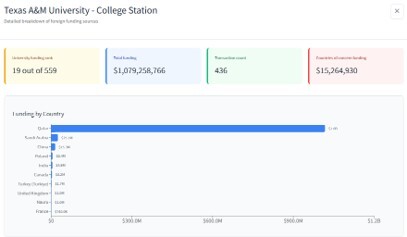
Federal Section 117 disclosures show Qatar has been among the largest foreign financial contributors to American universities. Yet even those figures provide only a partial picture, because federal law generally requires disclosure only of gifts and contracts valued at $250,000 or more, and compliance has repeatedly proven inconsistent across higher education. Texas A&M itself became one of the most visible examples of those reporting failures.
That recent hearing also highlighted another weakness in HB 127.
Bettencourt asked whether the legislation has broad enough application. It does not.
HB 127 places reporting and compliance obligations on universities and their governing boards. However, it does not clearly extend those same statutory obligations to affiliated entities that conduct university research but may argue they operate separately from the institution itself.
Texas A&M’s previous position regarding TEES illustrates exactly why that distinction matters.
If an affiliated research organization can argue it falls outside the law’s reporting requirements, the Legislature has left open the very type of loophole that sophisticated foreign actors are most likely to exploit.
Fortunately, lawmakers already have a model for fixing this problem.
HB 4195, introduced but not adopted by lawmakers in 2025, would require detailed annual disclosures not only from universities but also from their affiliated organizations. It would require substantially greater transparency regarding foreign gifts, contracts, donations, their purposes, values, beneficiaries, conditions, and duration. Most importantly, it would make far more difficult the kind of organizational shell games that have complicated foreign influence investigations in the past.
Transparency remains another major concern.
Under HB 127, much of the information submitted to the Research Security Council is confidential and exempt from public disclosure.
If Texans cannot independently evaluate whether universities are identifying foreign threats, lawmakers and taxpayers are simply asked to trust the system.
Recent history demonstrates why trust alone is insufficient.
Research security should not be measured by the number of councils created or compliance offices established. It should be measured by whether dangerous foreign influence is actually identified.
Texas should strengthen HB 127 by explicitly covering affiliated research entities, increasing transparency, and ensuring that our research security strategy addresses all avenues foreign governments use to gain influence.
But even stronger laws alone will not solve the problem.
As will be addressed in Part 2, Texans should also ask why these institutions proved so vulnerable in the first place. The greatest weakness may not simply be inadequate reporting requirements or insufficient oversight, but a deeper loss of confidence in the principles that distinguish the American experiment from authoritarian regimes. Universities that no longer view the American founding as a coherent and defensible moral and political order are more likely to treat partnerships with hostile foreign governments as merely another source of funding rather than as relationships requiring profound scrutiny.
That is why we should reject the notion that foreign funding from regimes such as China or Qatar is politically or morally neutral.
America’s founders understood that governments are not interchangeable. Regimes built upon the suppression of liberty, natural rights, and self-government do not merely govern differently; they represent competing visions of political order.
Taxpayer funded research institutions should reflect that reality by approaching relationships with hostile authoritarian governments with far greater skepticism than they have in the past.