On May 2nd, 2026, Texas voters did something astonishing. They approved more new debt in that single afternoon than the entire gross domestic product of the country of Uganda.
The $76.4 billion in new principal debt authorized that day won’t be issued tomorrow; but with voter approval in-hand, local governments now have the go-ahead to borrow more and add onto the $368.3 billion in principal debt already owed. Of course, these totals become even more alarming once interest costs are added on. For instance, the $368.3 billion in local debt outstanding actually approaches $552 billion once interest is accounted for.
So how did this situation get so far out of hand? In part, it’s being driven by a lack of restraint.
Let’s consider a few examples.
During the May bond election cycle, Dallas ISD sought voter-approval for “a staggering $6.2 billion bond package—the largest school bond proposal in Texas history.” Shockingly, the cost of this new debt explodes to more than $12 billion once interest payments are included, based on the district’s Voter Information Document. Whether this mountain of new debt was even necessary is debatable considering the district’s long-term enrollment decline.
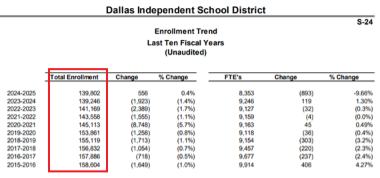
According to Dallas ISD’s latest available Annual Comprehensive Financial Report, the number of students enrolled shrank from 158,604 in the 2015-16 school year to 139,802 in the 2024-25 school year. That’s a loss of almost 20,000 students or a nearly 12% reduction. This trend raises several questions, like why does a district in decline need new buildings? How will it pay for new staff at these new facilities? What happens if the district’s falling enrollment doesn’t reverse? Aren’t there better ways for the district to spend new money other than on fancy new facilities?
Thirty miles to the west, the city of Fort Worth asked voters to support a massive $845 million bond package, “[t]he largest bond package in the city’s history.” Once interest costs are added in, taxpayers will have to pay back more than $1.3 billion in total. Discouragingly, few voters actually weighed-in too, as only 13,601 voters said YES from a total city voting population of 547,546, meaning just 2.5% of the electorate committed approved. Such low turnout is not unusual in the May election cycle, which is one reason why conservatives have continuously called for moving fiscal matters to the November elections—when voter turnout is significantly higher— but it is commonly opposed.
These are but two examples among many (there were 431 propositions offered up for consideration, with the Texas Bond Review Board reporting that 338 propositions were passed, 51 defeated, and 42 election results still pending). But they are illustrative in the sense that they represent the lack of restraint obvious at the local level right now.
With the 90th Texas Legislature fast-approaching, a much-needed opportunity for meaningful local debt reform is nearly here. The urgency of the moment is underscored by the scale of what happened on May 2nd, with local borrowing reaching staggering new heights and local governments seemingly unconcerned by the affordability crisis currently gripping Texas and the nation. Such indifference demands far-reaching fiscal constraints to protect taxpayers and engender responsible governance.
Current and future Texans cannot afford for the status quo to persist unabated. We must rein in local borrowing, lest the reckless abandon push taxes endlessly higher and nudge Texas to become a California-like mess.