On Tuesday, the Dallas Morning News’ editorial board shared a bit of bad news about Coppell ISD (CISD), a public school district located in the suburbs of north Dallas. According to the write-up:
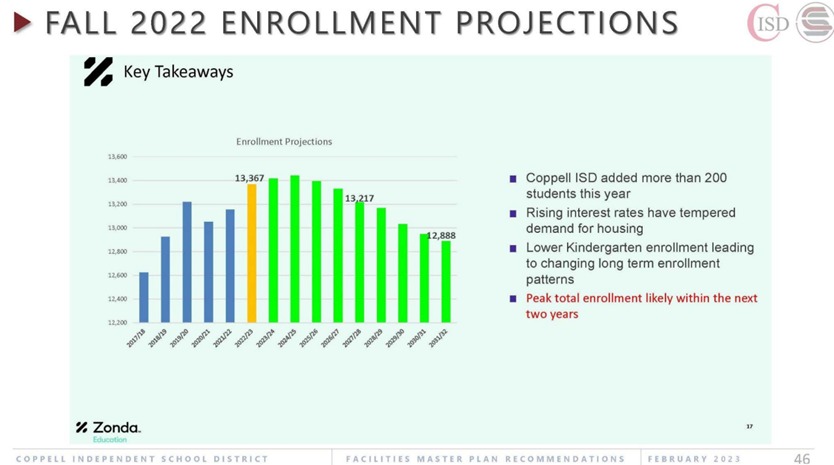
“Coppell school board members got a hard pill to swallow when their demographer projected lower-than-expected enrollment numbers for the next decade…[CISD] has 13,209 students, but it is expected to lose about 2,000 kids in the next 10 years, according to Zonda Education, the district’s demographer. This is a 15% loss.”
The editorial board hints at two factors behind CISD’s enrollment decline—lower fertility rates and an aging demographic. Both factors may indeed offer a partial explanation, but other factors almost certainly play a role as well, like the elevated burden of government, a general loss of public confidence, and social controversy. Whatever the case, the district’s shrinking student population is not a new concern.
In February 2023, the CISD school board was presented with multi-year enrollment projections related to a proposed $321.5 million bond. The presentation noted that “Rising interest rates have tempered demand for housing” and that “Lower Kindergarten enrollment leading to changing long term enrollment patterns.” As a result, the report observed that “Peak total enrollment likely within the next two years.” Considering that observation was made during the 2022-23 school year and that we are now 2 years advanced from that point, one is left to conclude that CISD’s student population will experience continual decline for the next several years.
Knowing that CISD will likely be serving fewer students well into the future, one might be tempted to think that district officials would be preparing to rightsize government to accommodate its new reality—but you would be mistaken.
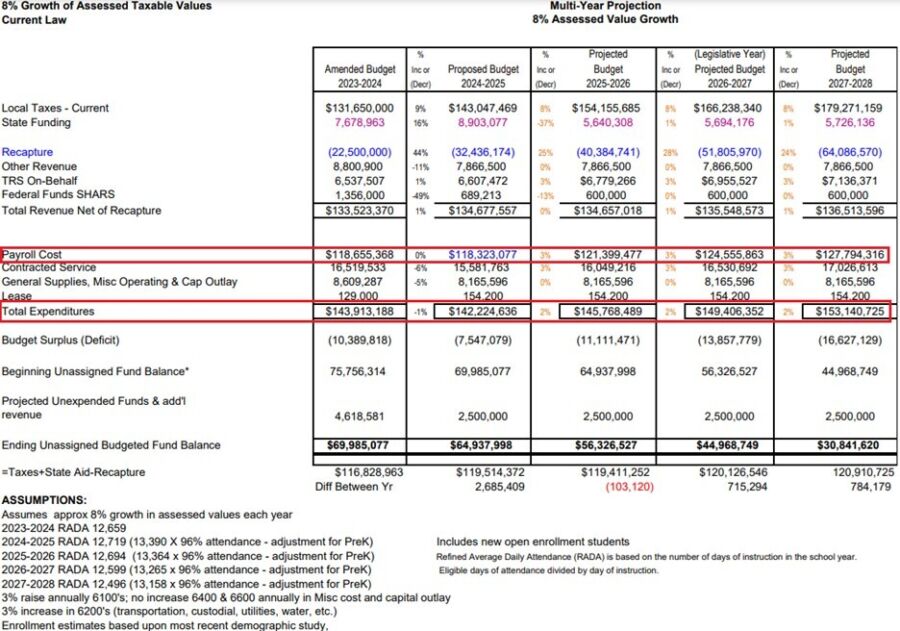
According to CISD’s most recently adopted budget, district officials show no sign of spending cuts. In fact, its budget projections (pg. 20) suggest that payroll costs are expected to grow from $118,323,077 this year to as much as $127,794,316 by the 2027-28 school year. That is nearly a 10% increase in projected payroll costs. What’s more, the district’s total spending is projected to rise from $142,224,636 this year to $153,140,725 in 2027-28.
In other words, CISD plans to spend more even while it serves fewer students!
The district’s appetite for spending other people’s money raises another question: How will CISD maintain the spending status quo while also continuing to lose students and the money that comes along with them? Here too the adopted budget offers a hint.
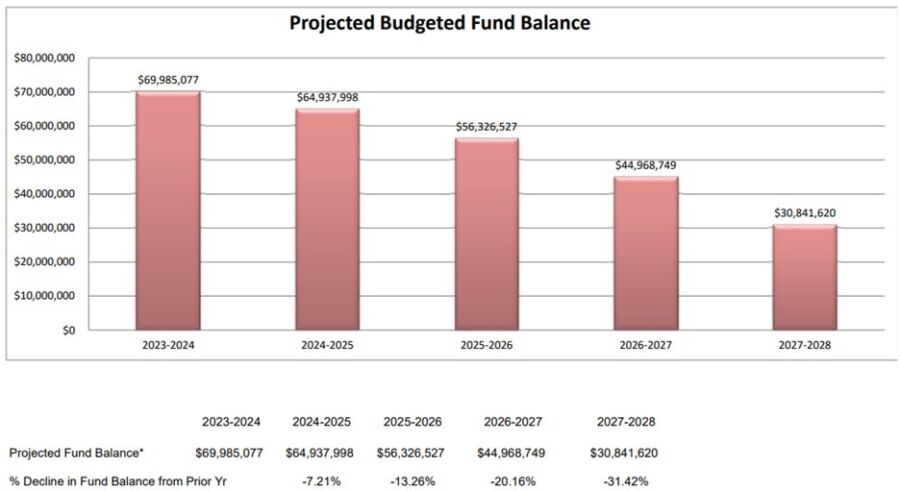
Per some additional budget detail (see pg. 21), district officials seem to be poised to draw down heavily on their fund balance, which in some ways is akin to a savings account. Such a tactic would see the district utilize a one-time funding source (i.e. its uncommitted fund balance) for its general operating needs, which is terrible fiscal policy. The district is not shy about admitting as much either. It states: “Future budget projections indicate that the district will utilize fund balance in increasing amounts each year due to declining enrollment.”
None of this is sustainable nor sensible policy. It’s unreasonable for any school district to serve fewer students and expect to grow its budget, especially when that involves one-time monies.
It’s time for CISD—and every other shrinking school district—to recognize today’s new reality and rightsize their budgets and operations accordingly. Because the more resistant they are today, the harder it will be tomorrow.