Competition is a part of the American spirit and inseparable from Texas culture. Few things are more enjoyable than watching the two opposing sides battle it out to beat the other. No other time of year captures the spirit of competition better than fall. Between football and the Major League Baseball playoffs, seemingly every day of week there is a match to watch.
But this fall, there is a hidden competition between two Texas agencies. Unlike football—and even federal and state elections—the cash involved in this contest is not in the millions nor in the hundreds of millions but nearly $100 billion that affects over 5.5 million Texans annually.
This is a theoretical battle between two governmental entities: the Texas Education Agency (TEA) and the Legislative Budget Board (LBB). One, the TEA, is tasked by the legislature to oversee primary and secondary public education; the other, the LBB, is a permanent joint committee tasked with developing budget recommendations and evaluating the efficiency of state operations. Both are required to examine how much money goes to and is spent on public education.
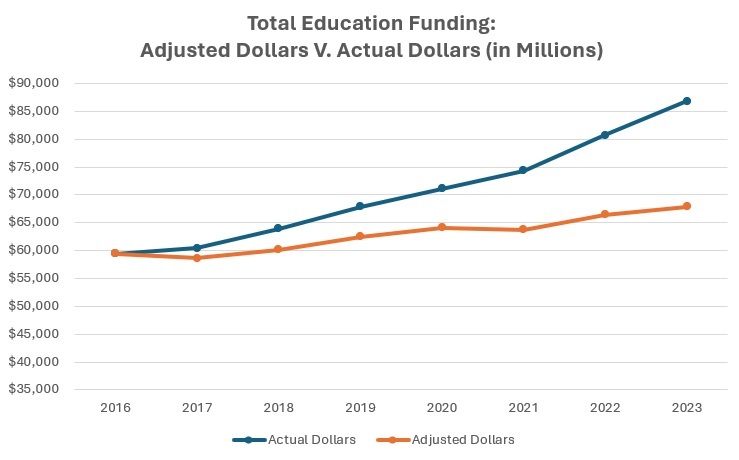
The drama emerges from a $21 billion disagreement in how much revenue the TEA receives from all sources. The TEA, after spending over a year finalizing its numbers, reported that in 2023 the agency received $86 billion. The LBB, on the other hand, recently reported in its Fiscal Size-Up that the TEA receives only $65 billion.
To make matters more interesting, the two bodies have not been able to agree on the official figure that the state dedicates for education since at least 2016. The chart below shows the difference between the two entities’ official funding numbers.

Of course, this difference in reporting has been politically useful to some in the education debate that’s been raging in Texas for over two years now. Opponents of parent empowerment and school choice are quick to point to the LBB’s lower number and claim that “Texas schools are underfunded.”
In their report, LBB also estimated budgets in “constant dollars,” which are a budgeting adjustment to try to account for inflation and other variables. When used for school funding, this estimate has a serious flaw. Typically, when looking at funding trends, you want to adjust for changes to population size—which, for Texas, has been extreme growth.
However, when making these adjustments, it is crucial that keep in mind what exactly we are measuring. When putting together their estimate for the TEA’s budget, the LBB used the numbers for Texas’s total population growth, not the student population growth.
While adjusting for total population growth would make sense for areas such as utilities, law enforcement, and healthcare, but—while the state of Texas has grown by over 11% in total population, Texas’ public school student population has only gone up by about 1%. Put simply, Texas and its public schools are growing at different rates, and so using the same rate for both of them results in bad calculations.
Texas public schools are not underfunded, they are mismanaged. Even after adjusting for inflation and changes to the average daily attendance, funding in education is up by more than 14%.
The simple truth is this: throwing more money at our public schools won’t fix the problem. We need to get our public schools to focus spending where it matters rather than doing things like spending almost a million dollars on a departing superintendent or funding an opulent retirement public school elites giving them up to $27,500 a month for the rest of their lives.
When we’re discussing the funding of our public schools, it’s important to use the right numbers—and right now, while the LBB numbers may be more convenient for certain political actors, the fact of the matter is that the TEA numbers are more accurate because of the simple fact that the TEA focuses exclusively on public education, while the LBB is using generalizations because it needs to worry about the entire state.
And looking at the TEA numbers, we can see that public schools are funded well—they’re just spending poorly.